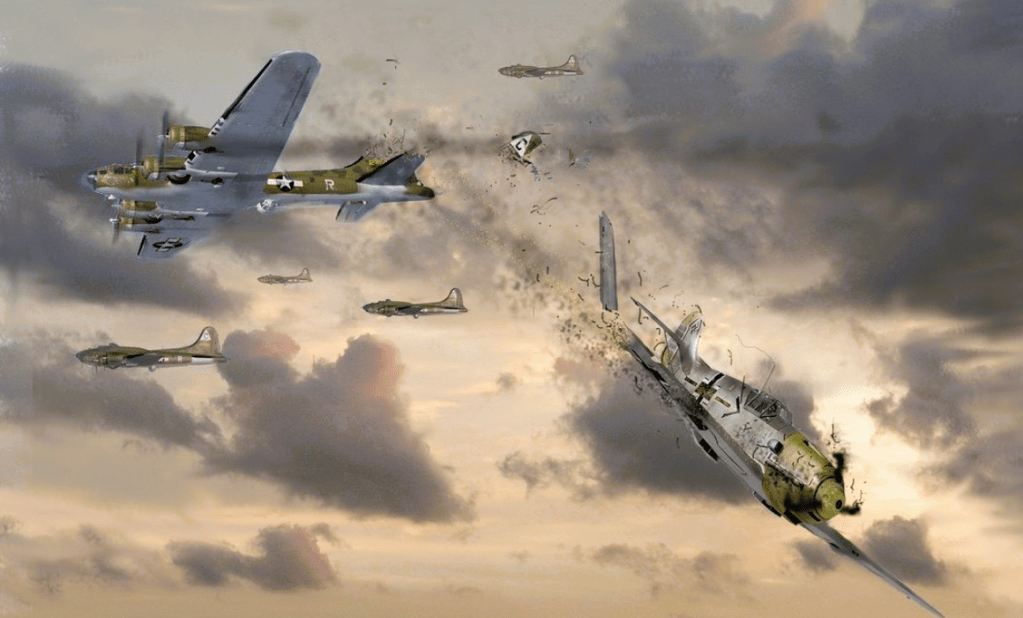
World War II was marked by dramatic shifts in military tactics and strategies, none more desperate than those deployed in the conflict’s final months. One such strategy was the formation of Sonderkommando Elbe, a unique Luftwaffe unit whose mission involved an extreme form of aerial warfare: ramming Allied bombers. In a bid to halt the relentless bombing of German cities, the Nazi leadership embraced a tactic that can only be described as suicidal. While it lacked the formal ethos of Japan’s kamikaze units, Sonderkommando Elbe stood as a symbol of Nazi Germany’s last-ditch attempts to defend its homeland. This essay explores the formation, operation, and ultimate failure of Sonderkommando Elbe within the broader context of a collapsing Nazi war machine.
Formation and Purpose
By early 1945, Germany was in a state of military and economic ruin. The Allied forces were advancing from the west, and Soviet troops were closing in from the east. The Luftwaffe, once a formidable air force, had been decimated by years of attrition. German cities and industrial centers were being relentlessly bombed by American and British Forces, particularly by the U.S. Army Air Force’s strategic bombing campaigns using the B-17 Flying Fortress and the B-24 Liberator. In response, Nazi leaders devised a drastic plan: creating an air unit to crash German fighter planes into Allied bombers.
The unit, known as Sonderkommando Elbe, was conceived as a last resort to stem the tide of destruction raining down on Germany. The goal was not simply to destroy the bombers but to do so in a manner that compensated for the Luftwaffe’s dwindling resources. The pilots were to deliberately ram their planes into the bombers, targeting engines, wings, or tail sections to disable the aircraft. In theory, these pilots would attempt to bail out after the collision, but in reality, survival was far from guaranteed.
Tactics and Aircraft
The aircraft used by Sonderkommando Elbe mainly were Messerschmitt Bf 109s, a staple of the Luftwaffe throughout the war. However, these planes were stripped of all unnecessary weight, including armor and heavy weaponry, to make them faster and more maneuverable in their suicide-like missions. Pilots were given only enough fuel to reach their targets, reflecting the desperation of the operation. The minimalist approach symbolized the straits in which Germany found itself: no longer able to sustain conventional aerial defense, the Luftwaffe was forced to improvise with limited resources.

The ramming tactic required great precision and nerve. Pilots were instructed to aim for the engines or critical control surfaces of the Allied bombers to bring them down without completely destroying them. In some cases, the goal was to cripple a bomber so that it could not complete its mission rather than outright destruction. Nevertheless, even with the stripped-down planes and training, these attacks were hazardous, and the chances of success—and survival—were low.
The Volunteers and Pilots
The pilots chosen for Sonderkommando Elbe missions were a mix of inexperienced young men and seasoned veterans. Many of the young recruits were teenagers from the Hitler Youth, indoctrinated with Nazi propaganda and instilled with a sense of fatalistic duty. Inexperienced in combat, these young pilots often saw their role in Sonderkommando Elbe as a chance to defend their homeland and uphold the ideals of the Third Reich, even at the cost of their lives.
For the older, battle-hardened Luftwaffe pilots, the decision to join Sonderkommando Elbe was often driven by desperation rather than idealism. These men had witnessed the gradual collapse of German air power and were painfully aware of the consequences of losing control of the skies. For them, the ramming missions represented one final, desperate stand to protect their homeland from complete destruction.
The Mission and Its Limited Success
The first—and most significant—ramming mission of Sonderkommando Elbe took place on April 7, 1945. Approximately 180 aircraft were launched against a large formation of American bombers over central Germany. Despite the scale of the mission, the results were far from decisive. Only a fraction of the aircraft reached their targets, as many of the Bf 109s were shot down before they could even engage the bombers. Those who did manage to make contact found the task of ramming the large, heavily armored bombers much more difficult than anticipated.
While there are reports of up to 15 bombers being damaged or destroyed by the ramming attacks, the overall impact was minimal in the broader context of the Allied bombing campaign. The American bombers continued to inflict massive damage on German infrastructure, and the losses suffered by the Luftwaffe during the Sonderkommando Elbe missions were devastating. The Luftwaffe had gambled with one of its last remaining assets—its pilots—and had little to show for it.
Desperation and the End of the War
The creation of Sonderkommando Elbe reflected a broader pattern of increasingly desperate measures taken by the Nazi regime in the closing months of the war. As Germany’s military position deteriorated, Hitler and his inner circle resorted to extreme, often irrational tactics in the hope of turning the tide. From the deployment of young boys and elderly men to defend Berlin to the increased reliance on so-called “wonder weapons” like the V-2 rocket, the regime became increasingly unhinged in its pursuit of victory.
Sonderkommando Elbe’s lack of success also underscored the futility of these desperate measures. By April 1945, Germany’s defeat was all but inevitable, and no amount of suicidal bravery could reverse the overwhelming momentum of the Allied advance. The Luftwaffe, once the terror of European skies, was reduced to launching suicide missions that had little strategic value. The dissolution of Sonderkommando Elbe in May 1945, coinciding with Germany’s surrender, marked the end of an era for the Luftwaffe and the Nazi war machine.
Sonderkommando Elbe stands as a tragic and desperate chapter in the history of the Luftwaffe. It embodied the hopelessness of Nazi Germany in its final days, as the regime resorted to extreme and reckless tactics in a last-ditch effort to stave off inevitable defeat. While not as famous as Japan’s kamikaze operations, Sonderkommando Elbe similarly represented the militarization of death, where pilots were asked to sacrifice their lives in missions that had little chance of success. In the end, the unit’s formation and failure highlighted the collapse of Germany’s military power and the lengths to which the Nazi regime was willing to go in its doomed defense of the Third Reich.
Sources
https://www.warhistoryonline.com/world-war-ii/sonderkommando-elbe.html
Donation
Your readership is what makes my site a success, and I am truly passionate about providing you with valuable content. I have been doing this at no cost and will continue to do so. Your voluntary donation of $2 or more, if you are able, would be a significant contribution to the continuation of my work. However, I fully understand if you’re not in a position to do so. Your support, in any form, is greatly appreciated. Thank you. To donate, click on the credit/debit card icon of the card you will use. If you want to donate more than $2, just add a higher number in the box left from the PayPal link. Your generosity is greatly appreciated. Many thanks.
$2.00
 History of Sorts
Leave a comment