
The freighter Marco Polo was laid down on September 28, 1943, at Wilmington, North Carolina, by the North Carolina Shipbuilding Company under a Maritime Commission contract (M.C. Hull 1356). It was renamed Mount Hood (AE-11) on November 10, 1943, launched on November 28, 1943, and sponsored by Mrs. A. J. Reynolds. The Navy acquired Mount Hood on a loan-charter basis on January 28, 1944, and it was converted into an ammunition ship by the Norfolk Shipbuilding & Dry Dock Company and the Norfolk Navy Yard in Virginia. Mount Hood was commissioned on July 1, 1944, under the command of Cmdr. Harold A. Turner.
Following a brief fitting out and shakedown period in Chesapeake Bay, Mount Hood reported for duty to the Commander, Service Force, Atlantic Fleet, on August 5, 1944. Tasked with transporting critical ammunition supplies to the Pacific, she set sail for Norfolk, where her holds were fully loaded. On August 21, as part of Task Group 29.6, Mount Hood departed for the Panama Canal, transited the isthmus on August 27, and continued on to her destination, Manus, in the Admiralty Islands. After a stop at Finschhafen, New Guinea, she arrived at Seeadler Harbor on September 22, where she began supplying ammunition and explosives to ships preparing for the Philippine offensive.
On the morning of November 10, 1944, at 8:30 a.m., Lt. Lester A. Wallace, USNR, Mount Hood‘s communications officer, along with a party of 17 men, left the ship for shore. At 8:55 a.m., while on the beach, they saw a flash from the harbor, followed by two quick explosions. Racing back to the water’s edge, they observed, in Lt. Wallace’s words, “There was nothing but debris all around…”
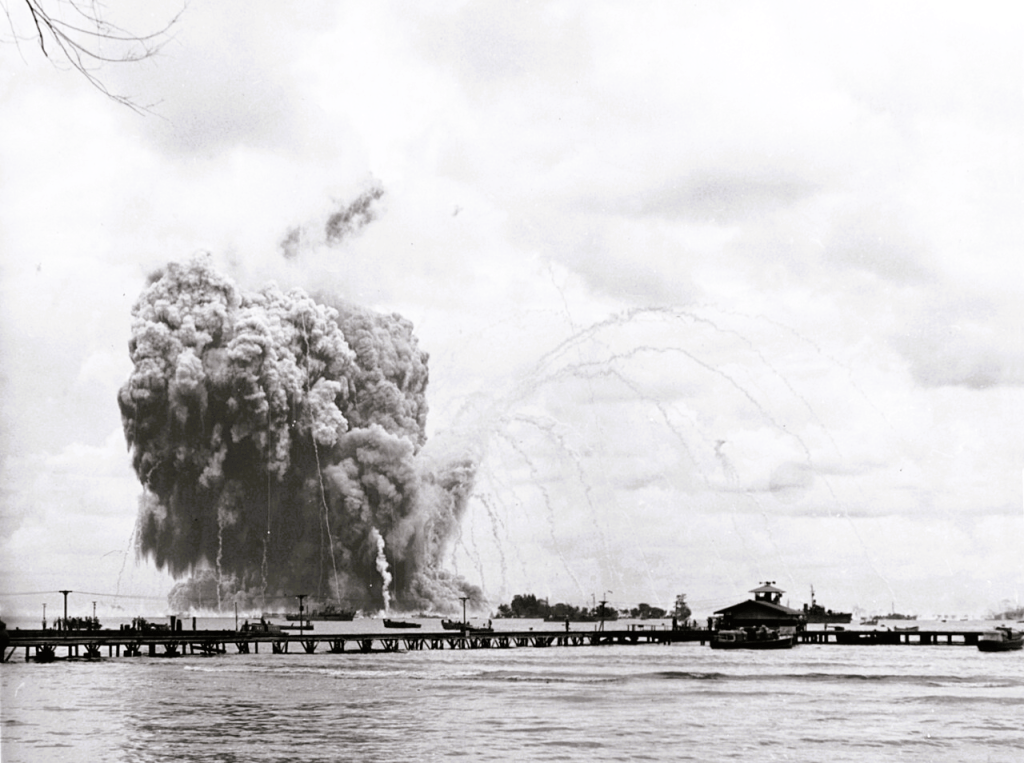
Mount Hood, anchored in about 19 fathoms of water, had exploded with approximately 3,800 tons of ordnance on board. The initial explosion shot flame and smoke up from the ship’s center, reaching above the mastheads, before a second, more powerful blast detonated the bulk of her cargo. A mushroom-shaped cloud rose to 7,000 feet, obscuring the ship and surrounding area for about 500 yards. The explosion’s force blasted a trough in the harbor floor, over 300 feet long, 50 feet wide, and up to 40 feet deep; debris was hurled as far as 2,000 yards from the explosion. Investigators later found no piece of the ship on the ocean floor larger than 16 by 10 feet.
The blast’s concussion and fragments caused casualties and varying degrees of damage to vessels within a 2,000-yard radius. The escort carriers Petrof Bay (CVE-80) and Saginaw Bay (CVE-82), destroyer Young (DD-580), destroyer escorts Kyne (DE-744), Lyman (DE-302), Walter C. Wann (DE-412), and Oberrender (DE-344); high-speed transport Talbot (APD-7); destroyer tender Piedmont (AD-17); auxiliary Argonne (AG-31); cargo ship Aries (AK-51); attack cargo ship Alhena (AKA-9); oiler Cacapon (AO-52); repair ships Cebu (ARG-6) and Mindanao (ARG-3) (the latter suffering 23 dead and 174 injured); salvage ship Preserver (ARS-8); fleet tug Potawatomi (ATF-109); and 15 motor minesweepers were all damaged.

Additionally, unclassified auxiliary Abarenda (IX-131), a covered lighter YF-681, and a fuel oil barge YO-77 were affected. Nine medium landing craft and a pontoon barge moored alongside Mount Hood were destroyed, while 13 smaller boats and landing craft were either sunk or damaged beyond repair and another 33 sustained damage but were repairable. Total casualties included 45 confirmed dead, 327 missing, and 371 injured, including Mount Hood’s crew; only those ashore survived. Repairing damaged vessels required over 100,000 manhours, with 48,000 hours needed for Mindanao alone.
The board convened to investigate the disaster but could not determine the exact cause.
Mount Hood (AE-11) was officially stricken from the Naval Register on December 11, 1944.
Sources
https://www.history.navy.mil/today-in-history/november-10.html
https://www.usni.org/magazines/proceedings/1963/february/mount-hood-explosion
 History of Sorts
Leave a comment