The night of April 14, 1865, marked one of the darkest moments in American history—the culmination of a calculated conspiracy that aimed to decapitate the leadership of the United States government during the final days of the Civil War. While President Abraham Lincoln’s assassination at Ford’s Theatre is the most remembered event from that night, a coordinated attack also took place against Secretary of State William H. Seward and his family. This essay explores the events of that night, the motivations behind the attacks, the consequences for Seward and his household, and the broader implications for the United States.
The Conspiracy
The attack on Seward and his family was part of a broader conspiracy orchestrated by John Wilkes Booth, a Confederate sympathizer and actor who was enraged by the South’s defeat and Lincoln’s policies toward Reconstruction. Booth’s plan involved the simultaneous assassination of President Lincoln, Vice President Andrew Johnson, and Secretary of State William H. Seward. The goal was to throw the U.S. government into disarray and revive the Confederate cause.
Booth assigned Lewis Powell (also known as Lewis Paine) the task of murdering Seward. Powell was a former Confederate soldier known for his violent tendencies. His role in the conspiracy was to eliminate the head of the State Department, a key figure in Lincoln’s cabinet who was instrumental in shaping Union foreign policy during the war.
The Attack on Seward
On the night of April 14, 1865—the same night Booth fatally shot Lincoln—Powell arrived at Seward’s home in Washington, D.C., under the pretense of delivering medicine. Seward was recovering from a serious carriage accident and was bedridden at the time. Powell forced his way into the home, brutally attacking several people.
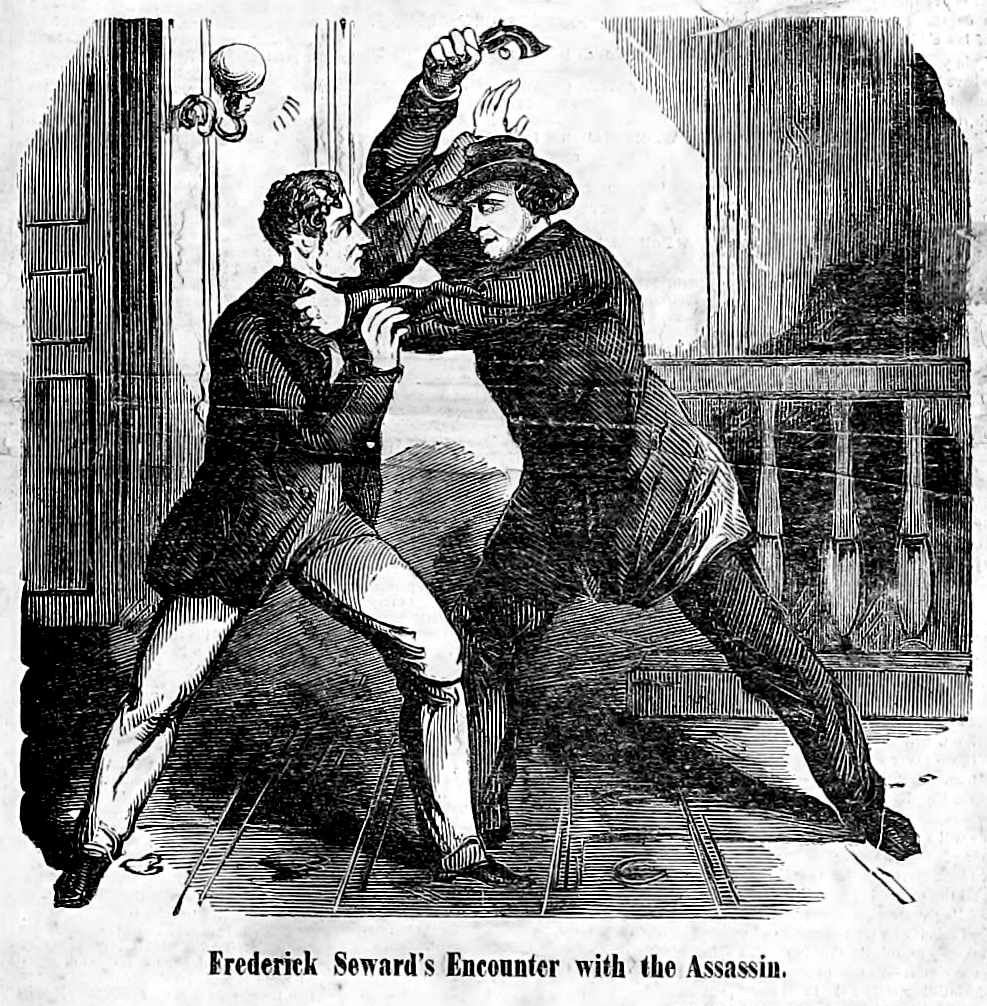
He first confronted Seward’s son, Frederick, striking him with a pistol and fracturing his skull. Powell then made his way to Seward’s room, where he slashed the Secretary’s face and neck with a knife. Miraculously, Seward survived the attack, in part due to a metal neck brace he was wearing from his recent injury, which deflected some of the blows.
The violence did not end there. Powell also attacked George F. Robinson, a Union Army sergeant and nurse caring for Seward, as well as Seward’s daughter Fanny, who witnessed the horrific scene. Robinson and Frederick Seward both sustained life-threatening injuries but eventually recovered.
Aftermath
Despite the shocking nature of the attack, Seward lived and continued his service in the U.S. government. His survival was seen by many as almost miraculous, especially given the savagery of the assault. Powell was later captured, tried by a military tribunal, and executed along with three other conspirators.
Lincoln, unfortunately, did not survive his own attack. Booth shot him in the back of the head at Ford’s Theatre while the president was watching a play. Lincoln died the following morning, on April 15, becoming the first U.S. president to be assassinated. The coordinated nature of these attacks deeply unsettled the nation and highlighted the lingering tensions in the aftermath of the Civil War.
Significance
The attacks of April 14, 1865, were a devastating blow to the American psyche. While Booth and his co-conspirators failed to destroy the federal government, they succeeded in spreading fear and uncertainty during a critical transitional period. The attempt on Seward’s life, though less well-known than Lincoln’s assassination, underscores the full extent of the conspiracy and the vulnerability of the nation’s leadership at that time.
Seward’s recovery and return to public life served as a symbol of resilience. He continued to serve as Secretary of State under President Andrew Johnson and is perhaps best remembered for his role in the purchase of Alaska from Russia in 1867, often called “Seward’s Folly.”
The night of April 14, 1865, was a carefully planned and nearly executed attempt to cripple the Union government. The attack on William H. Seward and his family was as brutal as it was personal, aimed at silencing one of Lincoln’s closest and most influential advisors. Together with Lincoln’s assassination, these events marked a traumatic end to the Civil War and a sobering beginning to the complex era of Reconstruction. They remain a chilling reminder of how close the nation came to an even deeper political catastrophe.

The Assassination of Abraham Lincoln: A Turning Point in American History
The assassination of President Abraham Lincoln stands as one of the most tragic and pivotal events in American history. On the night of April 14, 1865, just days after the conclusion of the Civil War, Lincoln was fatally shot by John Wilkes Booth while attending a play at Ford’s Theatre in Washington, D.C. The act not only shocked a war-weary nation but also marked the first assassination of a U.S. president, casting a long shadow over the post-war period known as Reconstruction.
The Context and Motivation Behind the Assassination
Abraham Lincoln had just led the Union to victory in the Civil War, preserving the United States and setting the stage for the abolition of slavery through the 13th Amendment. However, not all Americans shared in the triumph. John Wilkes Booth, a well-known actor and Confederate sympathizer, viewed Lincoln as a tyrant who had destroyed the Southern way of life. Booth initially plotted to kidnap Lincoln in hopes of using him as a bargaining tool to resurrect the Confederate cause. As the Confederacy collapsed, Booth’s desperation turned deadly.
Motivated by vengeance and extremist ideology, Booth devised a plan to decapitate the federal government by killing Lincoln, Vice President Andrew Johnson, and Secretary of State William H. Seward. Only Lincoln was successfully assassinated, with Seward surviving a brutal attack and Johnson’s would-be assassin backing out.
The Night of the Assassination
On the evening of April 14, 1865, Lincoln attended a performance of Our American Cousin at Ford’s Theatre. Booth, familiar with the theatre’s layout, gained access to the presidential box and shot Lincoln in the back of the head with a .44 caliber Derringer pistol. He then leapt onto the stage, allegedly shouting “Sic semper tyrannis” — Latin for “Thus always to tyrants” — before fleeing into the night.
Lincoln was carried across the street to the Petersen House, where he died the next morning, April 15, at 7:22 a.m. His death plunged the nation into mourning, with thousands of citizens paying their respects during a long funeral procession from Washington, D.C., to his burial site in Springfield, Illinois.
The Aftermath and Legacy
Booth was hunted down and killed by Union soldiers on April 26, 1865, in a Virginia barn. His co-conspirators were arrested, and four were hanged for their involvement. Although the assassination was meant to revive the Confederate cause, it had the opposite effect. Instead of destabilizing the Union, it galvanized national unity and made Lincoln a martyr for freedom and equality.
Lincoln’s assassination profoundly affected the course of Reconstruction. His successor, Andrew Johnson, lacked Lincoln’s political skill and vision, leading to a more turbulent and punitive post-war era. Historians often speculate that had Lincoln lived, his moderate policies might have eased the nation’s transition and promoted a more lasting reconciliation between North and South.
The assassination of Abraham Lincoln was not merely a personal tragedy or a political act — it was a national calamity that altered the trajectory of American history. It silenced a leader who had guided the country through its most perilous moment and left a legacy that endures to this day. Lincoln’s death reminds us of the fragility of democracy and the enduring impact of leadership grounded in compassion, unity, and justice.
sources
https://en.wikipedia.org/wiki/William_H._Seward
https://en.wikipedia.org/wiki/Assassination_of_Abraham_Lincoln
https://ahec.armywarcollege.edu/exhibits/CivilWarImagery/edwards_Assassination.cfm
Donation
Your readership is what makes my site a success, and I am truly passionate about providing you with valuable content. I have been doing this at no cost and will continue to do so. Your voluntary donation of $2 or more, if you are able, would be a significant contribution to the continuation of my work. However, I fully understand if you’re not in a position to do so. Your support, in any form, is greatly appreciated. Thank you. To donate, click on the credit/debit card icon of the card you will use. If you want to donate more than $2, just add a higher number in the box left from the PayPal link. Your generosity is greatly appreciated. Many thanks.
$2.00
 History of Sorts
Leave a comment