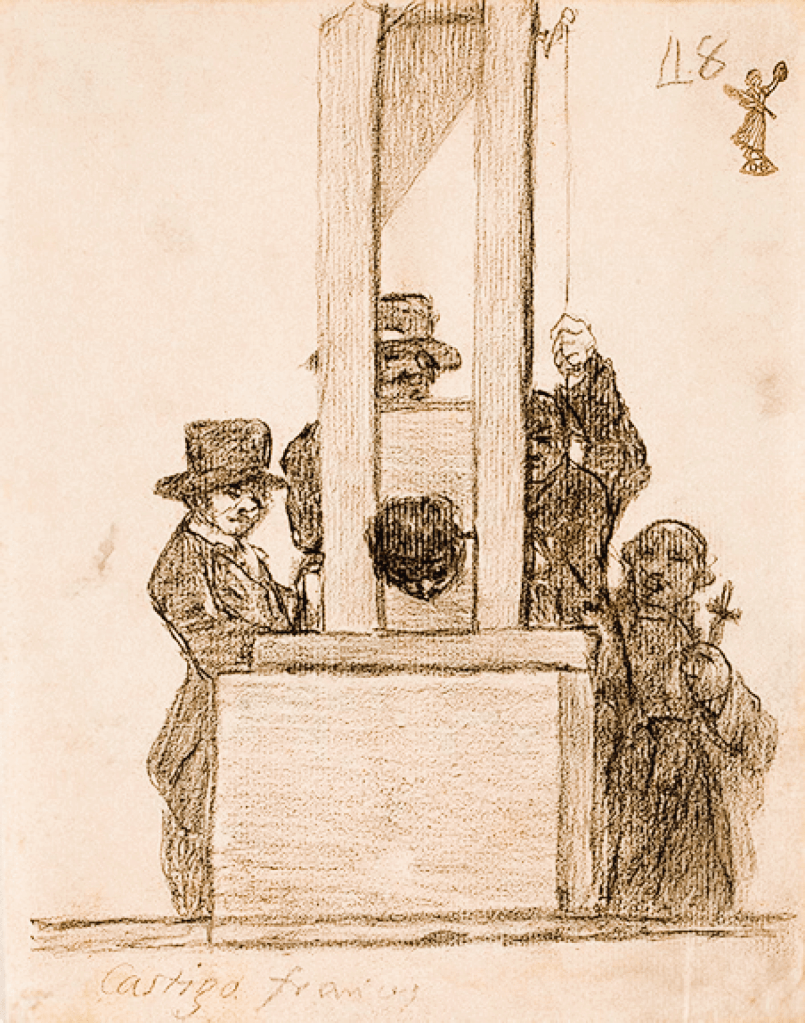
Nicolas Jacques Pelletier occupies a unique and somewhat grim place in French history as the first person executed by guillotine. While his crime may have been unremarkable in the annals of criminal history, the method of his execution symbolized a turning point during one of the most turbulent times in France: the French Revolution.
Pelletier was a French highwayman and criminal who lived during the late 18th century. On October 14, 1791, he committed a violent robbery, assaulting a passerby and stealing money and valuables. The crime itself was serious but not necessarily uncommon for the period. However, it was the political and cultural context of France in 1792 that would catapult Pelletier into historical notoriety.
The French Revolution had begun in 1789, bringing with it not only sweeping changes to the political landscape but also intense debates about justice and equality. One such debate centered around capital punishment. Dr. Joseph-Ignace Guillotin, a physician and member of the National Assembly, had proposed a more humane and egalitarian form of execution. Previously, the method of execution depended heavily on one’s social class — nobles might be beheaded by sword, while commoners could be hanged or broken on the wheel. Guillotin’s proposal sought to eliminate this disparity.
Enter the guillotine — a device designed by Dr. Antoine Louis and built by Tobias Schmidt. It was engineered to provide a quick and painless death, with a heavy blade falling swiftly to decapitate the condemned. In a symbolic gesture of the Revolution’s ideals of equality, all citizens — regardless of status — would face the same fate if sentenced to death.
Pelletier was sentenced to die on April 25, 1792. As he stood in the Place de Grève in Paris, a large crowd gathered to witness this new form of justice. There was a strange blend of curiosity and skepticism in the air. People wanted to see the guillotine in action, but many were also disappointed by what they viewed as the anticlimactic and impersonal nature of the execution. Unlike the dramatic flair of older methods, the guillotine was efficient and, some said, too clinical.
Despite the mixed reactions, the guillotine quickly became the standard method of execution in revolutionary France, later gaining infamy during the Reign of Terror. Over the next decade, it would claim the lives of thousands, including King Louis XVI and Queen Marie Antoinette.
Nicolas Jacques Pelletier might have been a relatively minor criminal, but his name lives on as a historical footnote — not for what he did, but for how he died. His execution marked the beginning of a new chapter in the history of capital punishment, one rooted in the revolutionary ideals of equality and rationality, however paradoxical they may seem when viewed through the lens of state-sanctioned death.
sources
https://en.wikipedia.org/wiki/Nicolas_Jacques_Pelletier
https://www.colonialsense.com/Society-Lifestyle/Census/Person/Nicolas_Jacques_Pelletier/13448.php
Donation
Your readership is what makes my site a success, and I am truly passionate about providing you with valuable content. I have been doing this at no cost and will continue to do so. Your voluntary donation of $2 or more, if you are able, would be a significant contribution to the continuation of my work. However, I fully understand if you’re not in a position to do so. Your support, in any form, is greatly appreciated. Thank you. To donate, click on the credit/debit card icon of the card you will use. If you want to donate more than $2, just add a higher number in the box left from the PayPal link. Your generosity is greatly appreciated. Many thanks.
$2.00
 History of Sorts
Leave a comment