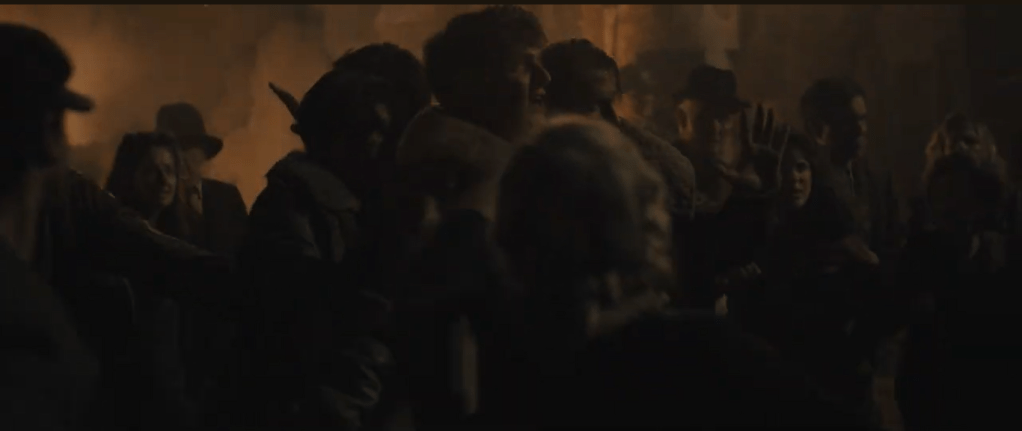
The image above is from Episode 6 of Masters of the Air. In this scene, captured USAAF airmen are marched through the burning streets of a bombed German town. A furious mob of civilians, spurred on by a local party official, overpowers the guards and attacks the Terrorflieger (“terror flyers”). Most of the airmen are killed.
Not all war crimes committed during World War II were carried out by soldiers. Some were committed by ordinary citizens—neighbors, workers, and townspeople.
Rüsselsheim, Germany, was one such place. A typical industrial town east of Mainz, Rüsselsheim was home to about 60,000 residents and the Opel automobile plant, operated in partnership with General Motors. Chartered in 1437, the town’s historic district and quiet streets concealed a dark chapter of history—one that its residents might have preferred to forget.
During the war, the Opel plant and other industrial sites made Rüsselsheim a target for Allied bombing. The Royal Air Force (RAF) carried out nighttime “area bombing,” while the United States Army Air Forces (USAAF) pursued “precision bombing” by day.
The Downing of Wham! Bam! Thank You, Ma’am
On August 24, 1944, an American B-24 bomber named Wham! Bam! Thank You, Ma’am, commanded by 2nd Lt. Norman J. Rogers Jr., was shot down during a mission over Hanover. The nine-man crew parachuted near Hutterup.

Staff Sgt. Forrest W. Brininstool was badly wounded by shrapnel and received first aid from an elderly farming couple. As thanks, he gave them his silk parachute—a valuable possession during wartime. Most of the crew were soon captured and taken to Greven for interrogation; later they were moved to a nearby air base to spend the night. Brininstool was sent to a hospital in Münster for further surgery.
The next morning, the remaining crew members boarded a train to Dulag Luft, a prisoner-of-war interrogation center in Oberursel. Along the way, civilians spat on the windows and hurled insults at the “terror flyers.”
The Bombing of Rüsselsheim
On the night of August 25, 1944, the RAF sent 116 Avro Lancasters to bomb the Opel factory, dropping 674 two-thousand-pound bombs and more than 400,000 incendiaries. The attack devastated the plant, damaged railway lines, and left parts of the city in ruins. Air raid warden Josef Hartgen organized civilians to put out fires.

The “Death March”
The following morning, damaged rail lines forced the American POWs off the train near Rüsselsheim. Escorted by two German soldiers, they were marched through town to catch another train. Many residents assumed the prisoners were part of the previous night’s bombing.
Two women, Margarete Witzler and Käthe Reinhardt, shouted:
“There are the terror flyers! Tear them to pieces! Beat them to death! They destroyed our houses!”
When one airman tried to explain in German that they had not bombed Rüsselsheim, he was ignored. A brick was thrown, and the mob turned violent. Civilians armed with rocks, sticks, shovels, and hammers joined in. Three Opel workers brought iron bars, striking the prisoners.
Air raid warden Hartgen arrived with a pistol. The guards made no effort to stop the mob. After the airmen collapsed, Hartgen lined six of them up and shot them in the head. Out of ammunition, he left two—Sgts. William M. Adams and Sidney E. Brown—alive but badly injured. The survivors and the bodies were loaded onto a cart and taken toward a cemetery.
When an air raid siren sounded, the mob dispersed. Adams and Brown crawled away and hid for four days before being captured by a policeman and sent to Oberursel.
The War Crimes Investigation
In March 1945, the U.S. Third Army entered Rüsselsheim. Locals claimed that eight British airmen had been murdered, but the victims were later confirmed as Americans. Captain Luke P. Rogers was assigned to investigate. He compiled eyewitness accounts and arrested several suspects, including women who had incited the mob.
Rogers exhumed six bodies; the whereabouts of Adams and Brown were still unknown. Eventually, Josef Hartgen was captured after a suicide attempt in prison.
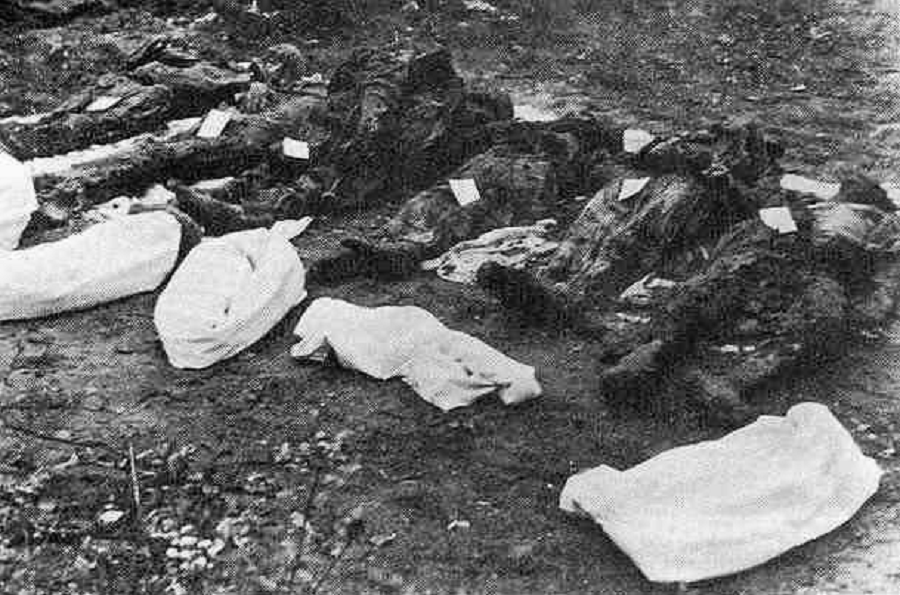
When the U.S. forces occupied Rüsselsheim in early 1945, the atrocity came to light during their investigations. Eleven townspeople, including Hartgen, were tried by a U.S. military commission in Darmstadt in July 1945—the first such war crimes case even before Nuremberg.
Lieutenant Colonel Leon Jaworski—the same figure who would later gain fame in Watergate prosecutions—led the prosecution, rejecting excuses of propaganda-induced hysteria: “They were all grown men and women… If they are called on to commit the murder and they do, they are just as responsible as any other murderers.
The Trial and Sentences
Under the Geneva Convention of 1929 and the Hague Convention, civilians were required to treat surrendered enemy combatants humanely. Eleven defendants, including Hartgen, stood trial in Wiesbaden, defended by Lt. Col. Roger E. Titus. Over six days, 21 witnesses testified to the brutality of the killings.
Five defendants, including Hartgen, were sentenced to death. Others received prison terms. None of the women involved were executed.
Three weeks later, the mystery of the missing two airmen was solved: Adams and Brown wrote to General Davidson from the U.S., explaining their survival and recapture. Both had been sent to Stalag Luft IV and liberated in May 1945.
Hartgen and four others were hanged on November 10, 1945. Otto Stolz, who had beaten the wounded airmen at the cemetery, was also executed. The remains of some crew members were returned to the United States; others were buried in France.
Broader Context: Nazi-Fueled “Lynch Justice”
The tragic events in Rüsselsheim were part of a disturbing pattern of “Lynchjustiz” in Nazi Germany—vigilante violence against downed Allied airmen. Historian Kevin T. Hall’s book Terror Flyers estimates at least 3,000 such lynching incidents occurred between 1943 and 1945, often fueled by civilian rage and Nazi propaganda’s exploitation of populist resentment.
sources
https://muse.jhu.edu/book/99018?utm_source
https://aircrewremembered.com/norman-rogers.html
https://www.jewishvirtuallibrary.org/the-russelheim-massacre-august-1944
https://en.wikipedia.org/wiki/R%C3%BCsselsheim_massacre
Please support us so we can continue our important work.
Donation
Your readership is what makes my site a success, and I am truly passionate about providing you with valuable content. I have been doing this at no cost and will continue to do so. Your voluntary donation of $2 or more, if you are able, would be a significant contribution to the continuation of my work. However, I fully understand if you’re not in a position to do so. Your support, in any form, is greatly appreciated. Thank you. To donate, click on the credit/debit card icon of the card you will use. If you want to donate more than $2, just add a higher number in the box left from the PayPal link. Your generosity is greatly appreciated. Many thanks.
$2.00
 History of Sorts
Leave a comment