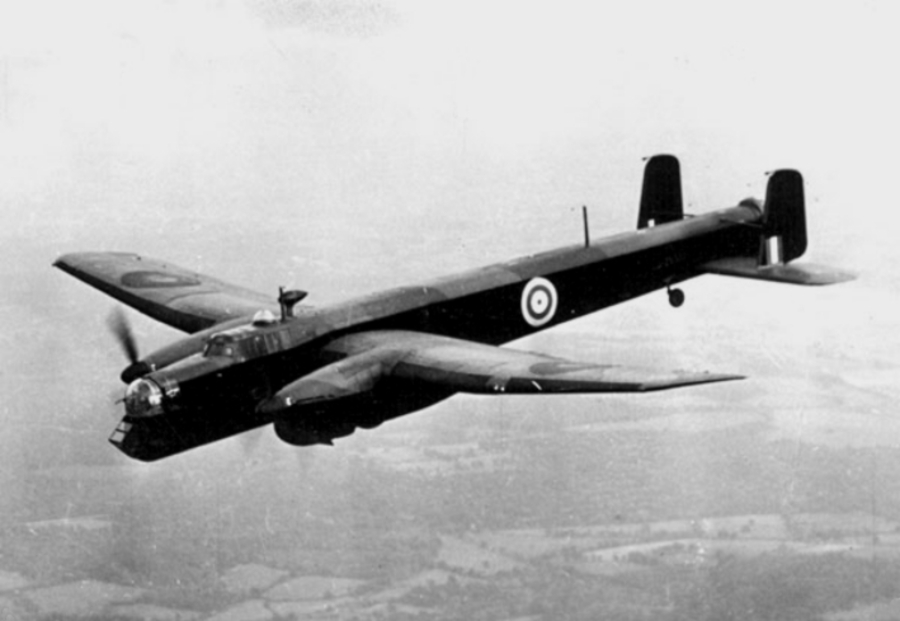
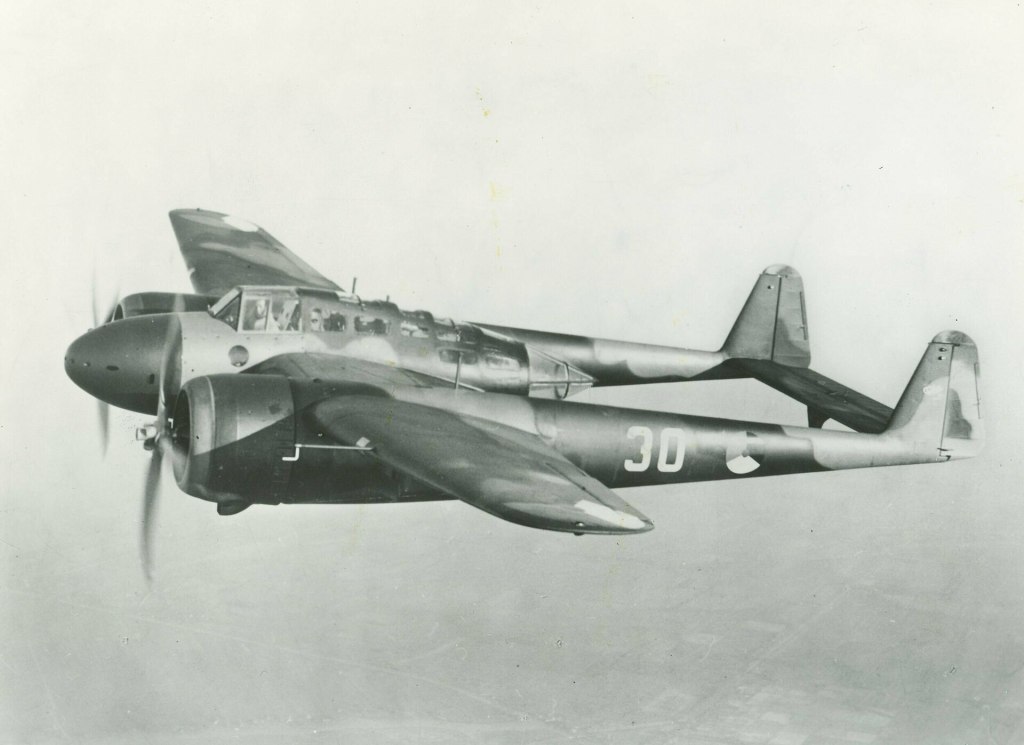
On March 27/28 in 1940, the Dutch Fokker G.I recorded its first aerial victory when it shot down a British Armstrong Whitworth Whitley over Pernis.
As a neutral nation at the time, the Netherlands was obliged to intercept any aircraft violating its airspace. Of the five crew members aboard the Whitley, one was killed.
On the night of 27 March 1940, Armstrong Whitworth Whitley V N1357 (KN-H) of No. 77 Squadron RAF took off from RAF Driffield at 23:05 hrs on a reconnaissance and leaflet mission over north-west Germany.
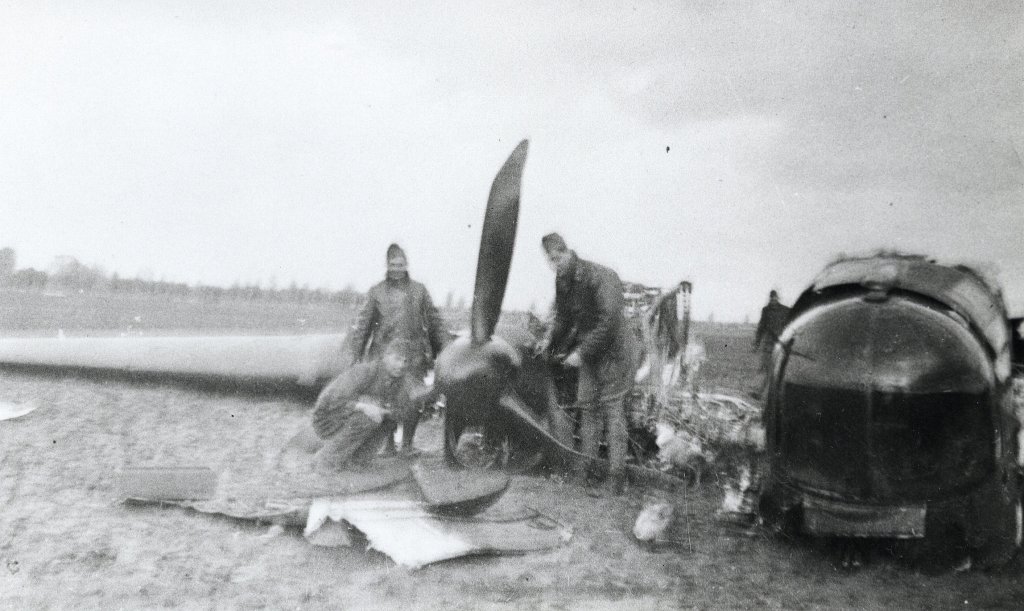
On its return, the aircraft drifted into Dutch airspace, where it was intercepted by a Fokker G.I of the 3rd JaVa (Dutch Air Force), flown by Luitenant Piet Noomen. The Whitley was damaged and subsequently crash-landed while on fire on the Vondelingenweg in Pernis, within the docks area of Rotterdam, Zuid-Holland.
Crew
Pilot: Fg Off Trevor James Geach – interned
2nd Pilot: Fg Off Walter Patrick Copinger – interned
Observer: Sgt James Emerson Miller – killed; buried at Crooswijk General Cemetery (Plot LL, Row 1, Grave 1)
LAC Stanley Harold Edward Caplin – interned
AC2 Robert Briggs Barrie – interned
Fg Off Copinger’s logbook records the mission as a leaflet raid over north-west Germany, noting: “Shot down in flames by Fokker G1 near Rotterdam.”
The incident was reported in the The Daily Telegraph on 29 March 1940 under the headline: “RAF ’Plane Shot Down By Dutch. Crew Declined to Return Fire.”
The inhabitants of the little Dutch villages of Rhoon and Pernis, near Rotterdam, were witnesses this morning of an exciting air battle in which a heavy British bomber was shot down by two Dutch Fokker fighters. The bomber is variously described as a Bristol Blenheim, an Armstrong Whitworth Whitley, and a Handley Page Harrow. The British machine which was apparently returning from a reconnaissance flight over Germany, was compelled to make a forced landing and one member of the crew, who jumped out at a height of about 35 ft above the ground was hit by one of the wings and was killed instantly. The other four members of the crew were taken into custody and will be interned. One of them had a bullet wound in the back.
According to the first accounts the British ’plane returned the fire of the Dutch fighters and a fight took place. Later however it was established that the British airmen had behaved with scrupulous correctness and had not returned the Dutch fire. It was shortly before six o’clock when the British ’plane was signalled and Lt. Noomen, a former Royal Dutch Airlines pilot, and another pilot were sent up from Waalhaven Aerodrome to drive it off or bring it down. The bomber was flying fairly low and people were brought running from their houses by the roar of the engines and the fire of the Dutch machine guns. In a few minutes the bomber was a mass of flames and came down on a piece of ploughed land. It taxied for about 150 yards before coming to a stop with its nose in the mud and its propeller snapped off.
Mr. Lengkeek, director of a dairy concern, who witnessed the fight, said that the British bomber made every effort to evade its pursuer which was blazing away at it from a position above its tail. Suddenly flame and smoke started to pour from the bomber and it disappeared behind the houses. Leaping into his car Mr. Lengkeek hurried to the scene of the crash. “I could see that the whole machine was in flames,” he said, “it was a fantastic sight. The ammunition must have begun to explode for it looked as if there was a firework display going on in the field.
The military from Waalhaven aerodrome arrived on the scene immediately. The airmen came to meet us looking very white and shaking. They seemed to think that they were in France, for one of them said to us: ’Parlez-vous francais?’ Conversation was difficult at first, for the Englishmen did not seem to understand us. When asked where they came from one of them would only say, ’We come from somewhere.’”
A cordon of sentries with fixed bayonets was immediately thrown round the scene of the crash by the Dutch military authorities and no one was allowed to approach the machine. The authorities also refused to divulge the names of the airmen before a full inquiry has been held. Much regret was felt that one of the British airmen had been killed. If he had stayed in the machine with his comrades he would probably have reached the ground safely.
The official version of the shooting contained in a communiqué issued by the Government Press service at The Hague stated:
Early this morning a British bomber, which flew over our country in a westerly direction, was hit by fire from a Dutch fighter. The British plane landed near the village of Pernis. Four occupants left the ’plane. One occupant was slightly wounded. It appears that a fifth occupant had previously jumped out of the ’plane and fell to his death. The ’plane was entirely burned out. The survivors will be interned.
They were interned in a fort at Edam until the Germans invaded Holland. Pat’s diary of his stay in Holland under the heading of 10th May 1940 reports:
Could not get to sleep for some unknown reason. Seemed to be awake half of the night. Sometimes I heard aeroplanes flying overhead and old Geach seemed to be awake. I got to sleep sometime I think, to be suddenly awakened by Mr. Poolman Siemens [the Camp Commandant] at about 7.30 with the words, “Gentlemen we are at war. I must ask you to get up and be prepared to leave at once.” We scrambled out of bed and dressed quickly. Poor old P.S. was very upset, and I expect everybody in Holland is. They are a very fine and peace loving people.
Pat went to The Hague where he was appointed the Assistant Air Attaché at the British Embassy, until the embassy staff was forced to leave Holland on 14th May 1940.
SOURCES
 History of Sorts
Leave a comment