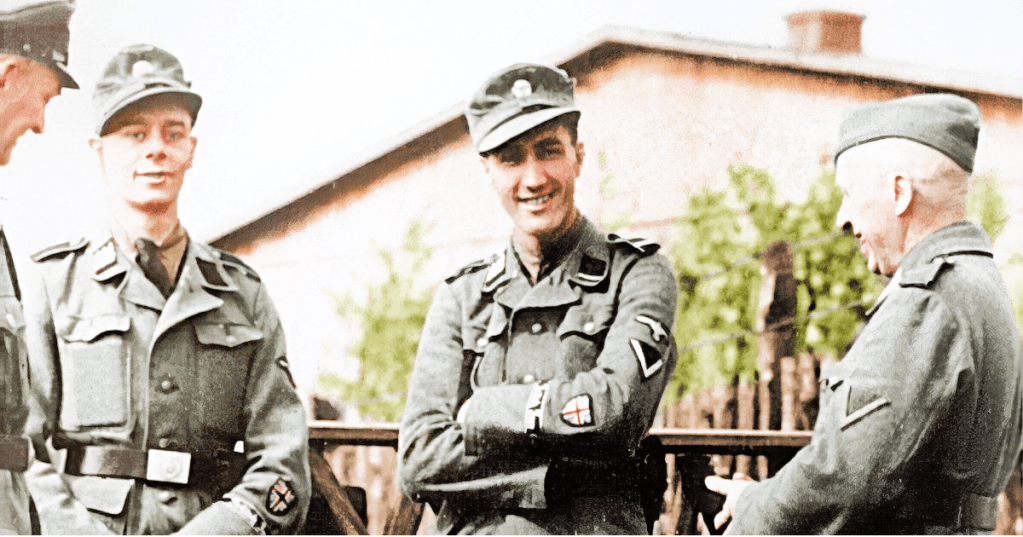
The British Free Corps (BFC) stands as one of the more peculiar episodes of World War II, symbolizing Nazi Germany’s propaganda-driven attempts to exploit discontent and division among Allied prisoners of war (POWs). Though numerically insignificant and operationally negligible, the BFC has drawn historical interest as a study in the intersection of ideology, coercion, and opportunism. Central to its conception and recruitment efforts was John Amery, a fervent British fascist who sought to sway his fellow countrymen into supporting the Nazi cause. This essay examines the origins, activities, and eventual demise of the BFC, alongside the controversial role played by Amery, to provide a comprehensive understanding of this small but infamous unit.
Origins and Formation
The BFC was born out of Nazi Germany’s larger propaganda strategy, which sought to undermine Allied morale and create divisions among its forces. The unit’s origins can be traced to late 1943 when the Nazis began targeting British and Commonwealth POWs for recruitment. The idea was to form a unit composed of British soldiers who would ostensibly fight against the Soviet Union on the Eastern Front. Initially conceived as the Legion of St. George, the unit was renamed the British Free Corps (BFC) to reflect its intended composition better.
German propaganda minister Joseph Goebbels and officials within the Waffen-SS viewed the BFC as a propaganda asset rather than a serious military force. They envisioned it as a tool to demonstrate that even British soldiers supported the Nazi cause, thus undermining Allied unity and morale. Recruitment efforts were led by figures such as John Amery, whose commitment to fascist ideology made him a natural collaborator in this endeavor.

John Amery: Architect of Treason
John Amery, the son of prominent British politician Leo Amery, was a central figure in the BFC’s creation. An ardent fascist and admirer of Adolf Hitler, Amery had lived in Europe before the war and developed connections with far-right groups. His disillusionment with British democracy and his belief in fascist ideology drove him to collaborate with Nazi Germany.
Amery’s role in the BFC was primarily as a recruiter and propagandist. He traveled to POW camps in Germany and occupied territories, attempting to persuade British and Commonwealth soldiers to join the unit. Amery’s speeches emphasized anti-communism, framing the BFC’s purpose as a noble struggle against the perceived threat of Soviet domination. He appealed to soldiers’ hardships in captivity, promising better living conditions and freedom from the deprivations of POW camps.
Despite his efforts, Amery met with limited success. Most POWs rejected his overtures outright, viewing him as a traitor. Many of those who did join did so under duress, coercion, or the hope of escaping the harsh conditions of captivity. Amery’s ideological fervor was not shared by the majority of recruits, whose motivations were often more pragmatic than political.
Recruitment and Composition
The BFC’s membership never exceeded 30 individuals, making it an extremely small unit. Recruits came from a mix of British, Australian, Canadian, and New Zealand soldiers. The recruitment process was fraught with difficulties, as most Allied POWs remained steadfastly loyal to their countries despite the hardships of captivity. Those who joined often cited coercion or deception, such as promises of repatriation or improved treatment, as reasons for their decision.
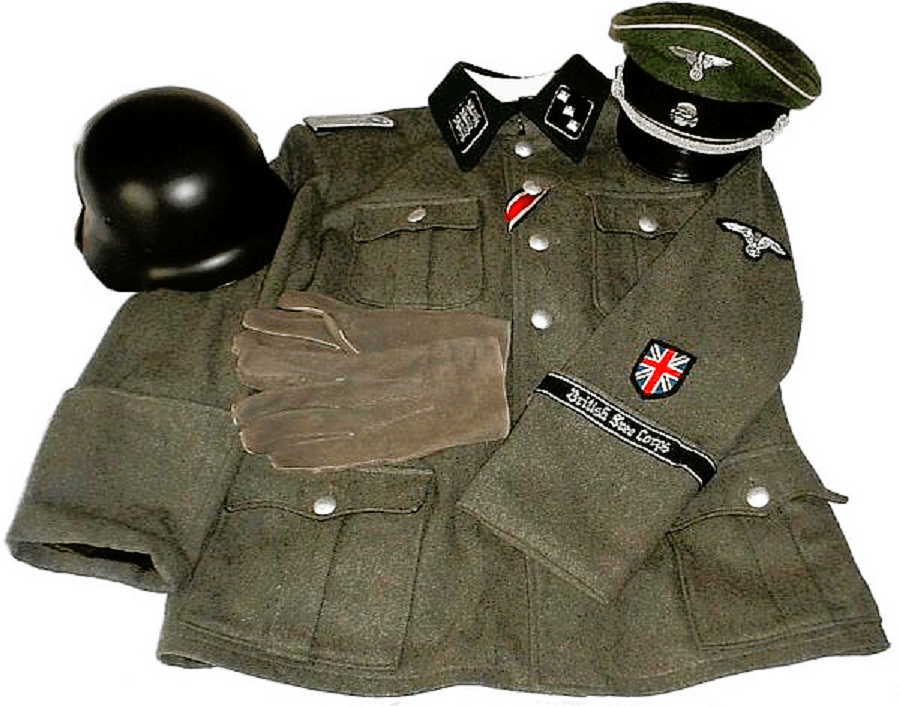
The BFC’s insignia included a Union Jack shield on the sleeve, a deliberate choice meant to lend the unit legitimacy. However, its members’ loyalty and commitment to the Nazi cause were highly questionable. Many recruits were apathetic at best, and some actively sought ways to sabotage the unit or escape.
Activities and Deployment
The BFC was never a significant military force. Its primary purpose was symbolic, intended to serve as a propaganda tool rather than a combat unit. The Nazis initially envisioned the BFC fighting on the Eastern Front, but the unit’s lack of training, cohesion, and commitment made this impractical.
In its brief operational existence, the BFC was relegated to minor roles, such as leaflet distribution and guard duty. Toward the end of the war, some members were sent to the Eastern Front, where they were attached to larger German units. However, their presence had no measurable impact on the war effort. By 1945, the BFC had effectively disbanded, its members either captured by advancing Allied forces or fleeing to avoid retribution.
Aftermath and Trials
The end of World War II brought harsh consequences for members of the BFC. Those captured by Allied forces faced charges of treason, a crime punishable by death in the United Kingdom. John Amery’s fate was sealed by his prominent role in recruiting for the unit. Arrested in Italy in 1945, he was extradited to Britain, where he pleaded guilty to treason and was executed on December 19 of the same year.

Other members of the BFC received varying sentences. Some were imprisoned, while others escaped severe punishment by cooperating with authorities or demonstrating that they had been coerced into joining. The trials underscored the moral and legal complexities of the BFC’s existence, as the line between treason and survival under duress was not always clear.
Legacy
The British Free Corps remains a historical anomaly, notable more for its propaganda value than its military significance. Its small size and ineffectiveness highlight the limited appeal of Nazi ideology among Allied POWs. However, the unit’s existence raises essential questions about loyalty, coercion, and the psychological toll of captivity.
John Amery’s role in the BFC has cemented his place in history as one of Britain’s most infamous traitors. His ideological zeal and betrayal of his country serve as a stark reminder of the dangers posed by extremism and propaganda. At the same time, the experiences of the BFC’s rank-and-file members illustrate the complex interplay of agency, survival, and moral choice in wartime.
The British Free Corps was a failed experiment in propaganda and collaboration, reflecting the limited success of Nazi efforts to exploit Allied divisions. Its story, though largely forgotten, offers valuable insights into the human dimensions of war. From John Amery’s treachery to the plight of coerced recruits, the BFC exemplifies the multifaceted nature of loyalty and betrayal during one of history’s darkest chapters.
Sources
https://www.jewishvirtuallibrary.org/the-british-free-corps
https://en.wikipedia.org/wiki/British_Free_Corps
https://en.wikipedia.org/wiki/John_Amery
https://historylearning.com/world-war-two/british-free-corps/
https://discovery.nationalarchives.gov.uk/details/r/C11439616
https://www.awm.gov.au/collection/LIB100020913
Donations
Your readership is what makes my site a success, and I am truly passionate about providing you with valuable content. I have been doing this at no cost and will continue to do so. Your voluntary donation of $2 or more, if you are able, would be a significant contribution to the continuation of my work. However, I fully understand if you’re not in a position to do so. Your support, in any form, is greatly appreciated. Thank you. To donate, click on the credit/debit card icon of the card you will use. If you want to donate more than $2, just add a higher number in the box left from the PayPal link. Your generosity is greatly appreciated. Many thanks.
$2.00
 History of Sorts
Leave a comment