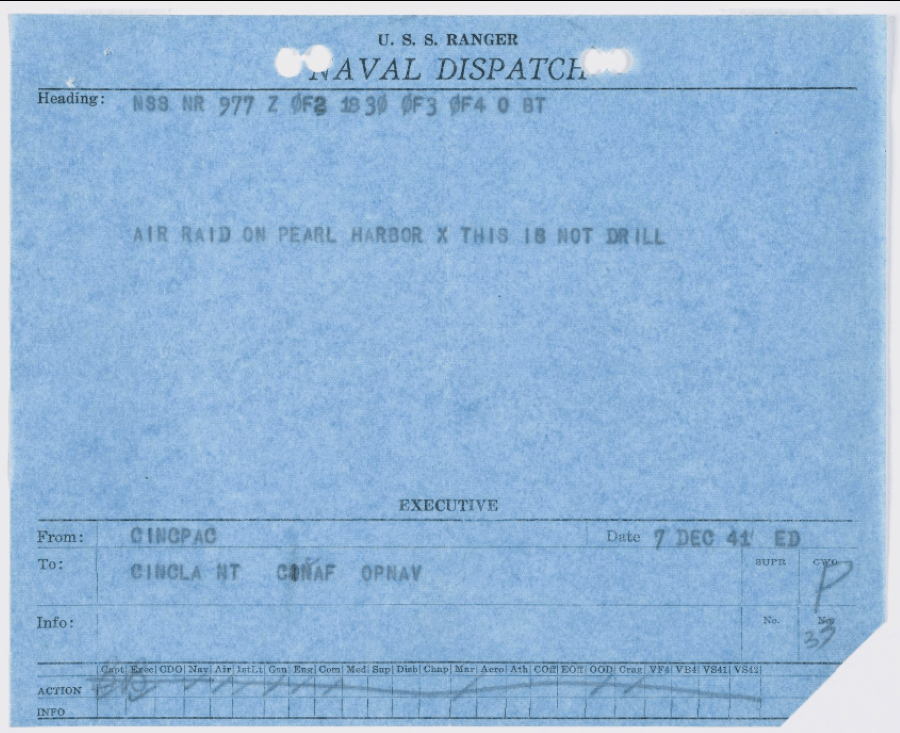
On December 7, 1941, Japanese planes attacked the United States Naval Base at Pearl Harbor in the Hawaii Territory, killing more than 2,300 Americans. The U.S.S. Arizona was completely destroyed, and the U.S.S. Oklahoma capsized. In total, twelve ships were sunk or beached, and nine additional vessels were damaged. More than 160 aircraft were destroyed and over 150 others were damaged.
The first official word of the attack came in a hurried dispatch from Admiral Husband Edward Kimmel, Commander in Chief of the United States Pacific Fleet, to all major Navy commands and fleet units. His message, sent from the ill-prepared Pearl Harbor base, read simply: “AIR RAID ON PEARL HARBOR X THIS IS NOT DRILL.”
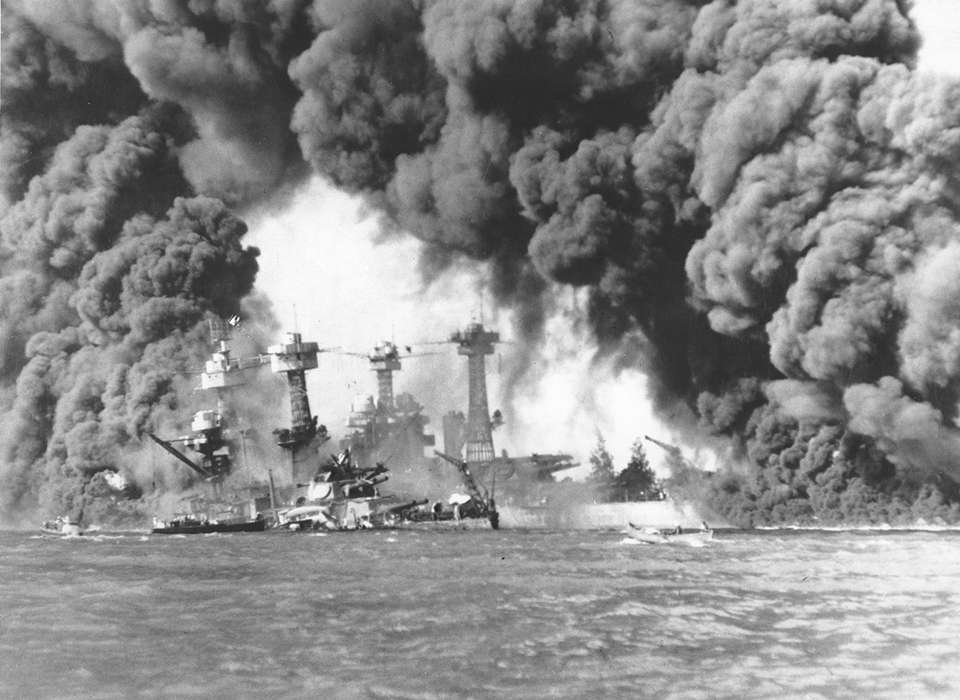
The attack on Pearl Harbor on December 7, 1941, stands as a watershed moment in global history. It marked the abrupt end of American isolationism, decisively brought the United States into World War II, and reshaped international power dynamics for decades to come. The event was not an isolated outburst of violence, but rather the culmination of deep-rooted political tension, imperial ambition, economic pressure, and diplomatic breakdown between the United States and Japan. Understanding the attack requires examining its context, execution, and far-reaching consequences.
I. Background: Rising Tensions in the Pacific
- Japanese Expansionism and U.S. Opposition
Japan’s militaristic trajectory began long before 1941. Fueled by industrial needs, nationalism, and imperial ideology, Japan sought to dominate East Asia and secure natural resources. Its invasion of Manchuria in 1931 and subsequent escalation into a full-scale war with China in 1937 intensified regional instability.
The United States, committed to the “Open Door” policy in China and increasingly critical of Japanese aggression, responded with diplomatic protests and economic sanctions. By 1940–41, these tensions escalated sharply. Japan’s alliance with Nazi Germany and Fascist Italy (the Tripartite Pact) deepened American suspicion, while Japan perceived U.S. restrictions—especially the oil embargo of 1941—as existential threats to its military and industrial survival. - Failed Diplomacy
Despite negotiations, both nations proved unable to reconcile their strategic aims. The U.S. demanded Japan withdraw from China and Indochina; Japan, unwilling to abandon its imperial gains, sought instead to negotiate a division of influence in the Pacific. Mutual mistrust and rigid positions eventually rendered diplomacy ineffective.
II. Planning the Attack
- Strategic Considerations
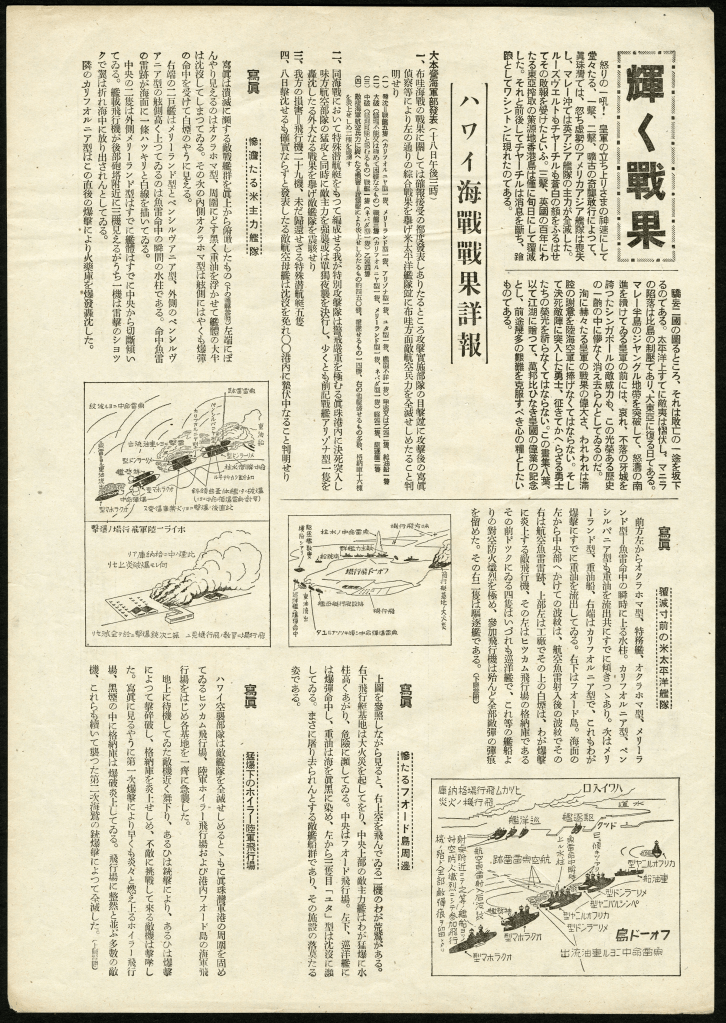
Admiral Isoroku Yamamoto, the mastermind behind the attack, recognized that Japan could not win a prolonged war against the United States. He therefore advocated a preemptive strike that would cripple the U.S. Pacific Fleet, breaking American morale and buying time for Japan to consolidate its territorial conquests. - Operational Preparation
Months of planning culminated in the assembly of a carrier strike force: six aircraft carriers, over 400 planes, and an array of support vessels. Japan emphasized surprise, speed, and overwhelming force. The fleet sailed across the northern Pacific, undetected, arriving north of Hawaii on December 6.
III. The Attack: December 7, 1941
- The First Wave
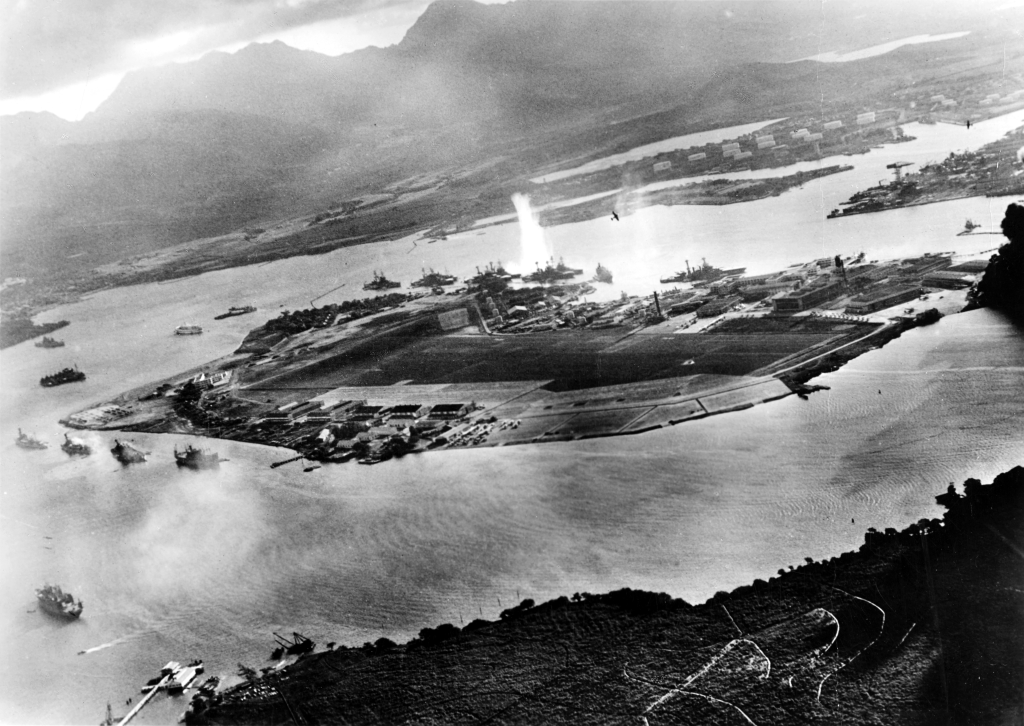
Just before 8:00 a.m., Japanese aircraft descended on Pearl Harbor. Torpedo bombers targeted battleships moored along Battleship Row, while dive bombers and fighters attacked airfields to prevent American counterstrikes. Within minutes, ships such as the USS Oklahoma and USS West Virginia were fatally damaged. - The Second Wave
A second wave intensified the destruction, attacking remaining ships and critical infrastructure. The most devastating explosion occurred aboard the USS Arizona, which sank with over 1,100 crew members—nearly half the total casualties of the attack. - American Response
Although surprised and temporarily paralyzed, American sailors, soldiers, and airmen fought back. Anti-aircraft fire downed dozens of Japanese planes, and several heroic efforts saved ships from sinking. Nonetheless, the assault had succeeded in achieving tactical surprise. - Human and Material Toll
In total, over 2,400 Americans were killed and roughly 1,200 wounded. Eighteen ships were damaged or sunk, and nearly 200 aircraft were destroyed on the ground.
Yet the Japanese failed to destroy key assets: American aircraft carriers (which were out at sea), repair facilities, oil storage depots, and submarine bases—omissions that would later prove strategically disastrous.
IV. Aftermath and American Mobilization
- A Nation Transformed
The attack unified the American public with unprecedented speed. On December 8, President Franklin D. Roosevelt delivered his famous “Infamy Speech,” and within hours, Congress declared war on Japan. Germany and Italy soon declared war on the United States, drawing the nation fully into the global conflict. - Military Reorientation
The U.S. rapidly mobilized for total war. Industrial production soared, the draft expanded, and scientific innovation accelerated. The attack also spurred major military strategic changes, including a heightened emphasis on aircraft carriers, naval aviation, and coordinated Pacific operations.
On the day after the attack on Pearl Harbor, Alan Lomax, head of the Library of Congress Archive of American Folk Song, sent a telegram to colleagues across the United States urging them to gather people’s immediate reactions to the bombing. Over the following days, prominent folklorists—including John Lomax, John Henry Faulk, Charles Todd, Robert Sonkin, and Lewis Jones—responded by recording “man on the street” interviews in New York, North Carolina, Texas, Washington, D.C., and other locations. They spoke with salesmen, electricians, janitors, oilmen, cabdrivers, housewives, students, soldiers, physicians, and many others about the events of December 7. Among those interviewed was a California woman visiting her family in Dallas, Texas.
Her reflections captured the mixture of sorrow, bewilderment, and resolve felt by many Americans:
“My first thought was what a great pity that… another nation should be added to those aggressors who strove to limit our freedom. I find myself at the age of eighty, an old woman, hanging on to the tail of the world, trying to keep up. I do not want the driver’s seat. But the eternal verities—there are certain things that I wish to express: one thing that I am very sure of is that hatred is death, but love is light. I want to contribute to the civilization of the world, but… when I look at the holocaust that is going on in the world today, I’m almost ready to let go…”
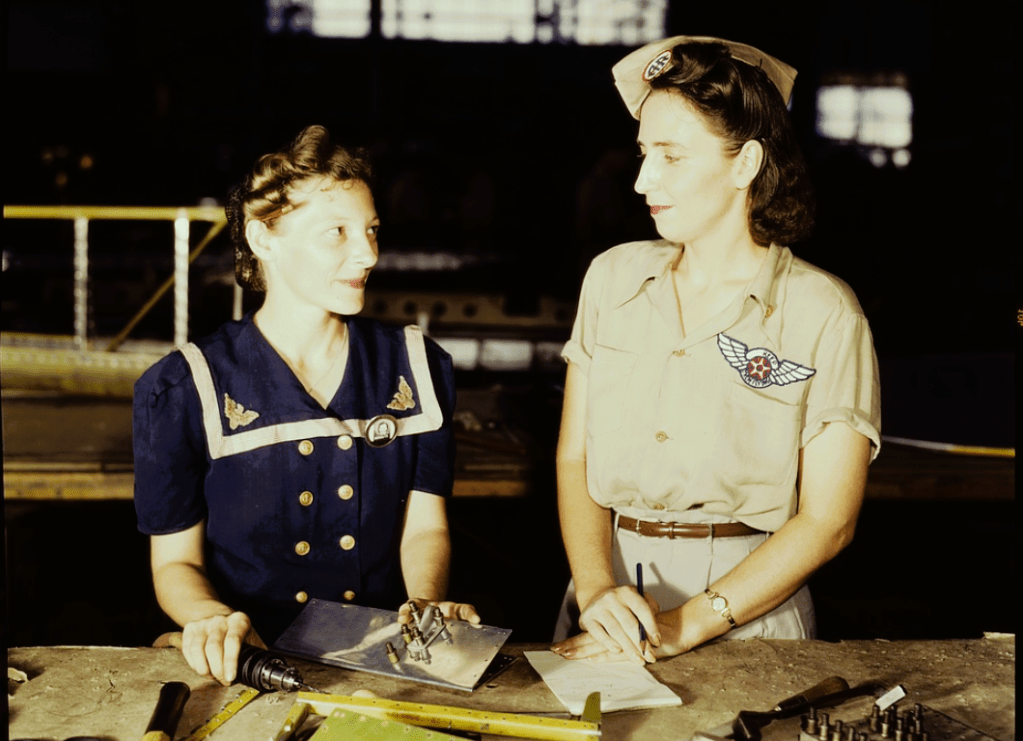
The Office of War Information (OWI) capitalized on the fear and outrage unleashed by the Pearl Harbor attack to rally public support for wartime mobilization. Established in June 1942—six months after the bombing—the OWI functioned as the U.S. government’s central propaganda agency, producing images and written material such as the photograph above depicting Pearl Harbor widows. Focusing on themes including aircraft production, military training, women entering the workforce, and the activities of the armed forces, the OWI documented and promoted a vision of American patriotism both in combat and on the home front.
V. Broader Consequences
- Turning the Pacific into a Major Theater of War
The attack initiated a brutal, far-reaching Pacific War. Battles such as Midway, Guadalcanal, Iwo Jima, and Okinawa would eventually erode Japanese power and culminate in Japan’s surrender after the atomic bombings of Hiroshima and Nagasaki. - Internment and Civil Liberties Issues
On the home front, fear and prejudice led to Executive Order 9066, resulting in the internment of over 110,000 Japanese Americans. This remains one of the most prominent civil rights violations in U.S. history. - Geopolitical Reordering
The attack and ensuing war reshaped the global balance of power. The United States emerged as a superpower, Japan was transformed into a pacifist democracy under American occupation, and the stage was set for the Cold War as the Soviet Union asserted influence in East Asia.
VI. Historical Legacy
Pearl Harbor has entered collective memory as a symbol of sacrifice, surprise, and national resilience. It prompted intense debate over preparedness, intelligence failures, and policy decisions. It also serves as a reminder of the dangers of militarism, miscalculation, and diplomatic breakdown. Today, the USS Arizona Memorial stands as a tribute to the lives lost and a solemn reflection on the costs of war.
The attack on Pearl Harbor was more than a dramatic military strike—it was a pivotal moment that reshaped the trajectory of the 20th century. Rooted in years of geopolitical tension and imperial ambition, executed with deadly precision, and followed by massive global repercussions, the event stands at the intersection of tragedy and transformation. Its legacy continues to inform international relations, military strategy, and national identity. Pearl Harbor remains, in every sense, a defining moment in world history.
sources
https://www.loc.gov/item/today-in-history/december-07
https://www.nationalgeographic.com/history/article/how-the-attack-on-pearl-harbor-changed-history
https://www.nationalww2museum.org/war/topics/pearl-harbor-december-7-1941
https://en.wikipedia.org/wiki/Attack_on_Pearl_Harbor
Donation
Your readership is what makes my site a success, and I am truly passionate about providing you with valuable content. I have been doing this at no cost and will continue to do so. Your voluntary donation of $2 or more, if you are able, would be a significant contribution to the continuation of my work. However, I fully understand if you’re not in a position to do so. Your support, in any form, is greatly appreciated. Thank you. To donate, click on the credit/debit card icon of the card you will use. If you want to donate more than $2, just add a higher number in the box left from the PayPal link. Your generosity is greatly appreciated. Many thanks.
$2.00
 History of Sorts
Leave a comment