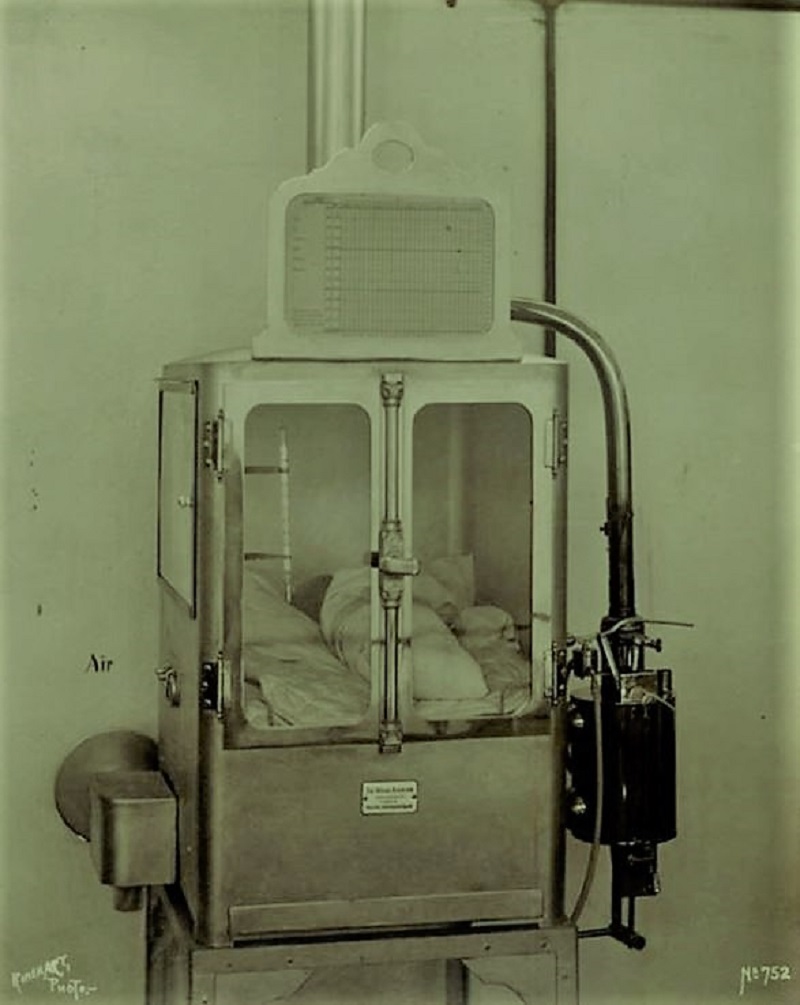
Seeing babies in incubators nowadays is a fairly common sight.
Infant incubators are used to provide a warm environment for babies born prematurely or for other infants who are unable to maintain a normal body temperature. The infant incubator is a relatively small, glass-walled box that may have portholes fitted with long rubber gloves through which nurses can handle and care for the infant. Most infant incubators are fitted with special devices that can control the concentration of oxygen inside the incubator; this is necessary because some infants need either greater or lesser amounts of oxygen owing to particular diseases they may have. Infant incubators also regulate the humidity inside the enclosure.
The concept of the incubator was developed in France as early as 1857. The first device in the USA was built by William Champion Deming at the State Emigrant Hospital on Ward’s Island, New York.
The device was warmed by 57 liters of water. The forerunners of this constant temperature sensor in the uterus were the Ruehlsche cradle in Moscow in 1835 and the ” warming bath ” introduced by Credé in Leipzig in 1864.
On September 7, 1888, an incubator was used for the first time in the U.S. to treat a premature baby. Edith Eleanor McLean, the baby in the photo above, was the first child to be placed into such a device. She weighed 1,106 grams at birth.
There is not much known what happened to baby Edith afterwards.
Update December 2.2021
One of Edith’s grandchildren contacted me and gave me the following additional information.
“I know what happened to little Edith. She is my grandmother. Her name was changed to Myrtle Eleanor. She went on to give birth to 13 children. My mom was the 12th.”
sources
https://www.onthisday.com/photos/baby-incubator
The first incubator baby was named Edith
https://de.wikipedia.org/wiki/Inkubator_(Medizin)

Donation
Your readership is what makes my site a success, and I am truly passionate about providing you with valuable content. I have been doing this at no cost and will continue to do so. Your voluntary donation of $2 or more, if you are able, would be a significant contribution to the continuation of my work. However, I fully understand if you’re not in a position to do so. Your support, in any form, is greatly appreciated. Thank you. To donate, click on the credit/debit card icon of the card you will use. If you want to donate more than $2, just add a higher number in the box left from the PayPal link. Your generosity is greatly appreciated. Many thanks.
$2.00



 History of Sorts
Leave a comment