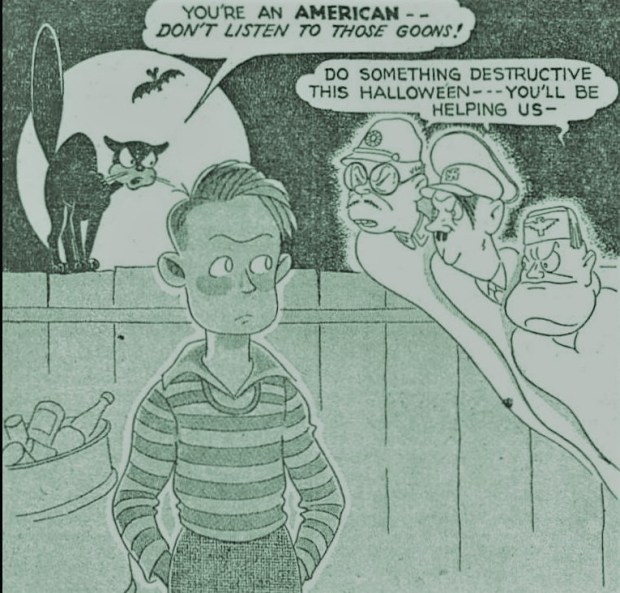
Here are some World War II Halloween stories and images. The above illustration was published in the San Diego Union on 25 October 1942.
A Halloween Party in 1942
The excerpt below provides a beautiful example of how Halloween was celebrated in the USA during World War II:
“Write your Hallowe’en invitations on cutouts of black cats, cauldrons, scarecrows, pumpkins, or witches. Use black or orange paper and write the invitation in the form of a jingle or just a note. Room decorations are a simple matter, for they can be as casual as you like. Spread a few sheaves of corn around the room or stand up some stalks of corn amid a profusion of gay autumn leaves.
Orange or black candles or orange bulbs—just a few to create an eerie effect—can be used to provide the light. Giant cutouts of black cats, witches, or pumpkins pinned to the walls around the room, brilliant orange, yellow, or red tablecloths of cotton, or old sheets dyed in any of those colours enhance them for the party. Playing games that originate from the character of the occasion, like pulling fortunes from the witches’ cauldron or spirit rapping, are times of interest for this type of party.
And don’t forget that traditional cider and doughnuts, orange and black candies, ice cream moulds with a pumpkin, or made-with-honey pumpkin pie contribute much in a decorative way.” —Wartime Entertaining, Ethel X. Pator [Consolidated Book Publishers: Chicago] 1942 (p. 49).
(Note: the original Hallowe’en spelling)
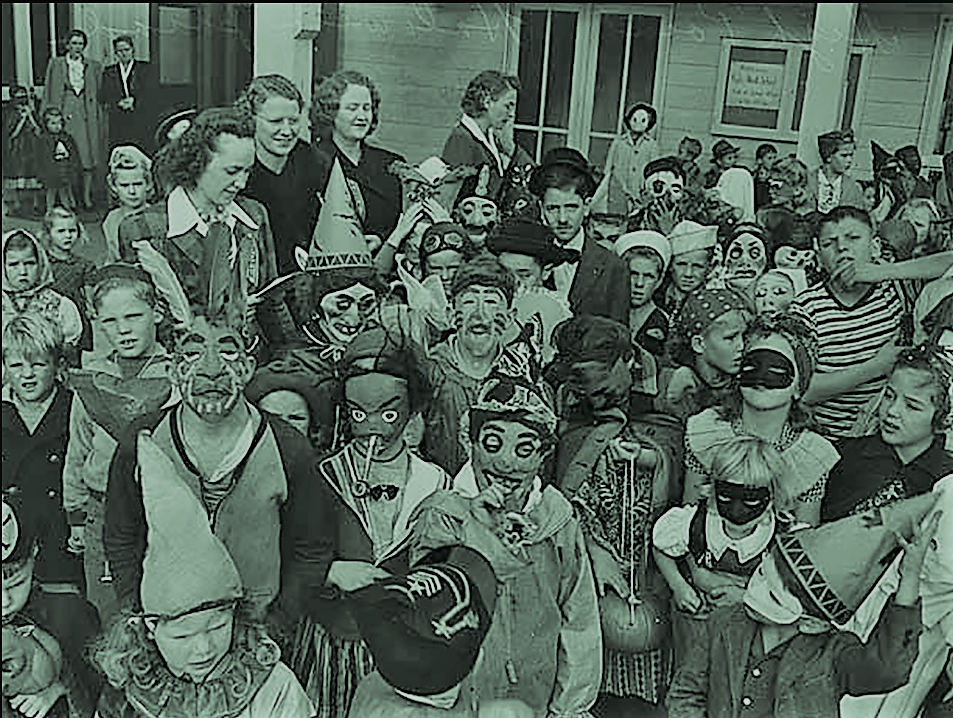
Photo above: Children in Halloween costumes at High Point, Seattle, 1943. (Image courtesy of MOHAI, Seattle Post-Intelligencer Collection, pi23331.)
Topeka’s Edward “Smitty” Smith was embroiled in a bloody battle on 31st October 1944. He suffered two injuries on 31st October 1944, in Marieulles, France.
“At this point, you displayed great and courageous initiative by rushing forward and pointing out booby traps to enable members of your squad to proceed safely. Reaching the edge of a clearing, you dashed into the clearing and emptied your rifle point-blank into the nearest enemy foxhole. You then ran behind a large tree, reloaded, and repeated this action on a second enemy foxhole.
You returned and, for the third time, rushed an enemy position, throwing grenades in the foxholes. All this action was done under heavy enemy small-arm and machine-gun fire, and returning from your third gallant raid, you were seriously wounded in the left arm by enemy rifle fire. You then jumped into a foxhole for cover, setting off a booby trap, which wounded you the second time (in the left leg). But even after this second wound, it was only at your squad leader’s order that you went to the rear.”
—Major General Harry Twaddle, Commanding General of 95th Division.
After his Halloween adventures, Smith received a Purple Heart, Combat Medal, Victory Medal, and European Campaign Medal.
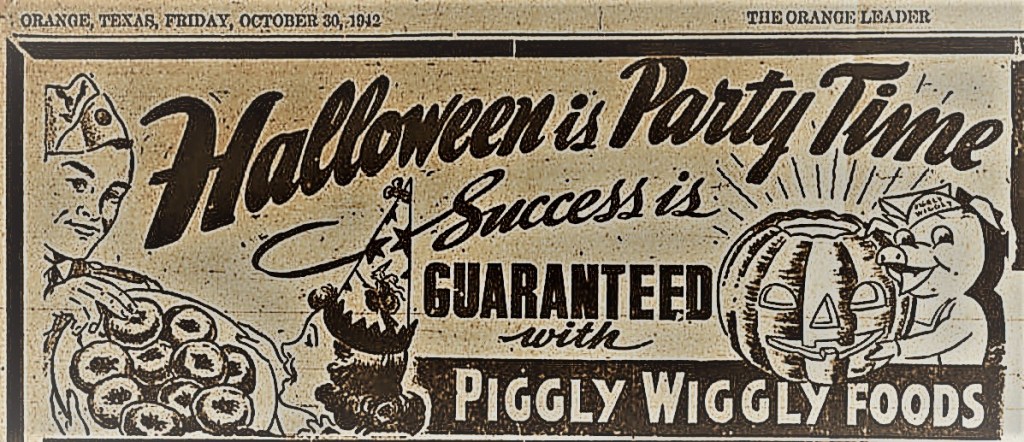
The Belfast Telegraph published the following article on Halloween celebrations on 31st October 1940.
“Halloween will be celebrated traditionally this evening with parties, dances, and other forms of entertainment, notwithstanding the changes and difficulties brought by the war.
From the kiddies’ point of view, however, the evening will lack that sparkle and excitement that fireworks and bonfires give to the scene, which, of course, are things of the past in these days of the blackout.
***
The scarcity of sugar will have an effect on the baking of cakes. However, judging by the demand for threepenny bits this morning, the old-fashioned apple tart will still have its fascination for youthful ‘treasure hunters.’
Halloween and Bonfire Night 1940 by Neil Coleman
“We were Church of England, my cousin Geoffrey and I, and were members of the choir at St Michael’s and All Angels, on Melton Road, on that piece of land that lay between Moira Street and Cannon Street, just North of the Melton turn in Belgrave, Leicester. We lived in a large house on a terrace directly opposite a church. We were both pupils at St Patrick’s Roman Catholic school on Harrison Road, Geoff being nine and I being eight, which meant that we were in different years. The school was connected with the Church of Our Lady at the Harrison Road end of Moira Street. And in 1940, at Halloween, we went to the party given in the hall attached to the church. Run by the teachers and parents, there was apple-bobbing, lucky dips in bran-barrels, toffee apples, ginger-snaps, and all sorts of games and fun. My mother went with us, and there was an enormous Moon on what was a clear night. Walking back along Moira Street, Mother said she thought the Moon was what she thought was called a ‘Hunter’s Moon.’
That night was 31st October 1940.”
Sources
https://www.beaumontenterprise.com/news/article/Halloween-tricks-not-a-treat-during-WWII-4932055.php
https://www.enemyinmirror.com/halloween-1942/

 History of Sorts
Leave a reply to historiebuff Cancel reply