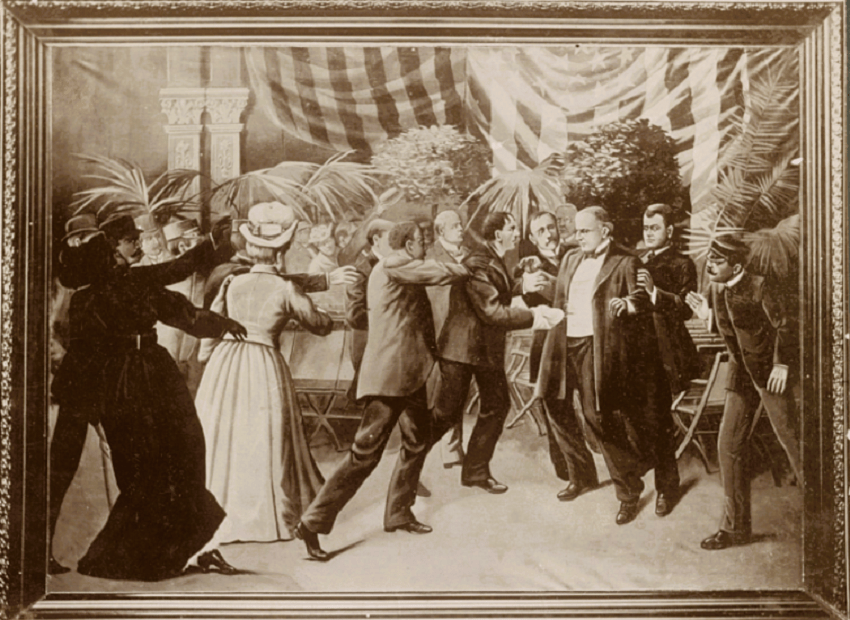
The 25th president of the United States, William McKinley, was assassinated on September 6, 1901, during a public event at the Pan-American Exposition in Buffalo, New York. McKinley was attending a reception at the Temple of Music, where he was greeting members of the public as part of his duties at the exposition, a grand showcase of technological and cultural achievements.
As McKinley stood shaking hands with visitors, Leon Czolgosz, a 28-year-old anarchist, approached him. Czolgosz had concealed a .32 caliber revolver beneath a handkerchief wrapped around his right hand, making it seem as if his arm was injured. When McKinley extended his hand to greet Czolgosz, the assassin raised the hidden revolver. It fired two shots at the president from point-blank range. One bullet grazed McKinley’s shoulder, but the second lodged deep in his abdomen, causing sever internal damage.
McKinley initially did not grasp the gravity of his wounds. In the moments after being shot, he reportedly said, “Be careful how you tell my wife.” Medical help arrived swiftly, and McKinley was taken to a nearby hospital on the exposition grounds, where doctors operated to remove the bullet. The surgery seemed successful at first, and McKinley was initially expected to recover. However, the medical team was unable to locate one of the bullets, and infection soon set in. Despite early optimism, McKinley’s condition deteriorated, and on September 14, 1901, he succumbed to gangrene and other complications. He died at 2:15 a.m. with his wife, Ida McKinley, at his side.
Motive of the Assassin
Leon Czolgosz, a factory worker from Cleveland, Ohio, was a committed anarchist who had become deeply influenced by the radical anti-government rhetoric of the time. He had been inspired by prominent anarchists like Emma Goldman and viewed the assassination as a strike against a corrupt and oppressive government. Czolgosz believed that by killing McKinley, he was acting on behalf of the common people against a system that favored the wealthy and powerful.
Czolgosz was arrested on the spot by law enforcement and members of the crowd, offering little resistance. His explanation for the assassination was simple: he believed that McKinley represented the heart of an unjust system, and removing him would help dismantle that system. He was tried for murder in a highly publicized trial and found guilty. On October 29, 1901, Czolgosz was executed by the electric chair in Auburn Prison, New York.
Consequences and Legacy
The assassination of McKinley had profound political and social effects:
- Theodore Roosevelt’s Presidency: McKinley’s death propelled Theodore Roosevelt, his young and energetic vice president, into the presidency. Roosevelt would go on to become one of the most consequential leaders in American history, promoting progressive reforms that shaped the nation’s political landscape.
- Secret Service Protection: Presidential protection was relatively lax at the time of McKinley’s assassination. After his death, the Secret Service assumed the official responsibility of protecting the president, a role it continues to perform today. This shift was a direct result of the growing awareness of the risks faced by public figures.
- Backlash Against Anarchism: Czolgosz’s identification as an anarchist sparked widespread fear and suspicion of anarchist movements, not just in the U.S. but globally. In the months following the assassination, authorities cracked down on anarchist groups and deported many foreign radicals. Anarchist sentiment was equated with terrorism, leading to the passage of stricter laws to combat political extremism.
- Public Mourning: McKinley’s assassination plunged the nation into a period of mourning. His funeral in Canton, Ohio, drew large crowds, and tributes poured in from around the world. McKinley was remembered as a leader who had guided the country through a period of economic growth, victory in the Spanish-American War, and the expansion of U.S. influence abroad.
McKinley’s assassination, following the earlier killings of Presidents Abraham Lincoln and James A. Garfield, highlighted the vulnerability of U.S. leaders to violent political extremism. It marked the third assassination of an American president in just over three decades, prompting a national reflection on the role of violence in politics and the importance of securing the safety of public officials.
Sources
https://www.loc.gov/item/today-in-history/september-06?loclr=eatod
https://www.history.com/this-day-in-history/president-william-mckinley-is-shot
 History of Sorts
Leave a comment