
Operation Source, executed on September 22, 1943, was one of the most daring and innovative operations conducted by the British Royal Navy during World War II. The objective of the operation was to neutralize the German battleship Tirpitz, one of the most significant threats to Allied naval operations in the North Atlantic and Arctic waters. By using X-class midget submarines, the British sought to cripple this formidable warship, which had been stationed in the Norwegian fjords as a strategic deterrent against Allied convoys to the Soviet Union. This essay will examine the strategic importance of Tirpitz, the planning and execution of Operation Source, and its impact on the war effort.
Strategic Importance of the Tirpitz
The Tirpitz was the largest battleship ever built by Germany and one of the most powerful in the world at the time. It was the sister ship to the infamous Bismarck, whose sinking in 1941 had been a significant victory for the Royal Navy. The presence of Tirpitz in Norwegian waters was a constant threat to Allied convoys supplying the Soviet Union via the Arctic route, as its firepower could devastate these convoys, which were critical for maintaining the Eastern Front. Even without engaging in battle, the mere presence of Tirpitz forced the Royal Navy to allocate significant resources to guard against a potential breakout.
Stationed in the heavily defended fjords of Norway, Tirpitz was protected by an array of anti-aircraft batteries, anti-submarine nets, and minefields. Its location in the Norwegian fjords made it difficult to attack with conventional air and sea forces, and as a result, the Royal Navy devised a plan to use unconventional means to neutralize this looming threat.
Planning and Development of the X-Craft
Operation Source was born out of necessity, leading to the development of the X-class midget submarines. These small submarines were designed specifically for the mission, measuring only 51 feet long and carrying a crew of four men. Their small size and maneuverability allowed them to penetrate enemy defenses more effectively than larger vessels. Each X-craft carried two large, detachable explosive charges known as “saddle charges,” which could be placed under enemy ships and detonated.
The mission was fraught with risk, as these submarines had to navigate through Norwegian waters, heavily defended by anti-submarine measures. The plan called for towing six X-craft across the North Sea by larger submarines to bring them within range of Tirpitz. Once in position, the midget submarines would be released to make the final approach on their own. Despite the technical challenges and the dangerous nature of the mission, the operation was greenlit in early 1943.
The Execution of Operation Source
The operation began on September 20, 1943, with six X-craft being towed by larger submarines toward the Norwegian fjords where Tirpitz was moored. The final phase of the mission began on September 22, 1943, as the X-craft submarines began their independent journeys toward the battleship. The fjords were heavily defended, with anti-submarine nets and patrols on high alert, adding to the complexity of the mission.
Of the six X-craft that were launched, three managed to reach the vicinity of Tirpitz—X-5, X-6, and X-7. Despite being spotted and coming under heavy fire, two of the submarines successfully placed their explosive charges beneath the battleship.
- X-6, commanded by Lieutenant Donald Cameron, managed to navigate through anti-submarine nets and avoided detection until the very last moment. When spotted, Cameron decided to surface and make a direct run toward Tirpitz. Despite being heavily damaged by German defenses, Cameron and his crew succeeded in releasing their charges beneath the ship.
- X-7, under Lieutenant Basil Place, also faced difficulties during its approach. The submarine became entangled in the anti-submarine nets but eventually broke free. Despite sustaining severe damage, Place and his crew were able to place their charges near the target.
- X-5, commanded by Lieutenant Henty-Creer, was lost during the mission, and its fate remains unclear. It is believed that it was detected by German forces and destroyed before it could release its charges.
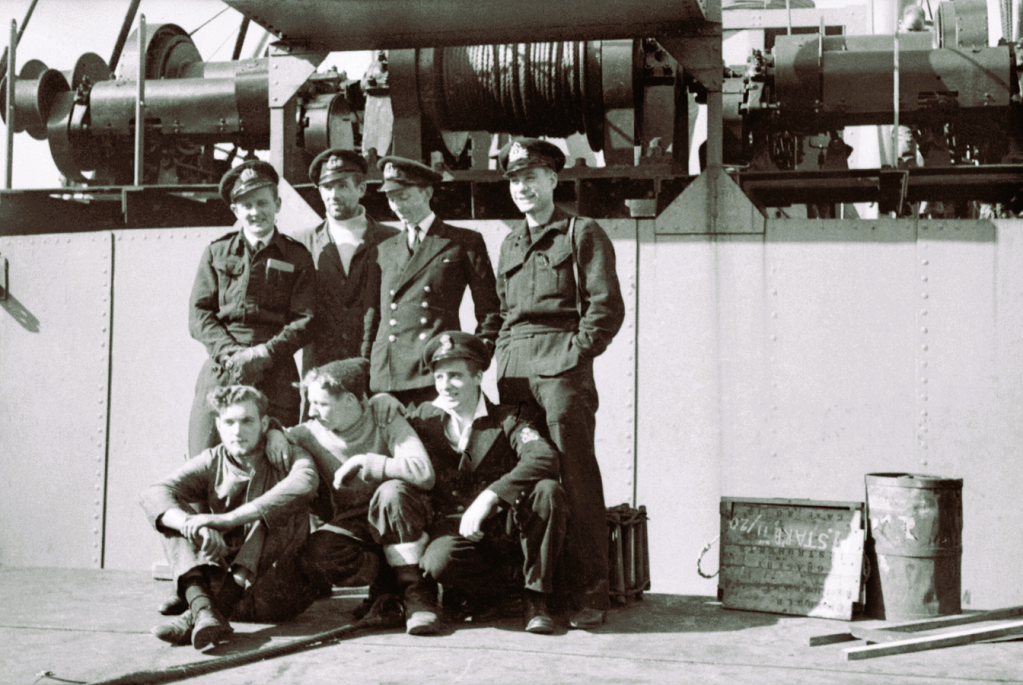
After successfully placing the charges, the surviving crew members of X-6 and X-7 were forced to scuttle their submarines and were captured by the Germans. Nevertheless, the charges detonated as planned.
Impact of the Attack
The explosions beneath Tirpitz caused significant damage to the battleship, despite the ship not being sunk. The blasts ruptured the hull, flooded multiple compartments, and severely damaged the main turrets and propulsion systems. The ship was rendered inoperable and had to undergo extensive repairs, which took several months. As a result, Tirpitz was unable to participate in naval operations for the rest of 1943 and well into 1944.
Although Tirpitz was not destroyed in Operation Source, the attack succeeded in temporarily neutralizing the threat it posed to Allied Arctic convoys. The Tirpitz never fully regained its operational capabilities and remained a target for the Allies until it was finally sunk in November 1944 during an air raid by the Royal Air Force (RAF) in Operation Catechism.
The Legacy of Operation Source
Operation Source was a tactical and technological triumph for the Royal Navy. It showcased the ingenuity and bravery of the crews involved, particularly those of X-6 and X-7. For their bravery, Lieutenant Cameron and Lieutenant Place were both awarded the Victoria Cross, Britain’s highest military honor. Other members of the operation received various distinctions for their role in the attack.
The success of Operation Source also highlighted the effectiveness of midget submarines in special operations, leading to further developments in unconventional naval warfare. It demonstrated that even the largest and most heavily protected warships could be vulnerable to small, agile forces employing creative tactics.
Operation Source was a bold and innovative mission that neutralized one of Nazi Germany’s most significant naval threats. Though it did not result in the immediate destruction of Tirpitz, the operation succeeded in rendering the battleship inoperable for a critical period, allowing Allied forces to continue their Arctic convoys unimpeded. The bravery and skill of the X-craft crews, combined with the innovative use of midget submarines, made Operation Source a pivotal moment in the battle for control of the North Atlantic. The operation stands as a testament to the ingenuity of the Royal Navy and the resolve of its sailors during one of the most challenging periods of World War II.
sources
https://www.kbismarck.com/tirpitz-midget-submarines.html
 History of Sorts
Leave a comment