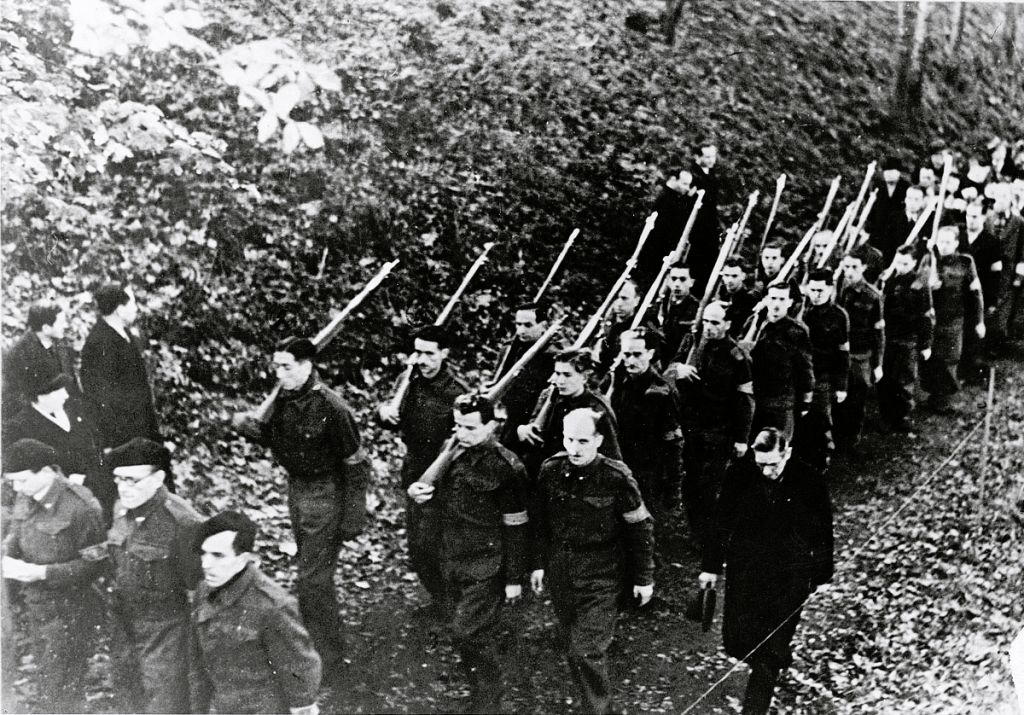
In November 1944, Jewish underground fighters in Belgium found themselves at a significant historical juncture. With the liberation of Belgium by Allied forces in September of that year, these fighters, who had risked their lives to resist Nazi occupation and protect Jewish lives, transitioned from covert operations to a new set of challenges and opportunities. Their contributions to the Belgian resistance, their struggles to rebuild after liberation, and their efforts to commemorate and protect their communities became defining features of the post-liberation period.
Belgian Jews played an active and influential role in the underground resistance and rescue operations during the Nazi occupation. They were integral to espionage networks and were particularly active within communist resistance movements. Many Jewish activists contributed to various resistance efforts, including the publication of underground newspapers and the creation of a unified Jewish resistance organization, the Comité de Défense des Juifs (CDJ), or Committee for the Defense of Jews. The CDJ, which coordinated with all major Belgian resistance groups, focused on rescuing Jews, forging alliances with both church and secular leaders, and raising essential funds for its activities.
The Belgian anti-German underground, including members connected to the CDJ, launched several impactful operations against Nazi efforts. They targeted the German database of Jewish records and assassinated Robert Holzinger, the chief Nazi official responsible for issuing deportation orders. In an especially daring operation, the resistance ambushed a deportation train carrying Jewish prisoners from the Malines transit camp to Auschwitz in April 1943. This raid was the only known assault across Europe on a train transporting Jews to the death camps, marking it as a unique and courageous act of defiance.
Jewish Resistance in Belgium during the Occupation
Jewish resistance in Belgium was a remarkable example of resilience and ingenuity under brutal conditions. The Nazi occupation, which began in 1940, introduced increasingly oppressive policies that targeted Belgium’s Jewish population, culminating in deportations to concentration and extermination camps.

Faced with these threats, Jewish individuals and groups joined the underground resistance despite the risks involved. Many joined organizations like the Comité de Défense des Juifs (CDJ or Committee for the Defense of Jews), which was founded in 1942 to coordinate efforts to protect Jewish lives and resist Nazi policies.
The CDJ, along with other Jewish resistance cells, focused on sabotage, rescuing Jewish children, forging false identification papers, and disseminating anti-Nazi propaganda. These resistance fighters worked in close coordination with broader Belgian resistance movements such as the Front de l’Indépendance (Independence Front) and the Communist underground. By late 1944, the CDJ had saved nearly 4,000 Jewish children from deportation, providing them with shelter, food, and false identities.
Armed Jewish fighters also played an active role in disrupting Nazi activities. They engaged in sabotage operations that included blowing up railway lines and targeting German convoys. Though small in number, their courage and strategic contributions were vital to the Belgian resistance’s broader operations. For these fighters, liberation brought a reprieve from Nazi persecution, but it also posed a new set of challenges as they confronted the devastation left by the Holocaust.
Transitioning from Resistance to Reconstruction
The liberation of Belgium in September 1944 was met with overwhelming relief and joy, yet for Jewish resistance fighters, it was also a bittersweet victory. By November, it became clear that a large part of Belgium’s Jewish community had perished in the Holocaust, and the devastation extended to families, neighborhoods, and cultural institutions. The fighters, many of whom had risked everything to save others, now faced the immense task of rebuilding their shattered communities.
Returning to normal life after years of underground work was no easy task. Many Jewish fighters were still in hiding or operating with false identities, and coming forward presented both physical and psychological challenges. Some had lost entire families, and the trauma of the Holocaust cast a long shadow over their lives. As a result, numerous Jewish resistance members committed themselves to post-war humanitarian efforts, focusing on survivor aid and community restoration.
One of the most pressing issues was locating and reuniting hidden Jewish children with surviving relatives. Many of these children had been placed with Belgian families or in monasteries under assumed names, making it difficult to identify and return them. The CDJ played an instrumental role in this effort, coordinating searches, processing records, and helping children reconnect with their heritage.
The Role of Jewish Fighters in Post-Liberation Belgium
For many Jewish resistance members, liberation brought not only relief but also a newfound sense of duty to protect and commemorate what had been lost. They recognized the importance of documenting the Jewish resistance and ensuring that future generations understood the struggle and the sacrifices made. Some Jewish fighters became involved in the establishment of Holocaust remembrance projects and the documentation of wartime atrocities, contributing to the collective memory of the Holocaust in Belgium and beyond.
In addition to remembrance, Jewish underground fighters became advocates for the welfare and rights of Holocaust survivors. They played a key role in securing resources, housing, and medical aid for survivors, many of whom had lost everything. Some resistance members became involved in legal efforts to pursue justice for Nazi war crimes and collaborated with Belgian authorities to prosecute collaborators and war criminals.
Beyond immediate post-war work, Jewish fighters in Belgium continued to champion human rights causes. Many remained politically active, supporting peace movements and civil rights organizations. Their experiences in the resistance gave them a deep commitment to social justice, and they carried forward the lessons of their resistance into their post-war lives.
The legacy of Jewish underground fighters in Belgium is a profound testament to the resilience of the human spirit. Their efforts during the occupation saved lives and offered hope to a beleaguered community, while their post-liberation work helped restore a sense of dignity and purpose for Holocaust survivors. By November 1944, Jewish resistance fighters had not only survived but had become part of Belgium’s legacy of resistance against tyranny and injustice.
In the decades that followed, the contributions of Jewish resistance fighters in Belgium were formally recognized, although often belatedly. Memorials were erected, and testimonies were collected, ensuring that their stories remained a part of Belgian and Jewish history. The documentation efforts they championed contributed significantly to Holocaust education and awareness, reminding future generations of the importance of resistance in the face of oppression.
In the immediate aftermath of Belgium’s liberation, Jewish underground fighters faced the dual task of dealing with profound personal losses and participating in the rebuilding of Jewish life in Belgium. Their courage, resilience, and commitment to justice and remembrance underscore their invaluable contributions to Belgian society and the Jewish community worldwide. By November 1944, their work was beginning in a new phase—one focused on healing, remembering, and advocating for a world where such atrocities would never be repeated. Their legacy endures as a reminder of the power of resistance, even in the darkest of times, and as a testament to the strength of the human spirit in the fight for freedom and justice.
Sources
https://www.yadvashem.org/holocaust/this-month/november/1944.html
https://www.jewishgen.org/forgottencamps/camps/BelgEngl.html
https://encyclopedia.ushmm.org/content/en/article/belgium
https://www.yadvashem.org/righteous/stories/belgium-historical-background.html
Donation
Your readership is what makes my site a success, and I am truly passionate about providing you with valuable content. I have been doing this at no cost and will continue to do so. Your voluntary donation of $2 or more, if you are able, would be a significant contribution to the continuation of my work. However, I fully understand if you’re not in a position to do so. Your support, in any form, is greatly appreciated. Thank you. To donate, click on the credit/debit card icon of the card you will use. If you want to donate more than $2, just add a higher number in the box left from the PayPal link. Your generosity is greatly appreciated. Many thanks.
$2.00
 History of Sorts
Leave a comment