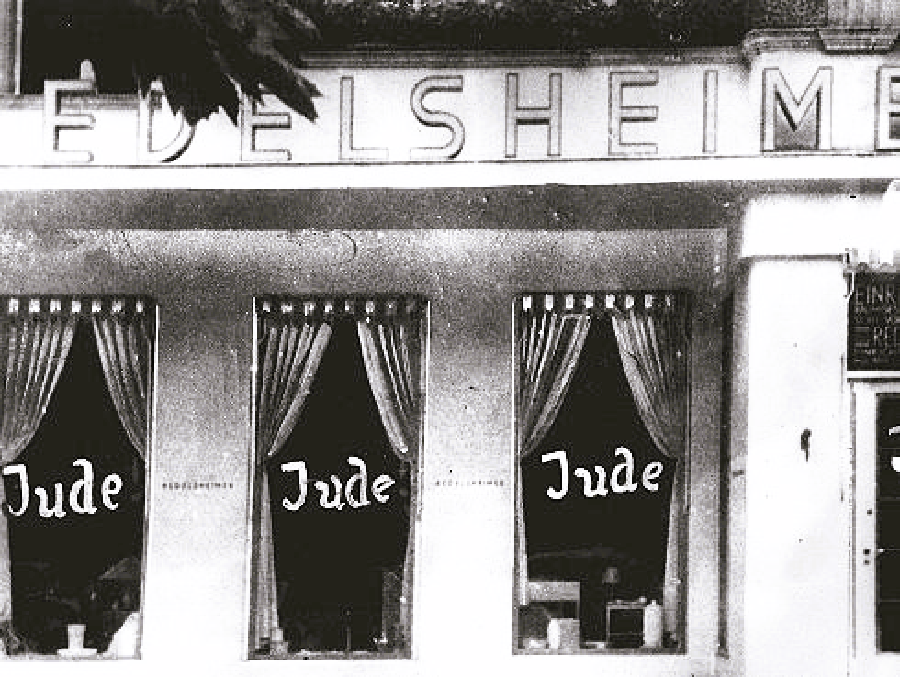
On November 12, 1938, the Nazi regime issued the Decree on the Elimination of Jews from Economic Life, marking another chilling step in its systematic campaign of persecution against Jewish people. This Decree sought to segregate Jews entirely from the German economy, forbidding them from owning businesses, selling goods and services, or engaging in trade. The legislation, which followed the violent anti-Jewish pogrom known as Kristallnacht (November 9–10, 1938), represented a critical escalation in the Nazis’ efforts to disenfranchise, isolate, and ultimately eliminate Jewish communities.
Background and Context
The Nazi Party had risen to power in 1933 on a platform steeped in anti-Semitism, promoting the exclusion of Jews from German society. Early measures, such as the Nuremberg Laws of 1935, stripped Jews of citizenship and prohibited intermarriage between Jews and non-Jews. These laws systematically institutionalized racial discrimination, but the Nazi regime continued to escalate its efforts to marginalize Jewish people economically, socially, and politically.
In November 1938, the Nazis orchestrated Kristallnacht. This nationwide pogrom that saw the destruction of synagogues, Jewish-owned businesses, and homes, as well as the arrest of tens of thousands of Jewish men. The violence left the Jewish community devastated, and the Decree on the Elimination of Jews from Economic Life served to capitalize on this terror, further stripping Jewish citizens of any semblance of independence or agency.
Provisions of the Decree
The Decree explicitly banned Jews from:
- Owning retail stores or mail-order businesses.
- Offering goods and services to the general public.
- Working as craftsmen, industrial workers, or in trades.
These provisions aimed to ensure that Jewish individuals could no longer participate in the German economy, rendering them entirely dependent on whatever limited resources they retained after the systematic expropriation of their property. Non-Jewish Germans were encouraged to take over businesses previously owned by Jews, often at prices far below market value—a process known as Aryanization.
Impact on the Jewish Community
The economic impact of the Decree was catastrophic. Already suffering from years of discrimination and boycotts, Jewish families now faced complete financial ruin. Many lost their homes, businesses, and livelihoods. Without the ability to work or earn a living, Jewish communities became increasingly vulnerable to state control and reliant on dwindling support from Jewish organizations and international aid.
Beyond the immediate material consequences, the Decree further marginalized Jewish people socially and psychologically. By erasing their presence from the public sphere, the Nazis sought to dehumanize Jews and isolate them from the broader population, making it easier to justify and carry out further atrocities.
A Prelude to the final solution
The Decree on the Elimination of Jews from Economic Life was not an isolated event but part of a broader strategy of persecution that culminated in the “Final Solution.” By eliminating Jews from the economy and confiscating their assets, the Nazi regime removed obstacles to the physical annihilation of the Jewish population. Without resources or social standing, Jewish communities became increasingly defenseless against the state’s genocidal ambitions.
The Decree on the Elimination of Jews from Economic Life exemplifies the calculated, bureaucratic approach the Nazi regime used to implement its ideology of hatred and exclusion. It not only devastated Jewish communities economically but also paved the way for the ultimate goal of the Holocaust: the complete eradication of Jewish life in Europe. By understanding this Decree within the broader context of Nazi policies, we gain insight into the mechanisms of systemic oppression and the importance of vigilance in preventing such atrocities from recurring.

Regulation for the Elimination of the Jews from the Economic
Life of Germany, November 12, 1938
On the basis of the Regulation for the implementation of the Four-Year Plan of October 18, 1936 (Reichsgesetzblatt, I, p. 887), the following is decreed:
§1
1) From January 1, 1939, Jews (§ 5 of the First Regulation to the Reich
Citizenship Law of November 14, 1935, Reichsgesetzblatt , I, p. 1333) are
forbidden to operate retail stores, mail-order houses, or sales agencies, or to carry on a trade [craft] independently.
2) They are further forbidden, from the same day on, to offer for sale goods or services, to advertise these, or to accept orders at markets of all sorts, fairs or exhibitions.
3) Jewish trade enterprises (Third Regulation to the Reich Citizenship Law of June 14, 1938 – Reichsgesetzblatt, I, p. 627) which violates this decree will be closed by the police.
§2
1) From January 1, 1939, a Jew can no longer be the head of an enterprise
within the meaning of the Law of January 20, 1934, for the Regulation of
National Work ( Reichsgesetzblatt, I, p. 45).
2) Where a Jew is employed in an executive position in a commercial
enterprise, he may be given notice to leave in six weeks. At the expiration of the term of the notice, all claims of the employee based on his contract, especially those concerning pension and compensation rights, become invalid.
§3
1) A Jew cannot be a member of a cooperative.
2) The membership of Jews in cooperatives expires on December 31, 1938. No special notice is required.
§4
The Reich Minister of Economy, in coordination with the Ministers concerned, is empowered to publish Regulations for the implementation of this decree. He may permit exceptions under the Law if these are required as the result of the transfer of a Jewish enterprise to non-Jewish ownership for the liquidation of a Jewish
enterprise or, in special cases, to ensure essential supplies.
Berlin, November 12, 1938
Plenipotentiary for the Four-Year Plan
Göering
Field Marshal General
Sources
Donation
Your readership is what makes my site a success, and I am truly passionate about providing you with valuable content. I have been doing this at no cost and will continue to do so. Your voluntary donation of $2 or more, if you are able, would be a significant contribution to the continuation of my work. However, I fully understand if you’re not in a position to do so. Your support, in any form, is greatly appreciated. Thank you. To donate, click on the credit/debit card icon of the card you will use. If you want to donate more than $2, just add a higher number in the box left from the PayPal link. Your generosity is greatly appreciated. Many thanks.
$2.00

 History of Sorts
Leave a comment