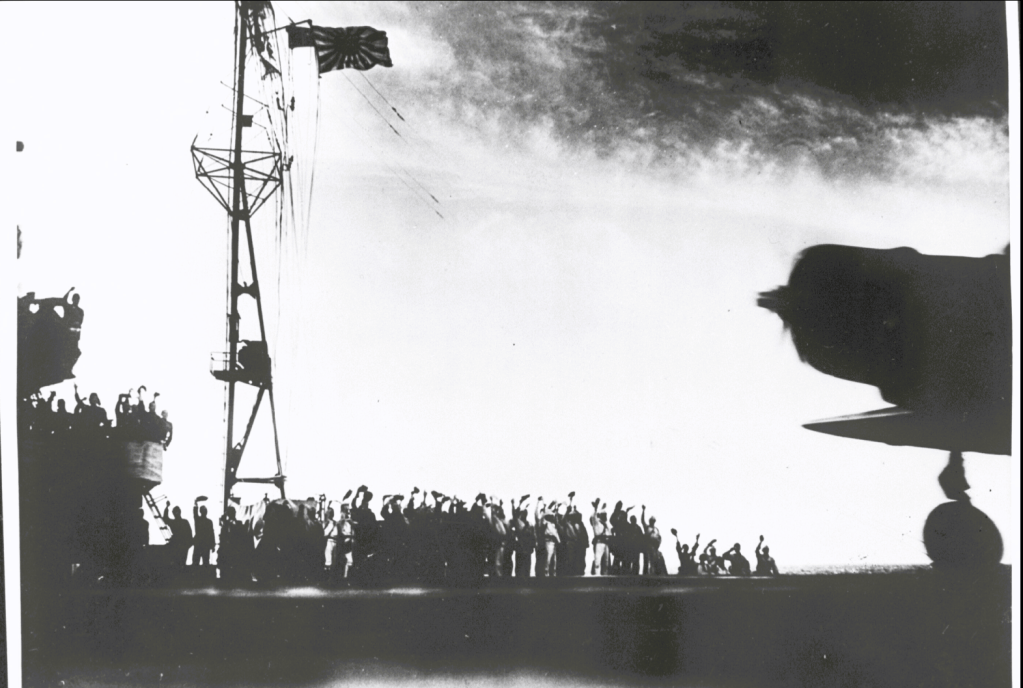
The attack on Pearl Harbor was a surprise military strike by the Japanese Imperial Navy Air Service on the United States naval base at Pearl Harbor, Hawaii, on December 7, 1941. The attack aimed to neutralize the U.S. Pacific Fleet as Japan pursued territorial expansion in Southeast Asia and the Pacific.
Key Details:
- Time and Execution: The attack began early in the morning, with over 350 Japanese aircraft, including bombers, fighters, and torpedo planes, launched from six aircraft carriers.
- Targets: The primary targets were U.S. battleships, aircraft, and other naval vessels docked at Pearl Harbor. Key airfields in the area were also bombed to prevent a counterattack.
- Damage:
- U.S. Losses: Over 2,400 Americans were killed, and more than 1,000 were wounded. The attack destroyed or damaged:
- Eight battleships (including the sinking of the USS Arizona and the capsizing of the USS Oklahoma).
- Numerous other ships and over 300 aircraft.
- Japanese Losses: Minimal in comparison—29 aircraft and five midget submarines were lost, with fewer than 100 personnel casualties.
- Impact:
- The attack led to the immediate entry of the United States into World War II, with President Franklin D. Roosevelt famously calling December 7th “a date which will live in infamy.”
- It galvanized American public opinion against Japan and its Axis allies, marking a turning point in U.S. foreign policy.
Despite its initial success, the attack failed to cripple the U.S. Navy completely, as aircraft carriers—key to modern naval warfare—were not in the harbor and major repair facilities were left intact. This oversight would play a critical role in the eventual U.S. victory in the Pacific.


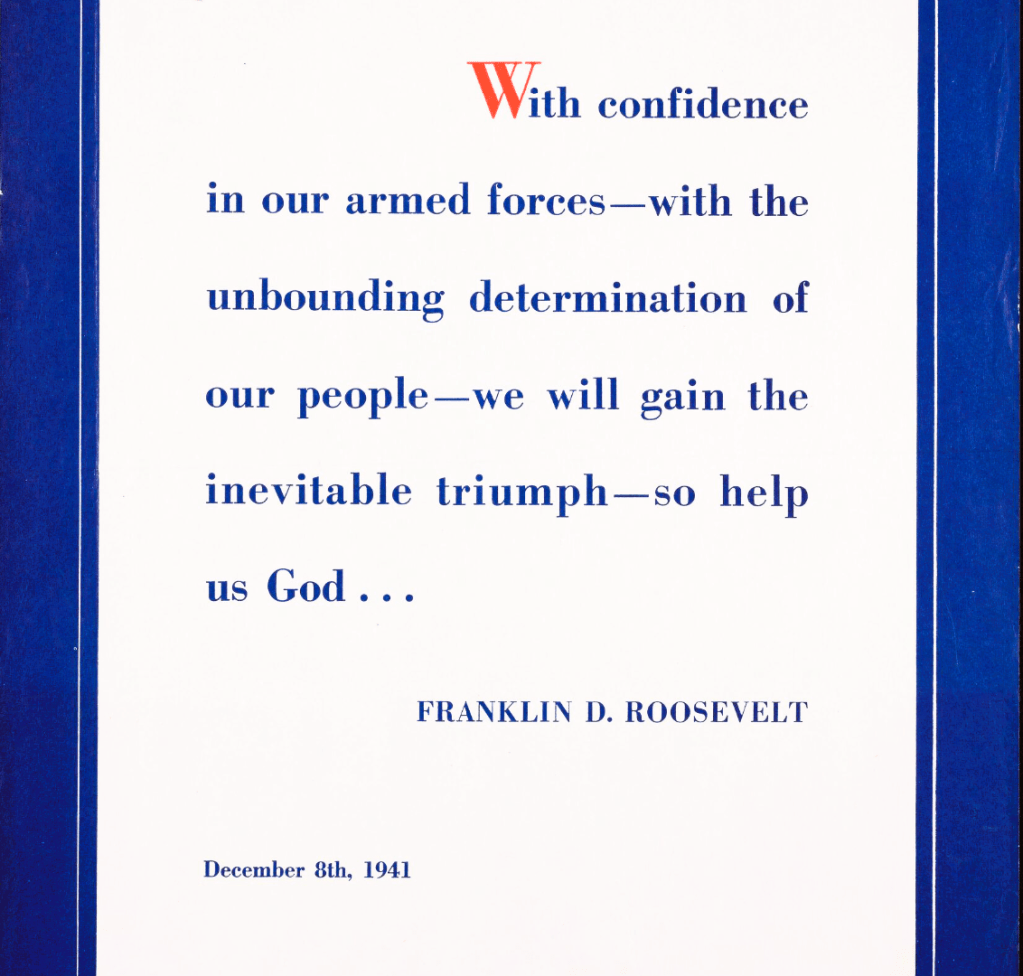
“With confidence in our armed forces – with the unbounding determination of our people – we will gain the inevitable triumph—So help us God.…”
The Japanese Context
From the Japanese perspective, the attack on Pearl Harbor was rooted in a combination of strategic, economic, and political factors that had been intensifying throughout the 1930s and early 1940s. Japan’s leaders viewed the attack as a calculated gamble to secure their empire’s survival and expansion in the face of increasing opposition, especially from the United States.
Historical Context:
- Imperial Ambitions:
- Japan sought to expand its influence in East Asia and the Pacific, motivated by the need for natural resources and markets to sustain its growing population and industrial economy.
- By the 1930s, Japan had occupied Manchuria (1931) and launched a full-scale war against China in 1937, leading to widespread condemnation, particularly from Western powers.
- Economic Pressures:
- The U.S. and its allies imposed economic sanctions to curb Japanese aggression. These included:
- A freeze on Japanese assets.
- An embargo on critical materials, most notably oil, upon which Japan’s military and economy heavily relied.
- Facing dwindling reserves, Japan saw the acquisition of resource-rich territories in Southeast Asia (such as the Dutch East Indies for oil and Malaya for rubber) as essential for survival.
- Strategic Calculations:
- Japan’s leadership, dominated by militarists, believed war with the U.S. was inevitable due to conflicting interests in the Pacific.
- Rather than wait for the U.S. to attack or build up further strength, Japan decided on a preemptive strike to disable the U.S. Pacific Fleet, allowing Japan free reign to consolidate its holdings in Asia.

Motivation for Pearl Harbor:
- Naval Doctrine:
- Japan modeled its naval strategy on the idea that destroying the enemy’s fleet in a decisive blow would yield strategic superiority.
- Pearl Harbor, the central hub of U.S. Pacific naval power, was an ideal target.
- Gambling on Quick Success:
- Japan hoped to deal such a devastating blow to American military power that the U.S. would negotiate a favorable peace rather than commit to a prolonged war.
- The attack was seen as a way to buy time to fortify its “Greater East Asia Co-Prosperity Sphere,” a concept Japan promoted as an Asian-led alternative to Western imperialism.
- Diplomatic Breakdown:
- Simultaneously, Japan was engaged in tense negotiations with the U.S., seeking to lift sanctions and avoid war.
- When these efforts failed—largely due to American demands for Japan to withdraw from China and Indochina—the militarists in Japan decided that military action was the only viable path forward.
Perception and Consequences in Japan:
- Initial Optimism:
- The successful attack on December 7, 1941, was celebrated in Japan as a stunning victory. It was seen as evidence of Japanese ingenuity, daring, and naval prowess.
- Propaganda hailed the attack as a righteous blow against Western imperialism and a step toward liberating Asia from Western domination.
- Underestimating U.S. Resolve:
- Japanese leaders misjudged American reaction, believing that the U.S. would prioritize the war in Europe or negotiate peace rather than engage in a total war in the Pacific.
- This miscalculation proved to be a critical error, as the attack unified American public opinion and fueled a determined U.S. war effort.
- The Long-Term Gamble:
- Japan achieved initial success in the Pacific but failed to secure a quick or decisive victory.
- The attack on Pearl Harbor, far from ensuring Japan’s dominance, ultimately led to its downfall as it awakened the industrial and military might of the United States.
Sources
https://www.nationalww2museum.org/war/topics/pearl-harbor-december-7-1941
https://en.wikipedia.org/wiki/Attack_on_Pearl_Harbor
https://www.history.com/topics/world-war-ii/pearl-harbor
https://www.defense.gov/multimedia/experience/remembering-pearl-harbor/
Donations
Your readership is what makes my site a success, and I am truly passionate about providing you with valuable content. I have been doing this at no cost and will continue to do so. Your voluntary donation of $2 or more, if you are able, would be a significant contribution to the continuation of my work. However, I fully understand if you’re not in a position to do so. Your support, in any form, is greatly appreciated. Thank you. To donate, click on the credit/debit card icon of the card you will use. If you want to donate more than $2, just add a higher number in the box left from the PayPal link. Your generosity is greatly appreciated. Many thanks.
$2.00

 History of Sorts
Leave a comment