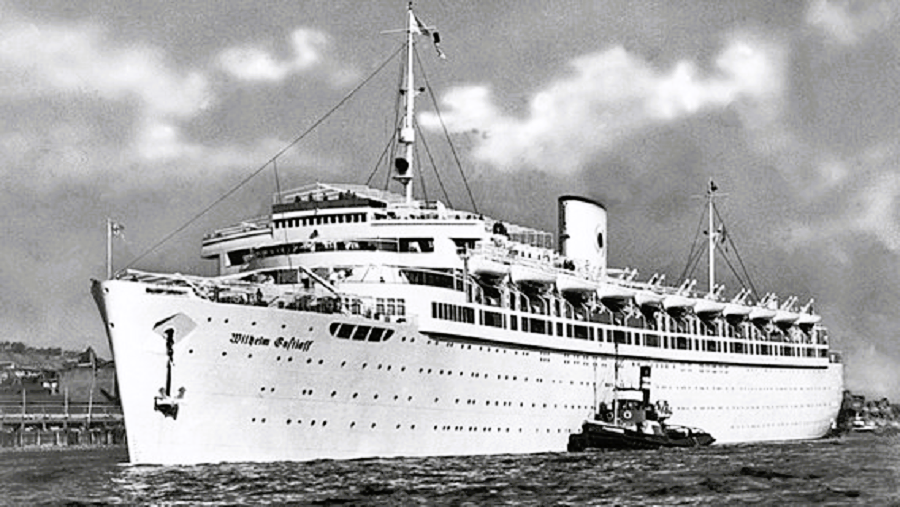
The sinking of the Titanic may be history’s most infamous maritime disaster and the torpedoing of the Lusitania, the most notorious wartime naval tragedy. Yet, both—with death tolls of approximately 1,500 and 1,200, respectively—are overshadowed by the fate of the MV Wilhelm Gustloff. On January 30, 1945, the German ocean liner was struck by torpedoes from the Soviet submarine S-13, killing an estimated 9,343 people, most of them civilians fleeing the advancing Red Army—including nearly 5,000 children. It remains the deadliest maritime sinking in history.
Originally built as a luxury cruise liner for the Nazi Kraft durch Freude (Strength Through Joy) organization in 1937, the Wilhelm Gustloff was later requisitioned by the Kriegsmarine (German Navy) in 1939. It first served as a hospital ship (1939–1940) before being repurposed as a floating barracks in Gdynia (Gotenhafen). In early 1945, it was assigned to evacuate refugees, Nazi officials, and military personnel as Soviet forces closed in.
On that frigid January evening, the Wilhelm Gustloff—designed to carry a maximum of 1,880 passengers and crew—was crammed with over 10,000 people. Among them were 4,000 infants, children, and youths seeking safety in the West. As the ship left the Oxhöft Pier in subzero temperatures (−18°C / 0°F), it became a prime target. Just hours into its journey, three Soviet torpedoes struck, sealing its fate.
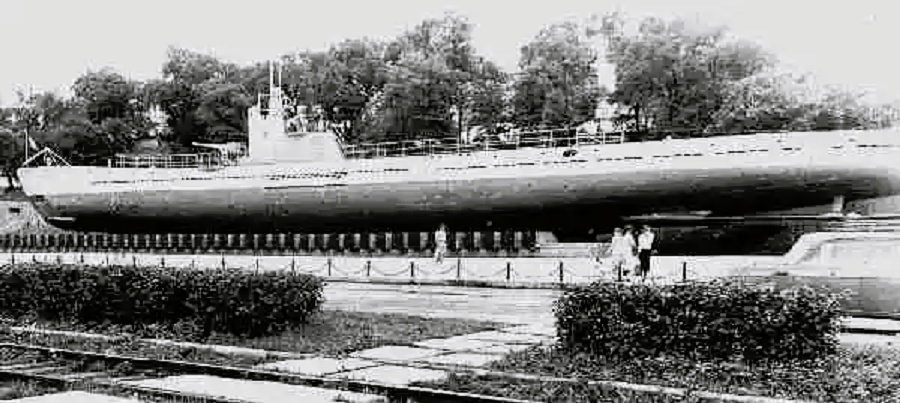
The disaster claimed more lives than any other single ship sinking in history. The MV Wilhelm Gustloff’s tragic end remains one of World War II’s lesser-known yet most catastrophic maritime losses.
In the summer of 1939, the Wilhelm Gustloff was requisitioned to bring the Condor Legion back from Spain after the Nationalist forces, led by General Francisco Franco, emerged victorious in the Spanish Civil War.
From September 1939 to November 1940, the ship served as a hospital ship under the designation Lazarettschiff D. On November 20, 1940, the medical equipment was removed, and the ship was repainted from its hospital ship colors of white with a green stripe to standard naval grey. Due to the British blockade of the German coastline, the Wilhelm Gustloff was repurposed as an accommodation ship (barracks) for about 1,000 U-boat trainees from the 2nd Submarine Training Division (2. Unterseeboot-Lehrdivision) in the German-occupied port of Gdynia, which had been renamed Gotenhafen near Danzig.
In 1942, the Wilhelm Gustloff was used as a stand-in for the RMS Titanic in a German film about the disaster, filmed in Gotenhafen, with members of the 2nd Submarine Training Division acting as extras. The ship sat idle for over four years before being put back into service to transport civilians and military personnel as part of Operation Hannibal.
Operation Hannibal was the naval evacuation of German forces and civilians from Courland, East Prussia, and Danzig-West Prussia as the Red Army advanced. The MV Wilhelm Gustloff’s final voyage aimed to evacuate German refugees, military personnel, and technicians working at advanced weapon bases in the Baltic, transporting them from Gdynia (then Gotenhafen) to Kiel.
Official records listed 6,050 people aboard, but this figure did not account for many civilians who boarded without being registered. Heinz Schön, a German archivist and survivor of the Wilhelm Gustloff sinking, estimated the total number of passengers and crew to be 10,582. This included 173 naval auxiliaries, 918 officers and men from the 2nd Submarine Training Division, 373 female naval auxiliaries, 162 wounded soldiers, and 8,956 civilians, of whom about 5,000 were children. The ship was severely overcrowded, and many passengers defied orders not to remove their life jackets due to the oppressive heat and humidity.
The ship departed Gotenhafen on January 30, 1945, accompanied by the passenger liner Hansa (also filled with civilians and military personnel) and two torpedo boats. However, Hansa and one of the torpedo boats encountered mechanical issues and could not continue, leaving Wilhelm Gustloff with just one escorting torpedo boat, the Löwe.
There were four captains aboard the Wilhelm Gustloff (the ship’s captain, two merchant marine captains, and the captain of the U-boat contingent) who failed to agree on the best course of action to avoid submarine attacks. Against the advice of military commander Lieutenant Commander Wilhelm Zahn (who recommended staying close to shore in shallow waters and avoiding lights), Captain Friedrich Petersen opted for deep waters, which were known to be clear of mines. When he received a mysterious radio message about an approaching German minesweeper convoy, Petersen activated the ship’s red and green navigation lights to avoid a collision, inadvertently making the Wilhelm Gustloff an easy target for Soviet submarines.
The ship was not protected under international accords as a hospital ship since it was not officially designated as one, and it was transporting military personnel. As a result, the MV Wilhelm Gustloff was vulnerable to attack.
At around 21:00 CET, the Soviet submarine S-13, commanded by Captain Alexander Marinesko, sighted the ship.
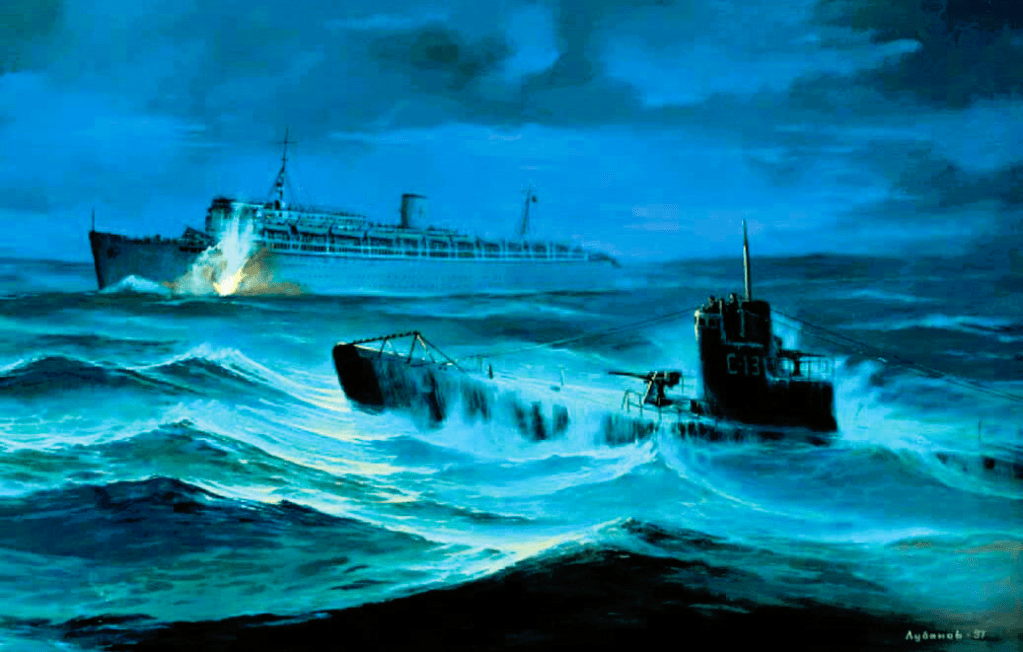
After trailing the vessels for two hours, S-13 launched three torpedoes at the Wilhelm Gustloff, hitting it on the port side about 30 km (16 nautical miles) offshore between Großendorf and Leba. The torpedo strike was devastating: the first hit sealed off the bow, where many of the crew were sleeping; the second hit the women’s naval auxiliary accommodations in the drained swimming pool, killing nearly all 373 women there; and the third torpedo struck the engine room, cutting off all power and communications.
In the chaos, only one lifeboat was successfully lowered; the rest had either frozen in their davits or capsized. The freezing Baltic Sea waters, with temperatures around 4 °C (39 °F), combined with the air temperature of −18 to −10 °C (0 to 14 °F) and ice floes, made survival impossible for most. Many drowned, were crushed in the panic or succumbed to exposure in the icy waters. The ship sank in less than 40 minutes, capsizing and lying on its side in 44 meters (144 feet) of water.
German forces were able to rescue 1,252 survivors, with various ships and boats involved in the operation, including torpedo boats T-36 and Löwe, and the minesweepers M387, M375, and M341. However, the sinking remains the deadliest single-ship disaster in history, with over 9,000 lives lost.
While all four captains survived, an official naval inquiry was conducted into Captain Wilhelm Zahn’s responsibility, but its conclusion was never reached due to the collapse of Nazi Germany. The incident remains one of the most tragic results of the war, with Wilhelm Gustloff standing as a somber reminder of the horrors of conflict.
Soviet propaganda falsely labeled the women aboard as “SS personnel from the German concentration camps,” but in reality, they were 373 female naval auxiliaries. On February 10, 1945, just 11 days after the sinking, the Soviet submarine S-13 sank another German ship, General von Steuben, killing around 3,000 people.
Captain Marinesko was awarded the Order of the Red Banner for his role in the sinking despite facing a court martial due to alcohol issues. However, he was dishonorably discharged in 1945, later reinstated in 1960, and posthumously awarded the title of Hero of the Soviet Union in 1990 by Mikhail Gorbachev.
Sources
https://www.britannica.com/topic/MV-Wilhelm-Gustloff
https://en.wikipedia.org/wiki/MV_Wilhelm_Gustloff
https://www.nationalww2museum.org/war/articles/sinking-wilhelm-gustloff
Donations
Your readership is what makes my site a success, and I am truly passionate about providing you with valuable content. I have been doing this at no cost and will continue to do so. Your voluntary donation of $2 or more, if you are able, would be a significant contribution to the continuation of my work. However, I fully understand if you’re not in a position to do so. Your support, in any form, is greatly appreciated. Thank you. To donate, click on the credit/debit card icon of the card you will use. If you want to donate more than $2, just add a higher number in the box left from the PayPal link. Your generosity is greatly appreciated. Many thanks.
$2.00
 History of Sorts
Leave a comment