
Under the Nazi regime, Jewish people were forced to wear identifying markers, such as armbands or badges in the shape of the Star of David. This measure aimed to reinforce Nazi ideology by visibly distinguishing Jewish people from the rest of the population. These identifiers facilitated isolation, harassment, and humiliation, further embedding systemic persecution.
Origins
The Magen David, meaning “Shield of David” in Hebrew, is commonly known as the Star of David. Composed of two overlapping equilateral triangles, it has held deep significance in Judaism since the late Middle Ages and is one of the religion’s most recognizable symbols. Despite its sacred meaning, the Nazis repurposed it as a tool of oppression.
After the Rise of Nazism
From 1938 onward, all Jewish prisoners in Nazi concentration camps were required to sew onto their uniforms a distorted version of the Star of David. These badges visually classified Jewish individuals, distinguishing them from other prisoner categories, such as political detainees. The Jewish identifier was yellow and had to be prominently displayed. Other prisoner groups were marked with colored triangles; for example, if a prisoner was both Jewish and homosexual, the lower triangle remained yellow while the upper triangle was pink, denoting both classifications.
Across Nazi-Occupied Territories
The Nazi regime systematically mandated Jewish identifiers across occupied Europe.
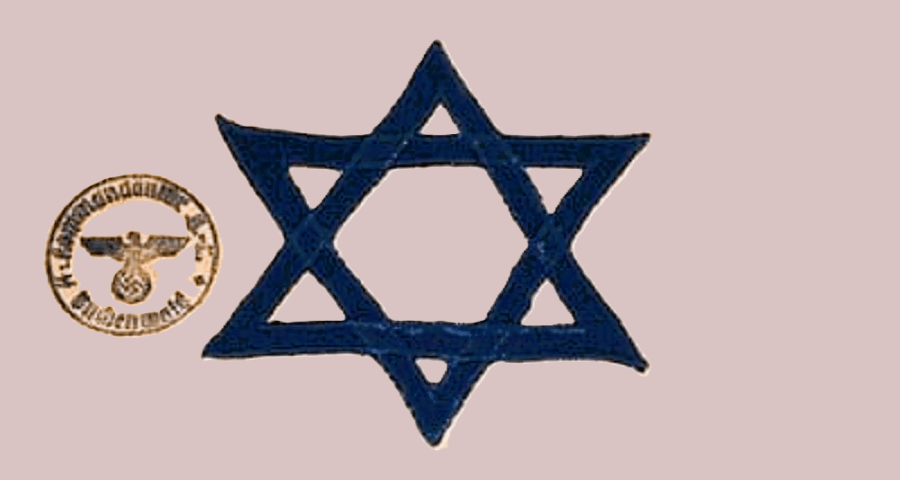
- Poland (1939): After the invasion in September, Jewish-owned shops were marked. On November 23, 1939, Governor-General Hans Frank decreed that, from December, all Jewish individuals over the age of 12 had to wear a four-inch-wide white armband featuring a blue Star of David.
- Bulgaria (1941): Jewish people were required to wear a small yellow star-shaped button stitched with yellow thread. Resistance to anti-Jewish laws led to the adoption of buttons instead of larger fabric badges. Enforcement was the responsibility of the Bulgarian Commissariat for Jewish Affairs (KEV). Due to slow production, by November 1942, only a limited number of identifiers had been manufactured. Some Jewish individuals crafted badges featuring images of Bulgaria’s royal family, as King Boris III opposed Nazi restrictions and sought to protect Jewish citizens.
- Croatia (1941): In the Independent State of Croatia, from June 4, Jewish people were required to wear badges marked with “ž,” derived from “Židov,” the Croatian word for Jew.
- Baltic States (1941): Hinrich Lohse, Reichskommissar for Ostland (covering Estonia, Latvia, and Lithuania), issued orders in Kovno on July 27, 1941, forcing Jewish individuals to wear a yellow star on both the left side of the chest and the middle of the back.
- Romania (1941-1942): The requirement was first introduced in the occupied territory of Bukovina in July 1941, later extending to other regions.
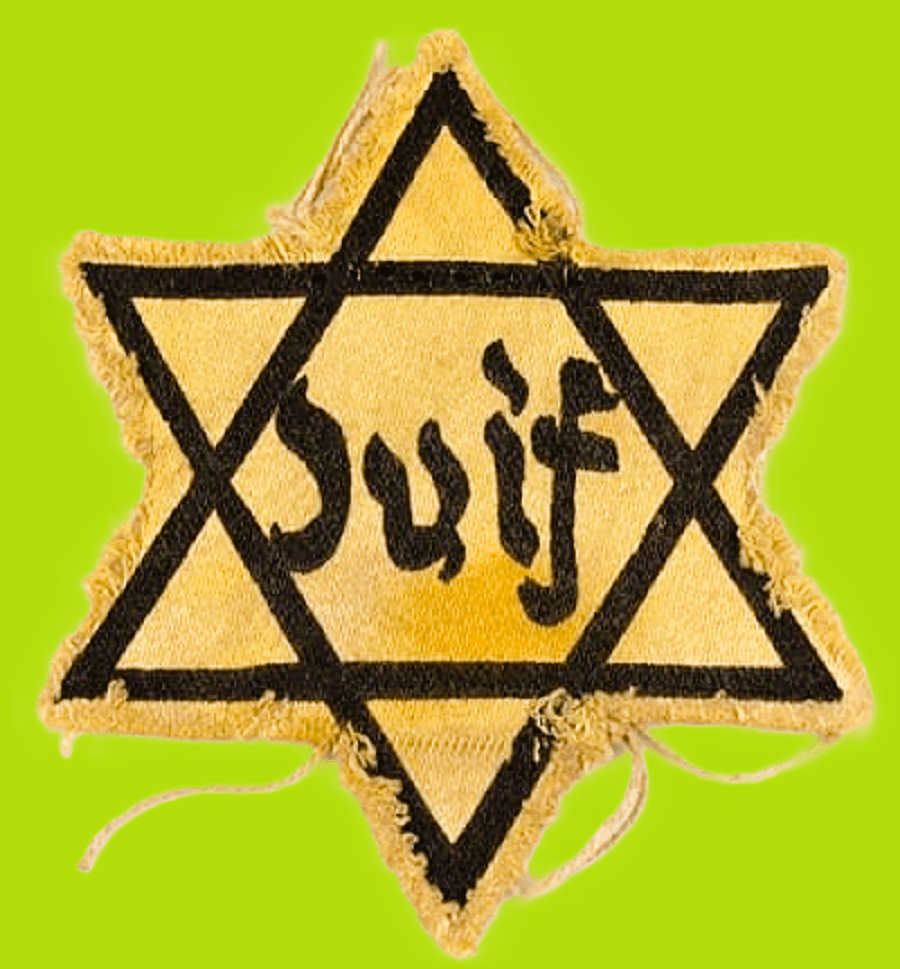
- Western Europe: Luxembourg, Slovakia, and the Netherlands enforced mandatory yellow stars in September 1941, May 1942, and April 29, 1942, respectively. Dutch newspapers published the decree requiring all Jewish individuals over the age of six to wear the identifier, specifying its size, location, and the inclusion of the word “Jew” in Dutch.
- Belgium and France (1942): Belgium enforced the identifier from June 3, while France mandated its use on June 7. The French version bore the words “Juif” (Jew) or “Juive” (Jewess).
- Hungary (1944): Although pressured by the Nazis to introduce yellow stars in December 1942, the Hungarian government only enacted the order on March 29, 1944, after the German occupation. Due to the large Jewish population, individuals were forced to make stars from any available yellow fabric.
- Greece (1943): The Jewish community of Salonika was ordered to wear the yellow star from February 6, 1943.
Enforcement and Production
On September 1, 1941, the Nazis issued the Police Regulation on the Labeling of Jews.
- Section 1 mandated that Jewish individuals over the age of six could not appear in public without wearing a Jewish star, specifying its size, shape, color, and placement.
- Section 4 set fines at 150 Reichsmarks for violations but also allowed for harsher punishments, including imprisonment, beatings, and execution.
- Section 5 extended enforcement to the Protectorate of Bohemia and Moravia, as well as Western Poland (Warthegau).
Reinhard Heydrich, a key architect of the Holocaust, had initially proposed Jewish badges following Kristallnacht in 1938. The Jewish population itself was forced to bear the cost and responsibility of producing and distributing the identifiers. Noncompliance resulted in severe consequences, including death.
Resistance and Solidarity
Despite widespread enforcement, there were acts of defiance and solidarity:
- Romania: Resistance delayed the implementation of Jewish badges in much of the pre-World War I Romanian territories, except for Moldavia, where Jewish people were forced to wear them in 1944.
- Denmark: Danish Jewish people were never compelled to wear badges due to strong resistance from both the public and King Christian X. A famous but unverified story claims the king stated he would be the first to wear a Jewish star if they were imposed.
- France and the Netherlands: Some Jewish individuals refused to comply, while non-Jewish individuals wore the badges in solidarity. In France, yellow became a popular fashion color in protest. In the Netherlands, an underground newspaper printed 300,000 yellow stars with the slogan “Jews and non-Jews are one and the same” on May 1, 1942.
The Dutch stars were manufactured in Enschede by the textile factory De Nijverheid. This Jewish family business operated under a non-Jewish administrator (Aryan Verwalter) appointed by the German occupiers, in this case, a German. A total of 569,355 stars were produced. The stars cost 4 cents each, and additionally, a textile ration coupon had to be surrendered. The penalty for not wearing the star was “six months’ detention or a fine of one thousand guilders
Psychological and Social Impact
The forced wearing of Jewish identifiers had devastating psychological and social effects. Jewish people faced daily public humiliation and isolation. In many places, such as Poland, where punishments were severe, compliance was nearly universal. Diaries from the era reveal sorrow, shame, and anger over the requirement. In Germany, the implementation of the badges coincided with a sharp increase in suicide rates among Jewish individuals.
The Nazi-imposed identifiers served as a visible step toward mass deportation and genocide. The widespread enforcement of these measures across occupied Europe remains a stark reminder of the systematic dehumanization that preceded the Holocaust.
aources
https://www.holocaust.org.uk/star-of-david-identifiers
https://www.holocaust.org.uk/pages/category/artefact?Take=100
https://nl.wikipedia.org/wiki/Jodenster
Please support us so we can continue our important work.
Donation
Your readership is what makes my site a success, and I am truly passionate about providing you with valuable content. I have been doing this at no cost and will continue to do so. Your voluntary donation of $2 or more, if you are able, would be a significant contribution to the continuation of my work. However, I fully understand if you’re not in a position to do so. Your support, in any form, is greatly appreciated. Thank you. To donate, click on the credit/debit card icon of the card you will use. If you want to donate more than $2, just add a higher number in the box left from the PayPal link. Your generosity is greatly appreciated. Many thanks.
$2.00

 History of Sorts
Leave a reply to tzipporahbatami Cancel reply