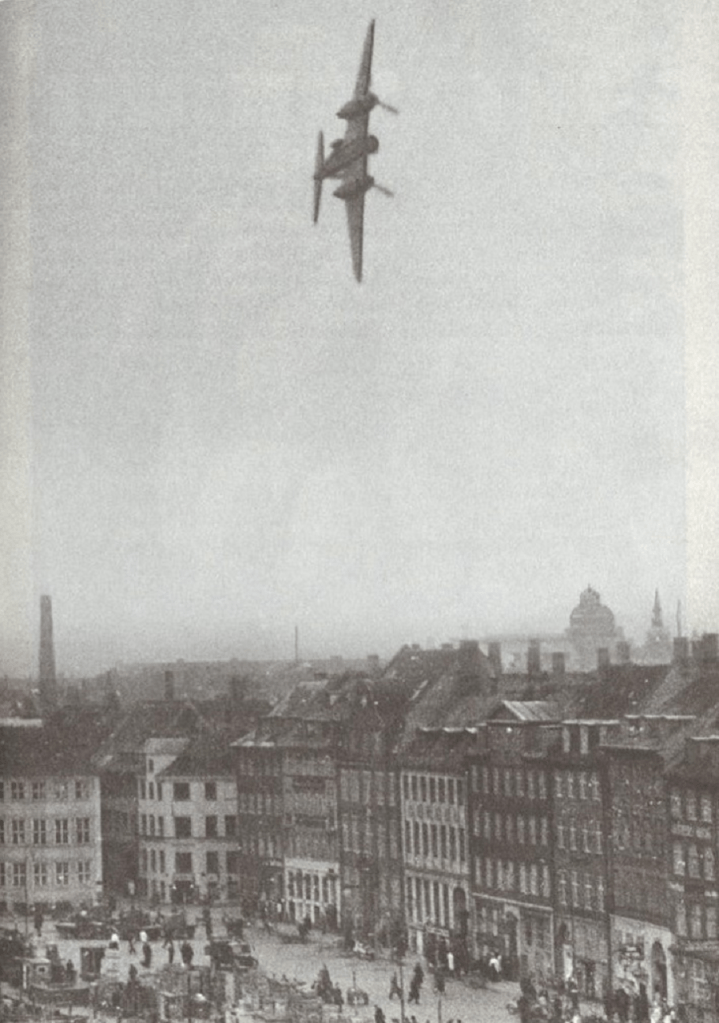
Operation Carthage was a British air raid conducted during World War II on March 21, 1945. The target of the raid was the Shellhus building in Copenhagen, Denmark, which housed the Gestapo headquarters. This operation was executed by the Royal Air Force (RAF) to support the Danish resistance movement by destroying German intelligence records and freeing imprisoned members of the resistance. Though largely successful in its primary goal, the operation also resulted in unintended civilian casualties, making it one of the most controversial air raids of the war.
Background and Planning
By early 1945, Nazi Germany was weakening, but the Gestapo in occupied Denmark remained a formidable force. The Shellhus building in central Copenhagen was a crucial site for the Gestapo, containing vital intelligence records, as well as a prison for resistance fighters. Danish resistance groups requested British assistance to eliminate this threat, leading to the planning of Operation Carthage.
The RAF’s No. 2 Group was assigned the mission, specifically 21 Squadron, 464 Squadron (Royal Australian Air Force), and 487 Squadron (Royal New Zealand Air Force), all part of the 2nd Tactical Air Force. The operation was meticulously planned, with the attack designed to be precise and swift to minimize collateral damage.
Execution of the Raid
The raid was carried out by de Havilland Mosquito fighter-bombers, known for their speed and agility. The attack was executed in three waves, each aiming to drop bombs on different sections of the Shellhus.
The first wave successfully struck the building, setting it ablaze and causing significant destruction to the Gestapo offices and records. The second wave further damaged the structure, ensuring its near-total collapse. However, during the attack, one aircraft was hit by anti-aircraft fire and crashed near a school, the Institut Jeanne d’Arc, leading to tragic unintended consequences.

Consequences and Impact
The raid achieved its primary goal—destroying the Gestapo headquarters and freeing numerous Danish resistance fighters. Many intelligence records were lost, significantly disrupting German operations in Denmark. The attack was seen as a major victory for the Danish resistance and their British allies.
However, the mission also resulted in the deaths of 125 civilians, including 86 schoolchildren and staff at the Institut Jeanne d’Arc. The accident occurred when some pilots, disoriented by the initial crash, mistakenly bombed the school instead of their intended target. This unintended tragedy overshadowed the military success of the raid.

Legacy and Historical Significance
Operation Carthage remains a debated topic in military history. While it effectively crippled the Gestapo’s influence in Denmark, the heavy civilian casualties have made it a subject of ethical scrutiny. It exemplifies the risks and consequences of wartime air raids, highlighting the fine balance between military necessity and collateral damage.
In Denmark, the event is commemorated with solemn remembrance for both the resistance fighters who were saved and the innocent lives lost. The operation also serves as a reminder of the complex nature of war, where even the most carefully planned missions can lead to unintended consequences.
Ultimately, Operation Carthage stands as a powerful example of the sacrifices and difficult choices made during World War II, reflecting both the bravery of those who fought against oppression and the enduring sorrow of wartime tragedies.
sources
https://en.wikipedia.org/wiki/Operation_Carthage
https://www.iwm.org.uk/collections/item/object/205229985
Donation
Your readership is what makes my site a success, and I am truly passionate about providing you with valuable content. I have been doing this at no cost and will continue to do so. Your voluntary donation of $2 or more, if you are able, would be a significant contribution to the continuation of my work. However, I fully understand if you’re not in a position to do so. Your support, in any form, is greatly appreciated. Thank you. To donate, click on the credit/debit card icon of the card you will use. If you want to donate more than $2, just add a higher number in the box left from the PayPal link. Your generosity is greatly appreciated. Many thanks.
$2.00


 History of Sorts
Leave a reply to tzipporahbatami Cancel reply