
The Rwandan Genocide, which took place over a horrifying span of 100 days from April 7 to July 19 1994, stands as one of the most brutal and rapid genocides in modern history. An estimated 800,000 to 1 million Tutsi and moderate Hutu were slaughtered in a planned campaign of mass murder orchestrated by the Hutu-led government and executed by militias, the military, and even ordinary citizens. This genocide was not only a result of long-standing ethnic tensions but also a failure of the international community to act decisively in the face of impending atrocity.
Historical Background
To understand how such a tragic event could occur, the Rwandan Genocide must first be viewed as a consequence of Belgian colonialism. Under colonial rule, Rwanda’s ethnic groups—Hutu, Tutsi, and Twa—were rigidly racialized. The colonial administration institutionalized these identities and linked them to access to political power, laying the groundwork for future ethnic tensions. When Rwanda gained independence in 1962, political control shifted to the Hutu majority. This transition led to systemic discrimination against the Tutsi minority, creating the conditions that would ultimately culminate in the 1994 genocide.
Furthermore, the genocide must be contextualized within the broader backdrop of civil war. In 1990, a conflict erupted between the Rwandan government forces and the Rwandan Patriotic Front (RPF), a rebel group composed largely of Tutsi exiles based in Uganda. The civil war fueled anti-Tutsi sentiment, and government-led propaganda increasingly portrayed Tutsis as internal enemies and traitors. The situation escalated dramatically in April 1994, when President Juvénal Habyarimana’s plane was shot down. This event served as the catalyst for a meticulously orchestrated campaign of mass violence, during which approximately 800,000 Tutsi and moderate Hutu were brutally killed.
The genocide triggered a profound humanitarian crisis that continues to affect the Great Lakes region today. The international community’s failure to intervene has left a lasting mark on the credibility of United Nations peacekeeping efforts and stands as a stark reminder of the consequences of global inaction.
Tensions escalated in the early 1990s as the Rwandan Patriotic Front (RPF), a rebel group composed mostly of Tutsi exiles, launched an invasion from Uganda. This fueled fear among Hutu extremists that the Tutsis were trying to regain control. These extremists began to plan for what they called a “final solution” to the Tutsi “problem.”
The Genocide
The assassination of President Juvénal Habyarimana on April 6, 1994, when his plane was shot down under mysterious circumstances, served as the spark for the genocide. Hutu extremists immediately launched a well-organized campaign to eliminate Tutsis and moderate Hutus. Radio broadcasts from the infamous Radio Télévision Libre des Mille Collines (RTLM) encouraged citizens to kill their Tutsi neighbors, framing the slaughter as an act of self-defense and national loyalty.
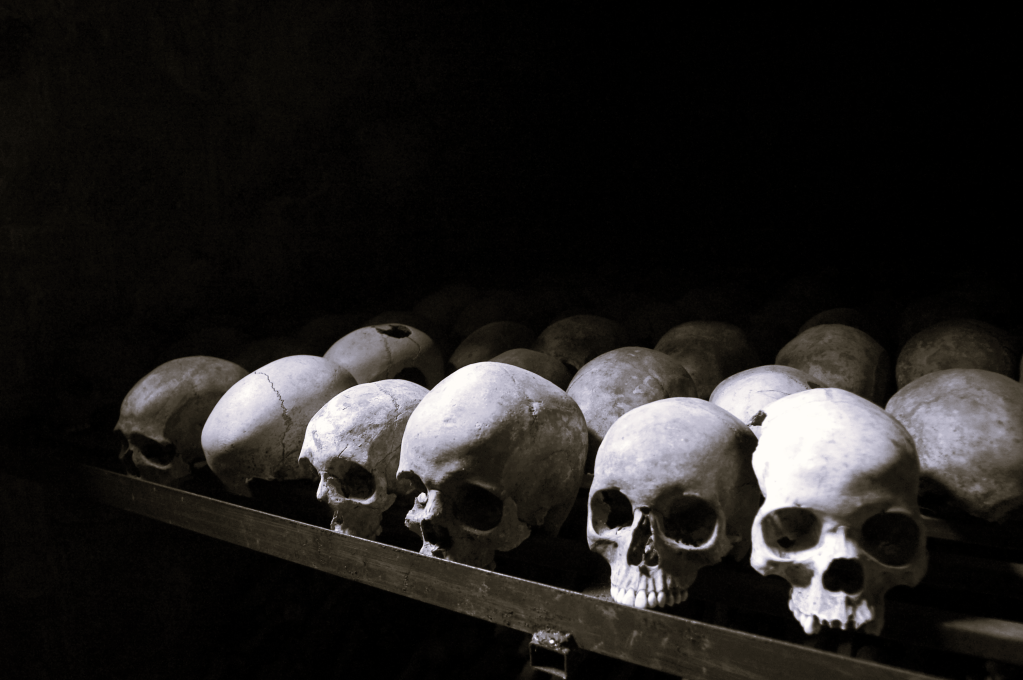
Killings were carried out with shocking speed and brutality, often using machetes and clubs. Entire communities were wiped out, and even churches—usually considered sanctuaries—became sites of mass murder. Women were systematically raped, and children were not spared. The genocide was characterized by an appalling level of participation by civilians, as the social fabric of the nation disintegrated under the weight of propaganda, fear, and hatred.
International Inaction
The international community’s response to the Rwandan Genocide has been widely condemned as grossly inadequate. Despite clear warnings from humanitarian groups and on-the-ground United Nations (UN) peacekeepers, the UN failed to increase its peacekeeping force or take decisive action. Western powers, including the United States and Belgium, hesitated to intervene, reluctant to engage in another African conflict so soon after the debacle in Somalia.
As a result, the genocide continued largely unchallenged until the RPF, led by Paul Kagame, captured Kigali and overthrew the genocidal regime in July 1994. By then, the human cost was catastrophic.
Aftermath and Legacy
The aftermath of the genocide left Rwanda devastated—physically, emotionally, and socially. Millions of people were displaced, and the country’s economy and infrastructure were in ruins. The Rwandan government, under Kagame, focused on rebuilding the nation through justice and reconciliation initiatives, including the Gacaca court system, designed to deal with the immense number of genocide-related cases.
The genocide also led to major reforms within the UN, especially regarding peacekeeping missions and the concept of the “Responsibility to Protect” (R2P). It highlighted the dangers of ethnic hatred, unchecked propaganda, and international indifference, leaving a lasting lesson on the need for vigilance and timely intervention in the face of mass atrocities.
Sources
https://www.bbc.com/news/world-africa-26875506
https://cla.umn.edu/chgs/holocaust-genocide-education/resource-guides/rwanda
https://www.un.org/en/preventgenocide/rwanda/historical-background.shtml
Donation
Your readership is what makes my site a success, and I am truly passionate about providing you with valuable content. I have been doing this at no cost and will continue to do so. Your voluntary donation of $2 or more, if you are able, would be a significant contribution to the continuation of my work. However, I fully understand if you’re not in a position to do so. Your support, in any form, is greatly appreciated. Thank you. To donate, click on the credit/debit card icon of the card you will use. If you want to donate more than $2, just add a higher number in the box left from the PayPal link. Your generosity is greatly appreciated. Many thanks.
$2.00
 History of Sorts
Leave a comment