
On the night of May 31, 1941, during the height of World War II, the city of Dublin, capital of neutral Ireland, was shaken by an unexpected and deadly event: a German Luftwaffe air raid that killed 28 people and left nearly 100 injured. This bombing, which occurred in the North Strand area, has remained one of the most shocking incidents of the war for the Irish people—a violent rupture in Ireland’s carefully maintained neutrality.
Context: Irish Neutrality in World War II
Ireland, under the leadership of Taoiseach Éamon de Valera, chose to remain neutral during the Second World War. This policy of neutrality, referred to domestically as “The Emergency,” was rooted in Ireland’s complex historical relationship with Britain and a desire to assert its sovereignty and independence. Despite geographical proximity and some covert cooperation with the Allies, Ireland was not officially aligned with either side in the global conflict. This position helped the country avoid the destruction experienced by many European nations but also placed it in a diplomatically sensitive position.
The Night of the Bombing
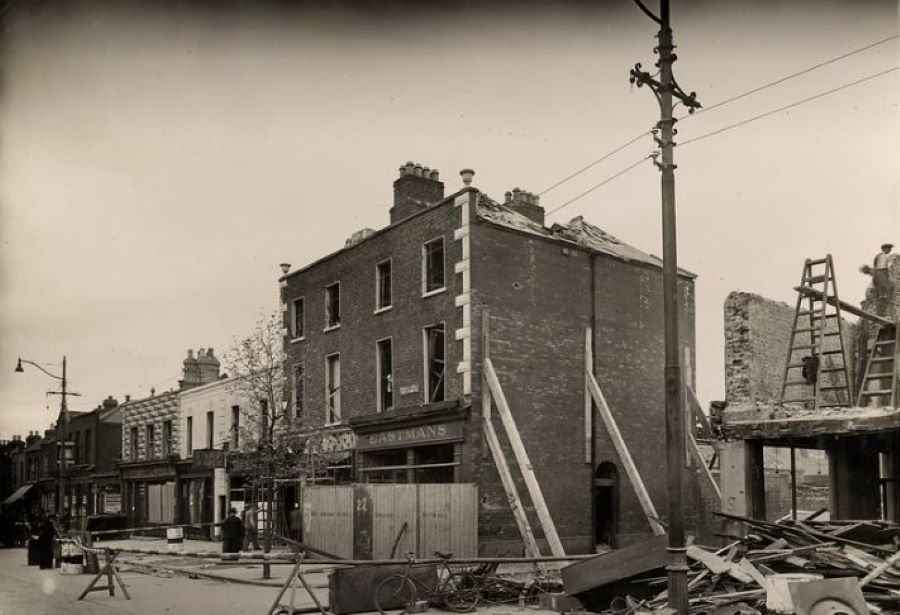
In the early hours of May 31, 1941, several bombs were dropped on Dublin by German aircraft. The most severe damage occurred in the North Strand district, a working-class neighborhood. Four bombs struck the area, destroying approximately 300 houses, damaging many more, and leaving hundreds homeless. The death toll reached 28, and around 90 people were injured, many seriously. The blast was so powerful that it left a crater and obliterated entire buildings.
Panic and confusion spread quickly. Emergency services, ill-prepared for such a calamity in a neutral city, struggled to cope with the scale of the destruction. Volunteers and local residents played a vital role in rescue efforts, helping to search through the rubble for survivors and assist the wounded.

Reasons and Theories
The motives behind the Luftwaffe raid have been the subject of debate and speculation. Germany issued an official apology, claiming that the bombing was accidental—attributed to navigational error during an intended raid on Belfast in Northern Ireland, which had been heavily targeted by the Luftwaffe in April and May 1941. Some historians have accepted this explanation, pointing to poor weather, malfunctioning equipment, or pilot disorientation.
However, others have argued that the attack might have been deliberate—a warning to Ireland for its alleged cooperation with Britain, including allowing Allied aircraft to use Irish airspace and sharing weather reports with the Allies. Some British and Irish sources from the time suggested that the Germans were expressing dissatisfaction with Ireland’s assistance to the UK, despite its stance of neutrality.
The Aftermath
The Irish government protested the bombing formally, and in a rare move, Germany later offered compensation of £327,000 to the victims and for the rebuilding of damaged infrastructure. While this payment was seen as an acknowledgment of responsibility, it did not erase the trauma or the sense of violation felt by the Irish public.
In Ireland, the bombing sparked fear and renewed debates about the nation’s neutral stance. It also fostered a greater sense of solidarity and unity among the Irish people. Emergency services were reviewed, air raid precautions improved, and public awareness of the war’s proximity intensified. De Valera visited the bombed area and expressed sorrow and resolve, reinforcing the government’s determination to maintain neutrality while preparing more earnestly for any future threats.
The North Strand bombing remains a poignant chapter in Irish history. It represents the harsh reality that, even in neutrality, no nation is entirely safe from the reach of global conflict.
The response of the Irish government
Memorandum by Joseph P. Walshe
On the Taoiseach’s instructions, I asked the German Minister to come to see me at midday today. He came at once and was clearly very moved and disturbed at the events of last night. He said he realised what a terrible position it was for him. He felt the very deepest sympathy with the relatives of those who were killed, with the wounded, and with the Government in their great sorrow. He did not believe that the bombing could have been deliberate. It was, he thought, due to some tragic error and he wanted to do everything to make reparation for the tragedy.
Dr. Hempel was quite clearly horrified at the tragedy. He did not make the slightest attempt to put the blame on other shoulders. His one anxiety was to prevent a recurrence in so far as it lay in his power. He had already sent a message to Berlin telling them as much as he knew and asking them to be extremely careful not to make any cheap propaganda use of what had happened.
I told Dr. Hempel it would be altogether wrong if the German radio tried to put the responsibility on the British. It would be better, if they did mention the matter at all as a piece of news, to say that they were making investigations and, if it became clear that the responsibility was theirs, they would express their deep regret to the Government.
I gave Dr. Hempel as many details as I could, including those about the President’s House and the American Legation, so that he could make the greatest possible impression on his Government, and, above all, so that he might convince them of the absolute necessity of keeping German airmen away from our territory altogether. So far the over-flying of our territory by German airmen had done nothing but harm to our relations, and he should emphasise that point with all his strength.
I told Herr Hempel that the Taoiseach, the members of the Government and our people generally, felt very deeply about this new tragedy, and the Taoiseach had asked me to call him in specially to explain to him how deep these feelings were and how essential it was to avoid any possibility of recurrence.
The German Minster took copious notes while I was speaking to him and left me to send a further message to his Government.
Joseph (Joe) Walshe (1886–1956) was an Irish civil servant and diplomat who served as Secretary of the Department of External Affairs from 1923 to 1946, making him the top official in the department
Eduard Hempel (1887–1972) was a German diplomat who served as Nazi Germany’s representative to Ireland from 1937 to 1945, during the lead-up to and duration of World War II. Initially not a Nazi Party member, he joined under pressure on 1 July 1938, despite Ireland’s preference for a non-Nazi appointee.
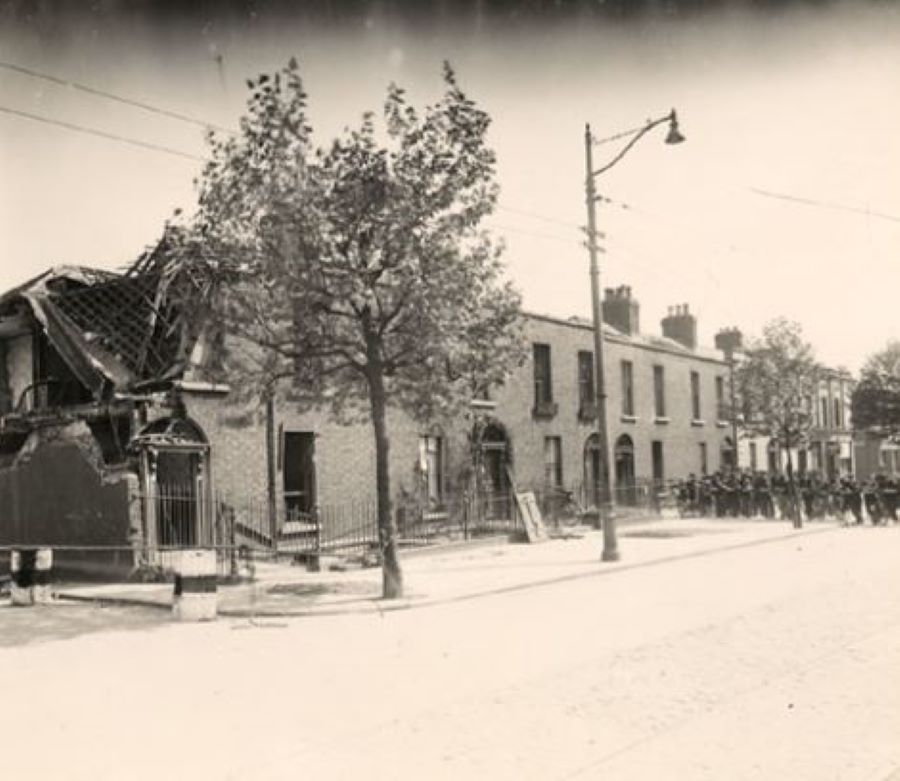
Personal code telegram from Joseph P. Walshe to William Warnock (Berlin)
(No. 112)
DUBLIN, 2 June 1941
Please make the following protest to the German Government immediately and leave the text as an aide mémoire:-
‘1. Between the hours of 1.0 and 2.0 approximately, Irish Summer Time, on the morning of Saturday, May 31st, bombs were dropped in the Dublin area. Three fell in a densely populated part of the North City and one fell in the Phoenix Park near the President’s Residence and the American Legation, both of which buildings suffered damage. In the city at least thirty persons were killed and over ninety were injured.1 A large number of houses were demolished and considerable additional damage to property was caused.
On Sunday morning, June 1st, at about 1.0 a.m., a bomb was dropped in the open country near Arklow, Co. Wicklow. Some material damage was done.
- The investigations have shown that the bombs were of German origin. In particular, a light-blue coloured plastic material, generally cylindrical in shape and bearing the instruction HIER NICHT ANHEBEN was found in each bombed area.
- The Irish Government cannot exaggerate the strength and depth of indignation caused amongst the Irish people by the tragic loss of life and injury to persons and property following the bombing of this neutral country. No neutral country has suffered a single catastrophe from air bombing involving such extensive loss of life. The Irish Government desire to protest in the strongest manner against the violation of the neutrality of Irish territory by German aircraft bringing death and serious injury to persons and property. They claim full compensation and reparation and they ask the German Government for explicit assurances that the strictest instructions will be given to secure that no further flights of German aircraft will take place over Irish territory or territorial waters.
- The Irish Government wish furthermore to remind the German Government that no satisfactory reply has been sent to the protest made by them in the month of January when air bombs bearing German markings caused loss of life and damage to property in Ireland.
- The Irish Government cannot emphasise too strongly that the strain imposed on Irish-German relations by such tragic events might well become insupportable. They therefore urge the German Government to take the most urgent measures to comply with the terms of this protest.’
William Warnock, a Trinity College Dublin graduate, joined the Foreign Service in 1935. He served in Berlin from 1938 to February 1944, becoming Chargé d’Affaires in August 1939
To this day, the debate over Irish neutrality continues. In my opinion, Ireland should not have remained neutral during World War II, and today it can no longer afford to be, due to decades of underfunding
The Air Corps operates two Airbus C295 maritime patrol aircraft for naval surveillance and Army ARW parachute missions. It also fields six AW139 helicopters, armed with FN MAGs and equipped for night mountain flying, supporting the ARW, Naval Service, and Gardaí. Eight Pilatus PC-9 turboprop trainers can carry rockets and machine guns, while two EC135 helicopters serve in pilot training, air-ambulance roles, and as sniper platforms for the ARW.
The Naval Service operates six patrol vessels (two P50-class and four P60-class), along with inflatable seagoing craft and training vessels, supporting its core maritime security and patrol role. However, due to staff shortage it can only operate 2 vessels at any given time.
As of December 2023, the Irish Army had around 6,136 active personnel and 1,351 in the Army Reserve. Following the disbandment of the 4th (Western) Brigade in 2012, the Army now operates under a two-brigade structure: the 1st Brigade covers the southern region, while the 2nd Brigade is responsible for the eastern and western regions. Additional support comes from the Defence Forces Training Centre and a logistics base at the Curragh.
The Army comprises nine specialist corps, classified as combat, combat support, or combat service support: Infantry, Artillery, Cavalry, Engineer, Ordnance, Medical, Transport, Military Police, and Communications and Information Services. Corps Directors coordinate training, equipment procurement, and other functions for these units.
Irish infantry use NATO-standard weapons including assault rifles, machine guns, grenade launchers, and anti-tank systems. The Army operates light armoured MOWAG Piranhas and has artillery units equipped with 120mm mortars and 105mm towed light guns.
Ireland’s special forces, the Army Ranger Wing (ARW), are based at the Curragh and handle high-risk operations.
When it comes to defending the country, Ireland isn’t neutral—it’s more neutered
sources
Donation
Your readership is what makes my site a success, and I am truly passionate about providing you with valuable content. I have been doing this at no cost and will continue to do so. Your voluntary donation of $2 or more, if you are able, would be a significant contribution to the continuation of my work. However, I fully understand if you’re not in a position to do so. Your support, in any form, is greatly appreciated. Thank you. To donate, click on the credit/debit card icon of the card you will use. If you want to donate more than $2, just add a higher number in the box left from the PayPal link. Your generosity is greatly appreciated. Many thanks.
$2.00

 History of Sorts
Leave a comment