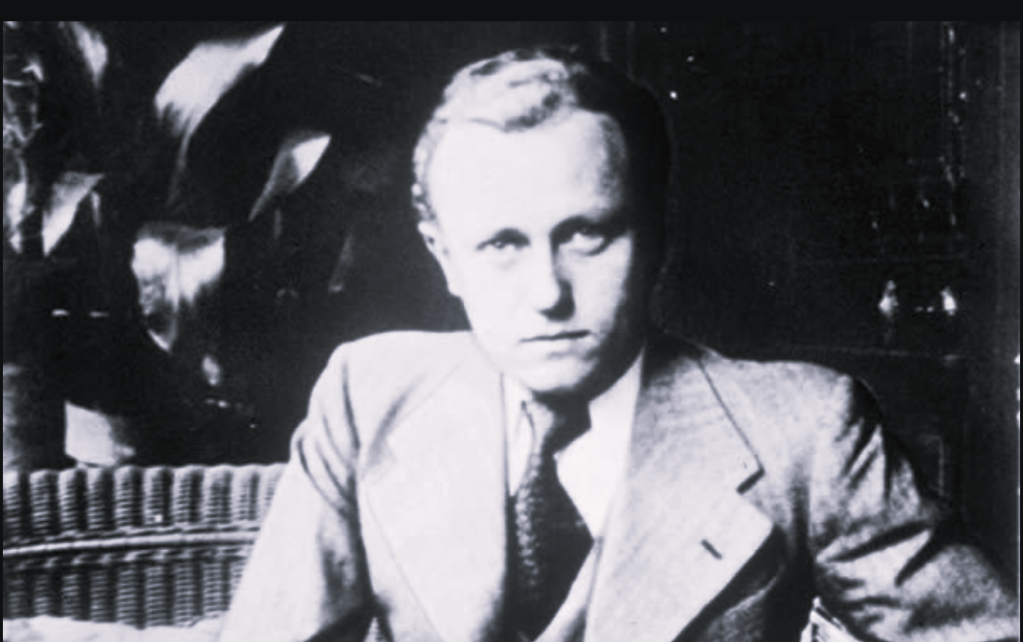
Paul Touvier was a French Nazi collaborator during World War II, known for his involvement in war crimes and crimes against humanity. His actions during the war and subsequent legal proceedings have marked him as one of the most notorious figures associated with the Vichy regime’s collaboration with Nazi Germany.
He was born on April 3, 1915, in Saint-Vincent-sur-Jabron, France. Initially, before the war, Touvier was involved with French far-right political movements.
During the Nazi occupation of France, Touvier joined the Milice, a paramilitary force created by the Vichy government to assist the Nazis in maintaining control and suppressing Resistance. He quickly rose through the ranks due to his zeal and dedication to the collaborationist cause.
On January 10, 1944, Victor Basch (president of the Human Rights League, then aged 80) and his wife, Ilona Basch (née Helene Furth), aged 81, were taken from their home in Lyon and assassinated by Joseph Lecussan and Henri Gonnet of the antisemitic Vichy French Milice Française under orders of Paul Touvier.
On June 29, 1944, Paul Touvier orchestrated one of his most infamous war crimes, known as the Rillieux-la-Pape massacre. This atrocity took place in a small village near Lyon, France, and involved the execution of seven Jewish hostages.
Philippe Henriot, the Vichy regime’s Minister of Information and Propaganda, was assassinated by the French Resistance on June 28, 1944. Henriot was a staunch collaborator with Nazi Germany and a prominent figure in Vichy’s propaganda efforts. In response to Henriot’s assassination, the Vichy authorities, including the Milice, sought immediate retaliation. Paul Touvier, a high-ranking officer in the Milice, took charge of this reprisal.
Touvier selected seven Jewish prisoners from Montluc Prison in Lyon as targets for the reprisal. The prisoners were chosen specifically because of their Jewish identity, making this act both a revenge killing and a continuation of the genocidal policies against Jews. The Milice took the hostages to a remote location in the village of Rillieux-la-Pape. On June 29, 1944, the seven Jewish men were executed by firing squad under Touvier’s orders. Without any legal process or trial, the execution was carried out solely as an act of revenge and terror.
The massacre was part of a broader pattern of brutal reprisals by the Vichy regime and its collaborators against perceived enemies, particularly Jews and members of the Resistance.
After the liberation of France by the Allied forces, Touvier went into hiding; he escaped the summary execution suffered by many suspected collaborators during the épuration sauvage. On September 10, 1946, the government sentenced him to death in absentia for treason and collusion with the Nazis. In 1947, he was arrested for armed robbery in Paris but escaped.

Connection with Jacques Brel
The connection between Paul Touvier and Jacques Brel is an unusual and surprising one, given their vastly different lives and legacies. Jacques Brel was a famous Belgian singer, songwriter, and actor, while Paul Touvier was a French Nazi collaborator and war criminal. Their connection arises from a specific incident that highlights the complexities of historical memory and personal connections. In the 1970s, the press revealed that Jacques Brel had provided financial assistance to Paul Touvier while he was in hiding. This information came to light during the investigation into Touvier’s war crimes and his long period of evasion from justice.
Touvier received support from various quarters, including some elements of the Catholic Church and individuals sympathetic to his plight. It was within this context that Brel’s assistance came to light.
Jacques Brel’s assistance to Touvier was reportedly motivated by a humanitarian desire to help someone in need rather than any ideological sympathy with Touvier’s past actions. Brel was renowned for his humanitarian efforts and acts of kindness, frequently assisting those in difficult situations. Some reports suggest that personal connections or appeals influenced Brel’s made on Touvier’s behalf by mutual acquaintances.
The revelation of Brel’s support for Touvier shocked many, given Brel’s public persona as a compassionate and principled artist. The idea that he would help a known war criminal seemed incongruous with his image. This incident added a layer of complexity to Brel’s legacy, prompting discussions about the nuances of personal morality and the challenges of judging historical figures based on isolated actions.

After decades of evading capture, the law finally caught up with Touvier in 1989. In 1994, he was tried and convicted of crimes against humanity, specifically for his role in the Rillieux-la-Pape massacre and other wartime activities. His sentence was life imprisonment.
On July 17, 1996, Paul Touvier died of prostate cancer at the age of 81 in Fresnes Prison, near Paris. A Tridentine Requiem Mass was offered for the repose of his soul by Father Philippe Laguérie at St Nicolas du Chardonnet, the Society of St. Pius X chapel, in Paris. His widow, Monique (died 2018), and their two children, Chantal and Pierre, survived him.
Sources
https://www.memoiresdeguerre.com/article-touvier-paul-58511668.html
https://www.onthisday.com/people/paul-touvier
https://www.internationalcrimesdatabase.org/Case/38/Touvier/
Donation
Your readership is what makes my site a success, and I am truly passionate about providing you with valuable content. I have been doing this at no cost and will continue to do so. Your voluntary donation of $2 or more, if you are able, would be a significant contribution to the continuation of my work. However, I fully understand if you’re not in a position to do so. Your support, in any form, is greatly appreciated. Thank you. To donate, click on the credit/debit card icon of the card you will use. If you want to donate more than $2, just add a higher number in the box left from the PayPal link. Your generosity is greatly appreciated. Many thanks.
$2.00


 History of Sorts
Leave a comment