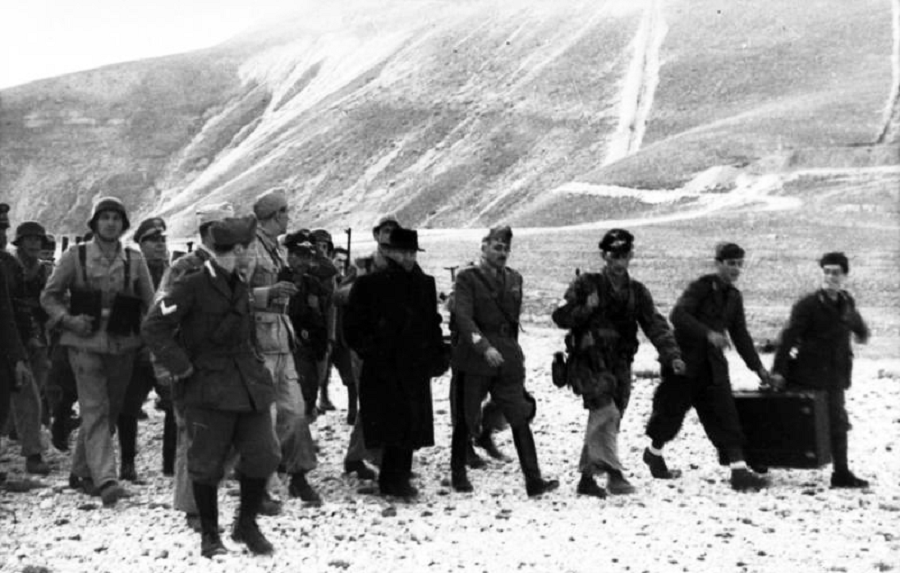
The German operation to liberate Benito Mussolini from captivity in September 1943, commonly known as the Gran Sasso raid or Operation Eiche (“Oak”), remains one of the most studied commando actions of the Second World War. Beyond its tactical novelty, the raid highlights the interplay between military planning, political symbolism, and propaganda in a period of profound instability in Italy.
Political and Strategic Context
By mid-1943, the Axis alliance faced mounting setbacks. Allied landings in Sicily in July revealed the vulnerability of Italy, and domestic discontent prompted King Victor Emmanuel III and the Fascist Grand Council to depose Mussolini on 25 July 1943. He was arrested and moved between locations under heavy guard, as the Italian government sought to distance itself from Germany and negotiate an armistice with the Allies.
For Adolf Hitler, Mussolini’s removal represented both a strategic threat and a personal affront. Restoring him to power was intended to secure continued Italian collaboration, at least in northern and central regions under German occupation.
Planning the Operation
Responsibility for the rescue fell to the SS and the Luftwaffe, with Otto Skorzeny playing a prominent role.

Intelligence eventually located Mussolini at the Hotel Campo Imperatore, a mountain resort on the Gran Sasso massif in the Abruzzo region, accessible only by cable car. The site’s isolation, while intended as a safeguard, also created vulnerabilities that could be exploited.
German planners opted for a glider-borne assault, using DFS 230 gliders to deliver troops directly onto the plateau. This avoided the heavily guarded valley approaches and reduced the risk of Italian forces destroying the cableway or relocating Mussolini during an approach by land.

Execution of the Raid
On 12 September 1943, German gliders landed with relative precision near the hotel. The assault force, numbering fewer than 100 men, quickly subdued the Italian guards without significant resistance or bloodshed. Mussolini was taken into German custody within minutes.
Evacuating him presented a greater challenge. With no road access, a small Fieseler Fi 156 Storch aircraft was brought to the plateau. Despite the difficult terrain and limited runway space, the aircraft successfully took off with Mussolini and Skorzeny on board, transferring the deposed dictator to German-controlled territory.
Aftermath and Implications
The rescue enabled Hitler to install Mussolini as the head of the Italian Social Republic, a German puppet regime established in the north after the Italian armistice with the Allies. However, Mussolini’s authority was minimal, and his government depended entirely on German military presence. Strategically, the raid did not reverse Italy’s military collapse, but it allowed Germany to retain control over parts of the peninsula and continue resistance against the advancing Allies.
The operation had disproportionate propaganda value. It was celebrated in Germany as evidence of the Wehrmacht’s daring and efficiency, and it elevated Skorzeny’s reputation as a commando leader. In historiography, it has often been examined as an example of special operations’ capacity to achieve high-visibility outcomes despite limited direct strategic effect.
The Gran Sasso raid illustrates how a well-executed tactical operation can resonate far beyond the battlefield. While it did not alter the course of the war in Italy, it served Hitler’s political objectives by restoring Mussolini as a symbolic leader and providing the German public with a narrative of success during a period of military setbacks. Today, it continues to be studied as a case of airborne innovation, operational daring, and the enduring importance of propaganda in modern warfare.
sources
https://arsof-history.org/articles/v11n1_eiche_page_1_v1.html
https://en.wikipedia.org/wiki/Gran_Sasso_raid
Donation
Your readership is what makes my site a success, and I am truly passionate about providing you with valuable content. I have been doing this at no cost and will continue to do so. Your voluntary donation of $2 or more, if you are able, would be a significant contribution to the continuation of my work. However, I fully understand if you’re not in a position to do so. Your support, in any form, is greatly appreciated. Thank you. To donate, click on the credit/debit card icon of the card you will use. If you want to donate more than $2, just add a higher number in the box left from the PayPal link. Your generosity is greatly appreciated. Many thanks.
$2.00
 History of Sorts
Leave a comment