
One key document that reveals the Nazis administrative machinery behind the Holocaust, is the August Frank memorandum, issued on September 26, 1942. Written by SS official August Frank, this memorandum outlines the procedures for handling Jewish property during deportations to extermination camps. While many Nazi documents focused on the mechanics of extermination, Frank’s memorandum offers a unique perspective on the financial and material exploitation that accompanied the mass murder of European Jewry. This essay will explore the contents, significance, and moral implications of this document, shedding light on how the Nazis transformed genocide into a meticulously managed bureaucratic enterprise.
Background and Context
By the time Frank issued his memorandum, the Final Solution—the Nazi plan to exterminate the Jews—was in full effect. The mass deportations of Jews to concentration camps such as Auschwitz and Treblinka were already underway, and millions had been murdered. The memorandum was not concerned with the logistics of killing but with how the Nazis could profit from their victims. As the head of the SS Economic and Administrative Main Office (WVHA), Frank was responsible for ensuring that the property confiscated from Jews deported to their deaths was efficiently managed and directed to support the war effort and the broader goals of the Reich.
The document reflects the broader Nazi policy of economic exploitation of the Jews before their murder. Jews were stripped of their homes, personal belongings, and valuables, which were then redistributed to the German war machine or to German settlers in newly occupied territories. This practice aligned with the Nazis’ racial ideology, which justified plundering Jewish property as part of their goal to “purify” Germany and expand its influence.

Key Contents of the Memorandum
The August Frank memorandum provides detailed instructions on how to handle the property of deported Jews. It demonstrates the thoroughness of Nazi planning, even in the context of mass murder. Key points from the memorandum include:
- Confiscation of Property: Frank ordered the confiscation of all Jewish property, from currency and valuables to personal belongings such as clothing, shoes, and bedding. These items were to be seized immediately upon deportation, with some redirected to support the German war effort and others distributed to “ethnic Germans” (Volksdeutsche) or settlers in Nazi-occupied territories.
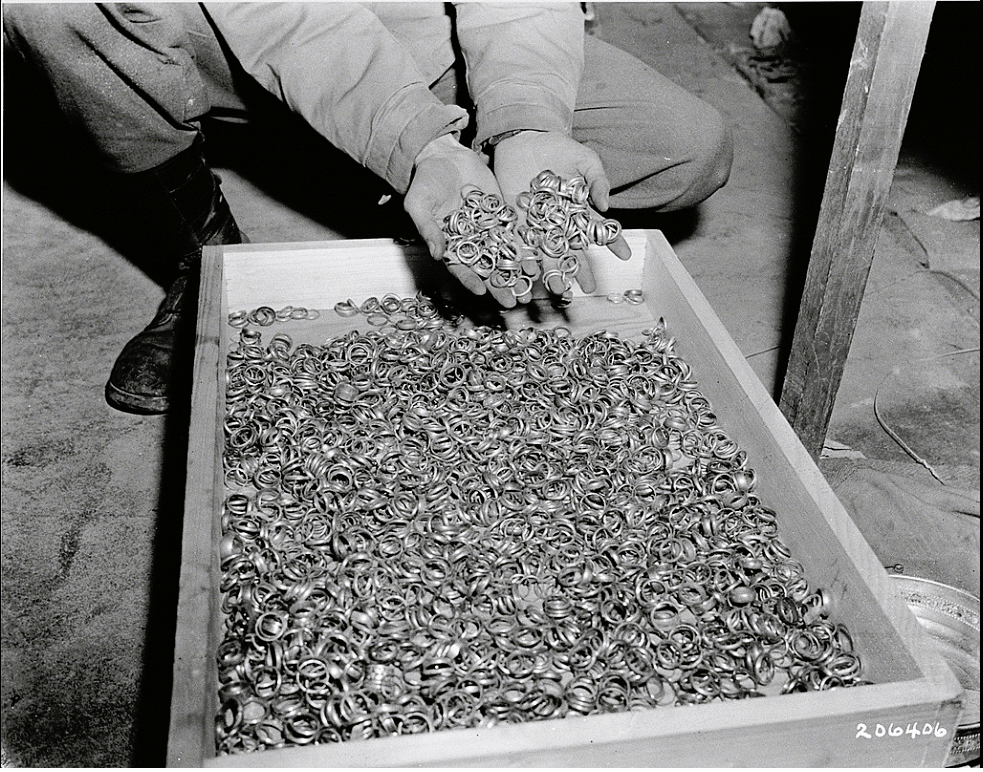
- Handling of Valuables: Items of value, including gold, silver, jewelry, and cash, were to be turned over to the Reich. Special provisions were made for handling these valuables, with specific instructions that they be sent to designated SS departments responsible for managing the economic assets of the Reich.
- Reuse of Clothing and Other Goods: Frank emphasized the importance of repurposing items such as clothing and household goods. These were to be cleaned, repaired, and reused, particularly by ethnic Germans. The memorandum explicitly mentions that clothing and shoes of Jewish victims should be redistributed to “desirable” German populations.
- Provisions for Jews of “Mixed Blood”: Reflecting the complexity of Nazi racial policies, the memorandum included provisions for handling the property of Jews classified as Mischlinge—people of mixed Jewish and non-Jewish ancestry. These individuals, though not always subject to immediate extermination, were still targeted for property confiscation.
- Efficiency in Administration: The memorandum underscored the importance of administrative efficiency, urging local SS offices and officials to follow the procedures exactly to ensure that no valuable property went uncollected. Frank’s emphasis on bureaucracy was characteristic of the Nazi regime, which transformed genocide into an organized, almost industrial process.
Significance and Implications
The August Frank memorandum is significant for several reasons. First, it reveals the economic motivations behind the Holocaust. While the primary aim of the Nazi regime was the racial “purification” of Europe, the Nazis also sought to exploit the material wealth of their victims. The memorandum demonstrates that the Holocaust was not only a genocidal endeavor but also an economic enterprise. Jewish property—money, jewelry, clothing, and household items—was systematically stolen to fund the German war effort, support German settlers, and enrich the Reich.
Second, the memorandum illustrates the bureaucratic nature of the Holocaust. The Nazi regime prided itself on efficiency and meticulous record-keeping, even when it came to mass murder. Frank’s detailed instructions for how to handle Jewish property reflect a broader bureaucratic approach to the Final Solution, in which millions of lives and livelihoods were reduced to administrative tasks to be managed by mid-level officials. This bureaucratic indifference to human suffering is one of the most chilling aspects of the Holocaust.

Third, the memorandum highlights the moral degradation of those who participated in the genocide. By treating Jews as mere sources of wealth to be exploited, Frank and other SS officials dehumanized their victims in the most profound way possible. The memorandum’s tone is coldly detached, focusing on the practicalities of confiscating property with no acknowledgment of the human lives that were being destroyed. This document is a stark reminder of how easily bureaucracy can become complicit in atrocities when it is divorced from morality.
The August Frank memorandum provides a window into the bureaucratic and economic underpinnings of the Holocaust. While most Holocaust documents focus on the logistics of mass murder, this memorandum reveals the extent to which the Nazis sought to profit from their victims. It exemplifies how genocide was not just an act of violence but a carefully organized system of exploitation, where every aspect of a victim’s life—down to their clothing—was viewed as an asset to be appropriated by the Nazi regime.
Frank’s memorandum also underscores the moral emptiness at the heart of Nazi ideology. The cold, methodical instructions for handling Jewish property reflect the complete dehumanization of Jews and the transformation of genocide into an administrative task. This document serves as a powerful reminder of the dangers of unchecked bureaucracy, where ordinary officials can become agents of unspeakable atrocities when they lose sight of their humanity. In the end, the August Frank memorandum is more than just a historical artifact—it is a cautionary tale about the potential for evil when systems of power prioritize efficiency and profit over human dignity.
Top Secret
6 copies–4th copy
Chief A/Pr./B.
Journ. No. 050/42 secr.
VS 96/42
26 September 1942
To the Chief of the SS Garrison Administration Lublin
To the Chief of Administration Concentration Camp Auschwitz
Subject: Utilization of property on the occasion of settlement and evacuation of Jews.
Without taking into account the over all regulations which are expected to be issued during October, pertaining to the utilization of mobile and immobile property of the evacuated Jews, the following procedure has to be followed with regard to the property carried by them — property, which will in all orders in the future be called goods originating from thefts, receiving of stolen goods, and hoarded goods:
1. a. Cash money in German Reich Bank notes have to be paid into the account: Economic and Administrative Main Office 158/1488 with the Reich Bank in Berlin-Sehoeneberg.
b. Foreign exchange (coined or uncoined), rare metals, jewelry, precious and semi-precious stones, pearls, gold from teeth and scrap gold have to be delivered to the SS Economic and Administrative Main Office. The latter is responsible for the immediate delivery to the German Reich Bank.
c. Watches and clocks of all kinds, alarm clocks, fountain pens, mechanical pencils, hand and electrical razors, pocketknives, scissors, flashlights, wallets, and purses are to be repaired by the Economic and Administrative Main Office in special repair shops, cleaned, and evaluated; and have to be delivered quickly to front line troops. Delivery to the troops is on a cash basis through the post exchanges. Three-fourth price grades are to be set and it has to be made sure that each officer and man cannot buy more than one watch. Exempt from sale are the gold watches, the utilization of which rests with me. The proceeds go to the Reich.
d. Men’s underwear and men’s clothing including footwear has to be sorted and valued. After covering the needs of the concentration camp inmates and in exceptions for the troops they are to be handed over to the Volksdeutsche Mittelstelle. The proceeds go to the Reich in all cases.
e. Women’s clothing and women’s underwear, including footwear; children’s clothing and children’s underwear, including footwear; have to be handed over to the Volksdeutsche Mittelstelle against payment. Underwear of pure silk is to be handed over to the Reich Ministry of Economics according to orders by the SS Economic and Administrative Main Office. This order refers also to underwear, under letter.
f. Featherbeds, quilts, woolen blankets, cloth for suits, shawls, umbrellas, walking sticks, thermos flasks, ear flaps, baby carriages, combs, handbags, leather belts, shopping baskets, tobacco pipes, sun glasses, mirrors, table knives, forks and spoons, knapsacks, and suitcases made from leather or artificial material are to be delivered to the Volksdeutsche Mittelstelle. The question of payment will be decided later.
The needs in quilts, woolen blankets, thermos flasks, ear flaps, combs, table knives, forks and spoons, and knapsacks can be furnished from Lublin and Auschwitz from these stocks against payment from budget funds.
g. Linen, such as bed sheets, bed linen, pillows, towels, wiping cloths, and tablecloths are to be handed over to the Volksdeutsche Mittelstelle against payment. Bed sheets, bed linen, towels, wiping cloths, and table cloths can be furnished for the needs of troops from these stocks against payment from budget funds.
h. Spectacles and eyeglasses of every kind are to be handed in to the medical office for utilization. (Spectacles with golden frames have to be handed in without glasses together with the rare metals). A settlement of accounts for the spectacles and eyeglasses need not take place with regard to their low value and their limited use.

i. Valuable furs of all kinds, raw and cured, are to be delivered to the SS WVHA.
j. Ordinary furs (lamb, hare, and rabbit skins) are to be reported to the SS WVHA, Amt B II, and are to be delivered to the clothing plant of the Waffen SS, Ravensbrueck near Fuerstenbern (Mecklenburg).
k. All items mentioned under the letters d, e, and f, which have only one-fifth or two-fifths of the full value, or are useless altogether will be delivered via the SS WV HA to the Reich Ministry for Economics for utilization.
For the decision on items which are not mentioned under the letters b-i, application for a decision as to their utilization should be made to the chief of the WVHA.
- The SS WVHA will establish all prices under observation of the legally controlled prices. This estimation, however, can be made later on. Petty evaluations which only waste time and personnel may be eliminated. Average prices for single items have to be established in general. For instance, one pair of used men’s trousers 3.00 RM, one woolen blanket 6.00 RM, etc. For the delivery of useless items to the Reich Ministry for Economics, average Kilo prices will have to be established.
It has to be strictly observed, that the Jewish Star is removed from all garments and outer garments which are to be delivered. Furthermore, items which are to be delivered have to be searched for hidden and sewed-in values, this should be carried out with the greatest possible care.
ACTING FOR
[Signed] FRANK
SS Brigadefuehrer and Brigadier General of the Waffen SS
sources
https://collections.ushmm.org/search/catalog/pa1069626
https://military-history.fandom.com/wiki/August_Frank_memorandum
https://dbpedia.org/page/August_Frank_memorandum
Donation
Your readership is what makes my site a success, and I am truly passionate about providing you with valuable content. I have been doing this at no cost and will continue to do so. Your voluntary donation of $2 or more, if you are able, would be a significant contribution to the continuation of my work. However, I fully understand if you’re not in a position to do so. Your support, in any form, is greatly appreciated. Thank you. To donate, click on the credit/debit card icon of the card you will use. If you want to donate more than $2, just add a higher number in the box left from the PayPal link. Your generosity is greatly appreciated. Many thanks.
$2.00

 History of Sorts
Leave a comment