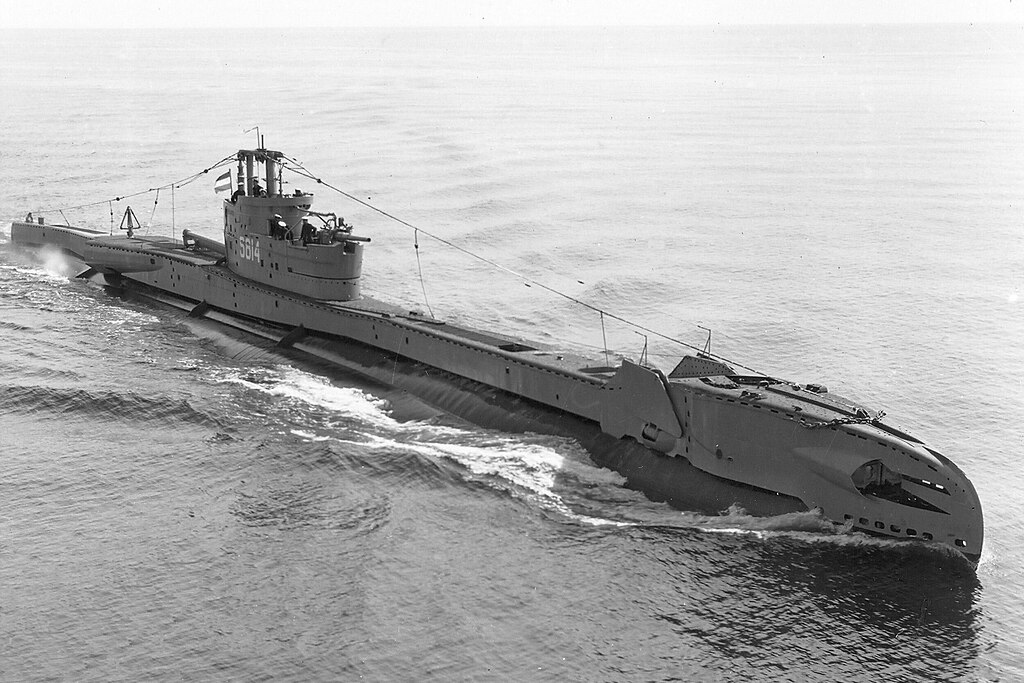
October 6, 1944 — deep in the tropical waters of the Java Sea, two submarines hunted beneath the same sun. One flew the flag of the Royal Netherlands Navy, the other bore the iron cross of Nazi Germany.
By the end of the day, only one would remain afloat.
A Dutch Submarine Far From Home
The HNLMS Zwaardvisch (P322) — whose name means Swordfish — was no ordinary submarine. Built in Britain as part of the Royal Navy’s T-class, she had been loaned to the exiled Dutch Navy during the Second World War.
Under the command of Lieutenant Commander H. A. W. Goossens, Zwaardvisch prowled the Indian and Pacific Oceans in 1944, stalking enemy shipping that supplied the Japanese war effort.
Life aboard was grueling — the air hot and damp, the hull alive with creaks and groans. But her crew, seasoned by years of exile and loss, were determined to strike back against the Axis powers that had overrun their homeland.
A German Visitor in the East
The German submarine U-168 had journeyed halfway across the world to join the fight in Asia. Part of a small flotilla of U-boats sent to collaborate with Japan, U-168 was based at Surabaya, in what was then the Dutch East Indies.
On the morning of October 6, 1944, she set out on another patrol, commanded by Korvettenkapitän Helmuth Pich.
But U-168’s luck was about to run out.
The Encounter in the Java Sea
As U-168 surfaced in the Java Sea, perhaps to recharge batteries or ventilate her hull, Zwaardvisch lay silently nearby. Her hydrophones picked up the thrum of diesel engines.
Goossens maneuvered his boat into firing position — a deadly underwater chess game played by sound and instinct.
At 05:30 a.m., Zwaardvisch launched six torpedoes.
Two struck home.
A thunderous explosion split the morning calm. The German submarine listed, then sank beneath the waves, leaving oil and debris scattered across the sea.
Twenty-three men went down with her; twenty-seven survivors were rescued — and later captured by the Japanese.
A Rare Submarine Duel
Submarine-versus-submarine encounters were exceedingly rare in World War II, and even rarer in the Pacific.
The sinking of U-168 by Zwaardvisch stands out not only as a tactical success but also as a symbol:
a Dutch vessel in exile, avenging her occupied homeland by sinking a German ally in waters once ruled by the Netherlands.
The Wreck Rediscovered
For decades, the story of U-168’s last patrol was little more than a footnote in naval history.
Then, in 2005, Indonesian divers rediscovered the wreck near Karimunjawa, her hull still resting silently on the seabed — a steel time capsule from a forgotten corner of the war.
Legacy of the Swordfish
After the war, Zwaardvisch was returned to the Netherlands and renamed HNLMS Zeehond (A879). She served until 1960, a proud reminder of the Dutch Navy’s resilience in exile.
Her victory over U-168 remains one of the most remarkable submarine actions in the Pacific theater — a day when the Swordfish struck true.
Sources:
- Royal Netherlands Navy archives
- Uboat.net historical records
- Indonesian maritime archaeology reports (2005)
 History of Sorts
Leave a comment