
Nearly every day I pass by this building—the Gerald Griffin Memorial Schools on Bridge Street, Court House Lane, Limerick. The school has a rich history, yet one particular chapter is often overlooked. This building, now a former Christian Brothers School, was originally constructed as a courthouse, as the name of the lane to its north, Court House Lane, attests. The identity of the original architect, however, remains unknown.One of its most famous trials was that of John Scanlan and Stephen Sullivan of County Limerick, who were charged with the murder of Ellen Hanley, known as “The Colleen Bawn.”
The Colleen Bawn
The Colleen Bawn is one of Ireland’s most famous tragic tales—a story of love, betrayal, and murder that has resonated through folklore, literature, and theater for over two centuries. The phrase “Colleen Bawn,” meaning “fair-haired girl” in Irish, refers not only to a real historical figure but also to the many retellings of her story in ballads, novels, and plays. At its heart lies the tragic fate of Ellen Hanley, a young Irish girl whose untimely death in 1819 inspired outrage, fascination, and countless adaptations.
In the autumn of 1819, at Moneypoint, Kilrush, the remains of Ellen Hanley were discovered. Known in story, drama, and opera as the Colleen Bawn, she was not yet sixteen years old. Her body washed ashore six weeks after her marriage, the victim of a murder orchestrated by her husband, John Scanlan of Ballykehan House, near Bruff, County Limerick.
Ellen Hanley was reputedly of extraordinary beauty and possessed a bright and friendly disposition. She was the daughter of a small farmer from Ballycahane, near Bruree, County Limerick. Her mother died when Ellen was six, and she was subsequently raised by her uncle, John Connery (Conroy).
Soon after meeting John Scanlan, Ellen was proposed to by him. Scanlan, a man in his twenties from the landed ascendancy, wished to marry her despite the difference in their social standing. Initially hesitant, Ellen was reassured, and the marriage was arranged. She eloped from her uncle’s home in early July 1819. The exact location of their marriage remains uncertain; it may have taken place in Limerick or at the Old Church in Kilrush.
Shortly thereafter, Scanlan grew weary of his young bride and, with his servant Stephen Sullivan, plotted her murder. Sullivan initially took Ellen for a boat trip on the river, armed with a gun, but lost his nerve and returned her safely to Glin. Scanlan then persuaded him, with whiskey, to resume the journey. Midway through the river, Sullivan murdered Ellen with a musket, removed her garments and ring, and tied her to a stone before dumping her body into the Shannon. Six weeks later, her body washed ashore at Moneypoint, shocking the community and arousing widespread horror and pity.
Both Scanlan and Sullivan initially disappeared, but the full weight of the law pursued them. Scanlan was the first to be captured, arrested, and brought to trial in March 1820. Given his family’s high social standing, the trial caused a sensation. Defended by the renowned lawyer Daniel O’Connell, known as The Liberator, it was widely assumed he would be acquitted, reflecting the belief that someone of the ascendancy should not suffer for a crime against a commoner. Yet Scanlan was convicted and sentenced to death. On March 16, 1820, he was taken from jail to Gallows Green on the Clare side of the Shannon. A carriage was provided for the mile-long journey, but the horses refused to move, despite whips and bayonets. Scanlan was forced to walk the final distance to his execution and was duly hanged.
Sullivan was apprehended shortly afterward, and his trial, held four months later in Limerick, drew almost as much attention as Scanlan’s. Found guilty and sentenced to death, he confessed on the gallows, admitting that Scanlan had planned the murder and that he had acted as the agent.
Ellen Hanley was buried in Burrane Cemetery, between Kildysart and Kilrush. The late Mrs. Reeves of Bessborough House, near the graveyard, erected a Celtic cross inscribed:
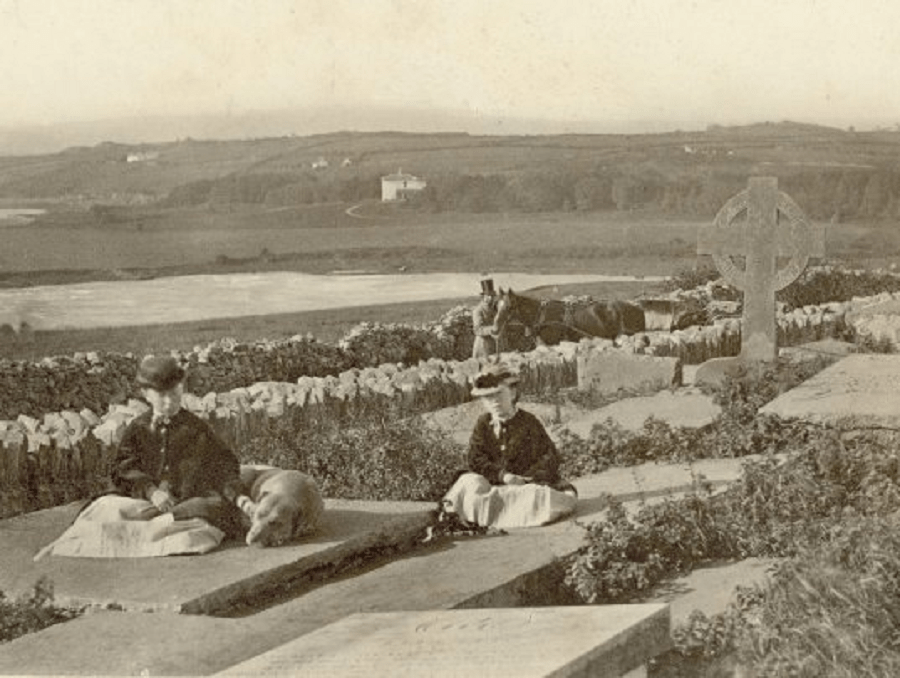
“Here lies the Colleen Bawn,
Murdered on the Shannon,
July 14th, 1819. R.I.P.”
Sadly, the cross no longer exists, having been chipped away over time by souvenir hunters. Ellen’s story has inspired many works, including Gerald Griffin’s novel The Collegians, in which he, as a young reporter covering the trials, fictionalized Scanlan and Sullivan as Hardress Cregan and Danny Mann. Dion Boucicault dramatized her in The Colleen Bawn, and Benedict’s opera The Lily of Killarney features her as the central character, though neither entirely reflects the true events of her life and death.
Thus ends the tragic tale of the Colleen Bawn, a story of profound sorrow and stark, unrelieved tragedy.
sources
https://digitallibrary.ul.ie/christian-brothers-gerarld-griffin-memorial-schools-st-marys-0
https://catalogue.nli.ie/Record/vtls000839418
https://www.clarelibrary.ie/eolas/coclare/people/bawn.htm
https://en.wikipedia.org/wiki/Ellen_Scanlan
Donation
Your readership is what makes my site a success, and I am truly passionate about providing you with valuable content. I have been doing this at no cost and will continue to do so. Your voluntary donation of $2 or more, if you are able, would be a significant contribution to the continuation of my work. However, I fully understand if you’re not in a position to do so. Your support, in any form, is greatly appreciated. Thank you. To donate, click on the credit/debit card icon of the card you will use. If you want to donate more than $2, just add a higher number in the box left from the PayPal link. Your generosity is greatly appreciated. Many thanks.
$2.00
 History of Sorts
Leave a comment