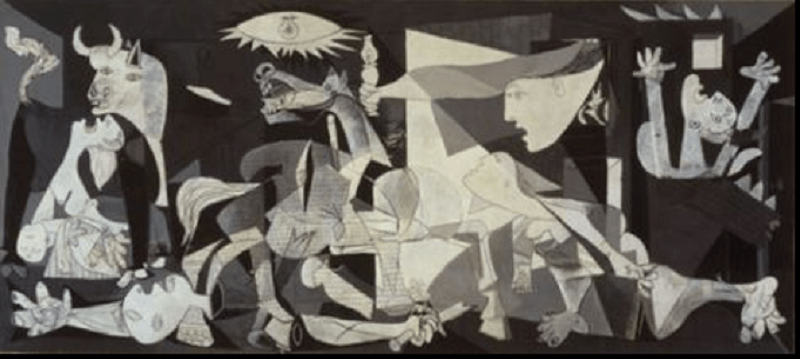
The famous painting above is titled Guernica and was created by Pablo Picasso. He painted it in his Paris home in response to the bombing of Guernica, a town in the Basque Country of northern Spain, on April 26, 1937, by Nazi Germany and Fascist Italy.
The Nazis committed atrocities long before the start of World War II.
On Monday, April 26, 1937, warplanes from Nazi Germany’s Condor Legion, commanded by Colonel Wolfram von Richthofen, bombed Guernica for about two hours. In his journal entry dated April 30, 1937, von Richthofen described the scene upon arrival: “There was smoke everywhere” from the attack by three aircraft, and because visibility was poor, “they just dropped everything right into the center.” The bombers destroyed houses, water mains, and key infrastructure. The materials used in Guernica’s buildings—tile roofs, wooden porches, and half-timbering—resulted in complete devastation. This bombing marked the first major action of the modern German army.
At the time, unease had already gripped the region, heightened by the recent bombardment of nearby Durango, approximately 30 kilometers from Guernica. Despite this, Guernica’s market proceeded as usual that day. While precise figures are difficult to determine, approximately 10,000–12,000 people were in the town when the bombing began.
At 16:20, the bells of the Santa María church rang out, warning the population of approaching enemy aircraft. Most of the planes belonged to the German Condor Legion, with some from Italy’s Aviazione Legionaria. The bombers launched from aerodromes in Vitoria, Burgos, and Soria. Following the warning, residents sought refuge in purpose-built shelters, where they remained for almost four hours as the relentless attack unfolded. The bombing occurred in continuous waves with barely any pauses.
The Bombing Tactics
Initial Attack:
The first wave of bombers, accompanied by fighter planes, forced residents into shelters in the town center. Fighter planes circled overhead, preventing escape.
Destructive Bombing:
The bombers then dropped explosive ordnance, or break-up bombs, weighing 50 to 250 kilograms. These bombs penetrated roofs and exploded on the ground, forming massive craters and exposing buildings’ wooden structures.
Incendiary Bombs:
Incendiary bombs followed, made of steel and weighing 1 to 2 kilograms. Filled with a magnesium-aluminum-zinc alloy, they triggered uncontrollable fires upon contact with metal, generating temperatures exceeding 1,500 degrees Celsius. The resulting inferno consumed Guernica and was visible from distant villages.
Machine-Gun Fire:
Survivors attempting to flee were machine-gunned by fighter planes diving as low as 50 meters. The aircraft circled Guernica’s outskirts, confining residents within the fire’s deadly perimeter.
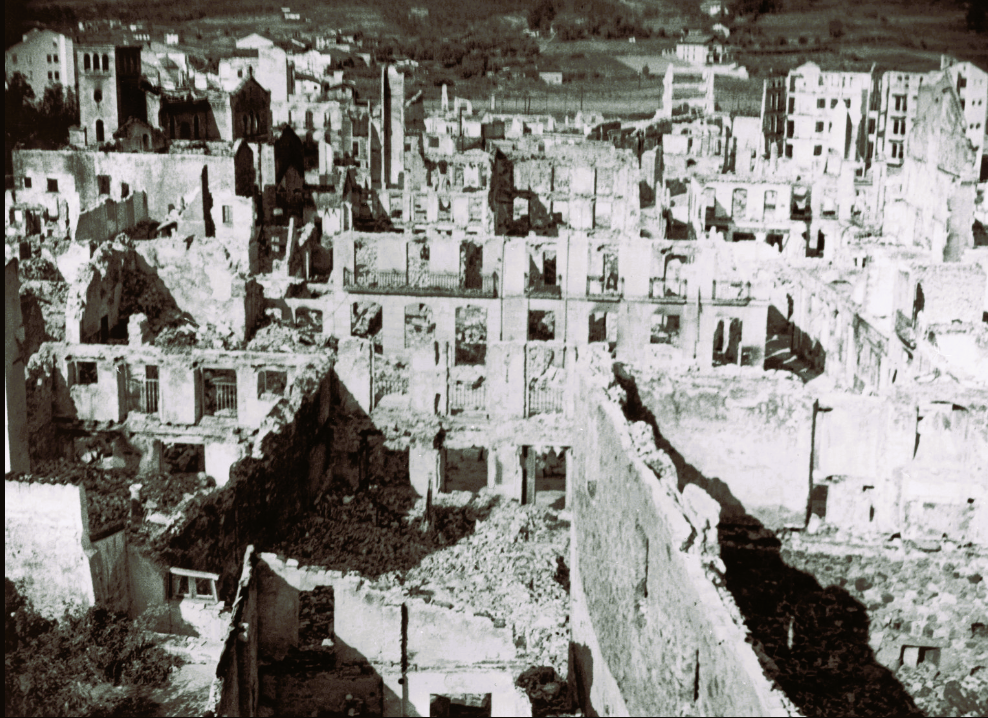
The town’s narrow streets and tightly packed houses facilitated the spread of the flames. Ultimately, more than 85% of Guernica was destroyed.
The painting Guernica was unveiled and first exhibited in July 1937 at the Spanish Pavilion during the Paris International Exposition, where both Nazi Germany and the Soviet Union had prominent pavilions. The Spanish Pavilion, funded by the Spanish Republican government during the Civil War, was constructed to highlight the government’s struggle for survival, deviating from the Exposition’s theme of technological progress.
At the entrance of the Spanish Pavilion, an enormous photographic mural of Republican soldiers was displayed alongside the following slogan:
We are fighting for the essential unity of Spain.
We are fighting for the integrity of Spanish soil.
We are fighting for the independence of our country and for the right of the Spanish people to determine their own destiny.
The exhibition of Guernica was accompanied by a poem by Paul Éluard, and the pavilion also featured The Reaper by Joan Miró and Mercury Fountain by Alexander Calder, both of which expressed solidarity with the Republican cause.
During World War II, the Nazis murdered many Spanish Republicans at the Mauthausen concentration camp.
In 2003, when U.S. Secretary of State Colin Powell presented his case for the invasion of Iraq at the United Nations, a reproduction of Guernica hung in the room. Powell requested it be covered, as he felt it would detract from his presentation.
Sources
https://www.annefrank.org/en/timeline/51/the-german-luftwaffe-bombs-guernica/
https://www.unr.edu/nevada-today/news/2022/gernika-criteria-of-truth
http://turismo.gernika-lumo.eus/en-us/descubre/Pages/bombardeo.aspx
Donation
Your readership is what makes my site a success, and I am truly passionate about providing you with valuable content. I have been doing this at no cost and will continue to do so. Your voluntary donation of $2 or more, if you are able, would be a significant contribution to the continuation of my work. However, I fully understand if you’re not in a position to do so. Your support, in any form, is greatly appreciated. Thank you. To donate, click on the credit/debit card icon of the card you will use. If you want to donate more than $2, just add a higher number in the box left from the PayPal link. Your generosity is greatly appreciated. Many thanks.
$2.00

 History of Sorts
Leave a comment