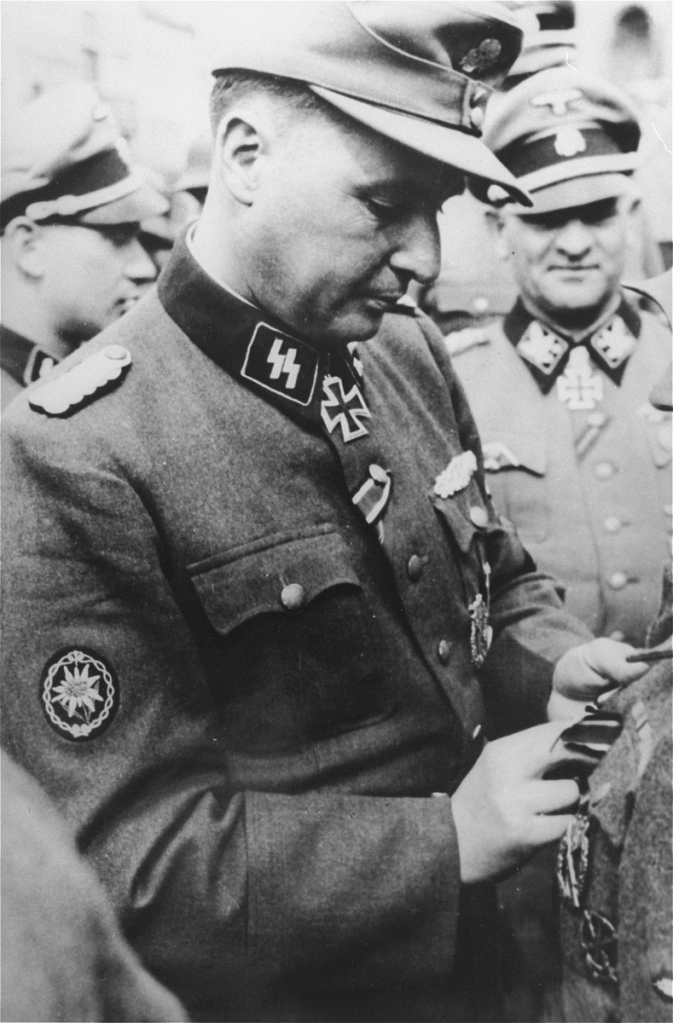
Léon Degrelle remains one of the most controversial figures in twentieth-century Belgian and European history. His life encapsulates the volatile convergence of populist politics, Catholic traditionalism, authoritarian ideology, and the radicalization produced by the crises of the interwar period and the Second World War. At once a gifted orator, an ambitious political entrepreneur, a collaborator with Nazi Germany, and an unrepentant exile after 1945, Degrelle’s trajectory illustrates how democratic fragility and ideological polarization could propel marginal figures to prominence—with lasting moral and political consequences.
Early Life and Intellectual Formation
Léon Joseph Marie Ignace Degrelle was born in 1906 in Bouillon, in Belgium’s Ardennes region. He was raised in a conservative, Catholic milieu that deeply shaped his worldview. Educated at Catholic institutions, including the University of Louvain, Degrelle was influenced by integral Catholic thought, which emphasized the moral authority of the Church, social hierarchy, and skepticism toward liberal democracy. He was particularly inspired by Catholic social doctrine and by intellectual currents that rejected both capitalism and socialism in favor of corporatist and authoritarian alternatives.
From an early age, Degrelle demonstrated considerable talent as a writer and speaker. He became involved in Catholic youth organizations and journalism, quickly gaining a reputation for rhetorical flair and ideological zeal. His early activities reflected a belief that Belgium—and Europe more broadly—was in moral and political decline, threatened by secularism, parliamentary inefficiency, and class conflict. These convictions would later form the ideological foundation of his political movement.
The Rise of Rexism
Degrelle’s entry into mass politics came with the creation of the Rexist movement in the mid-1930s. Originally rooted in a Catholic publishing venture called Christus Rex, Rexism evolved into a populist political party that combined Catholic traditionalism, authoritarian governance, and vehement opposition to the established political elite. The movement took its name from Christ the King, signaling its aspiration to reorder society according to a hierarchical, ostensibly Christian model.
Christus Rex began as a publishing house but quickly evolved into a radical right-wing Catholic political movement known simply as Rex. Initially, Rex operated within the Catholic Union, one of Belgium’s major political parties. In late 1935, however, Degrelle openly challenged and criticized the party’s leadership. As a result, Rex was forced to break away and become an independent political movement. The Rexist movement offered few concrete policy proposals; instead, it presented itself as a nationalist, authoritarian, right-wing party united around traditional values such as family, Catholicism, and loyalty to the Belgian monarchy.
Degrelle emerged as a charismatic public speaker, and Rex achieved unexpected success in the 1936 Belgian national elections, winning more than 11 percent of the popular vote. These results were remarkable for a newly formed party. In the months that followed, Degrelle and the Rexist leadership attempted to capitalize on this momentum by organizing local branches into a national network and promoting Rex as a staunchly anti-communist force. Despite these efforts, the movement failed to sustain its early success.
Degrelle himself bore partial responsibility for this failure. In October 1936, he organized a march on Brussels intended to demonstrate Rex’s strength and popular appeal. However, few supporters were willing to defy the government’s ban on public demonstrations. The march attracted only a small turnout and ultimately backfired, reinforcing the perception of Rexists as radical and disorderly lawbreakers.
Degrelle’s leadership also exposed Rex to accusations of foreign influence, particularly from Nazi Germany and Fascist Italy. Although Rexists denied having ties to other authoritarian movements in Europe, Degrelle traveled to Germany and Italy in 1936, met personally with Adolf Hitler in Berlin, and began receiving limited financial support from Nazi Germany. Rex also benefited from substantial funding from Fascist Italy.
In 1937, Degrelle ran for office in Brussels but was decisively defeated by Prime Minister Paul van Zeeland. This loss ended Rex’s early momentum and eliminated any remaining prospects of alliance with mainstream Catholic politics. The party never recovered its earlier popularity. As public support declined in the late 1930s, Rex became increasingly radical and openly anti-democratic, coming to more closely resemble other right-wing authoritarian movements in Europe.
Collaboration During the Second World War

The German invasion of Belgium in May 1940 marked a decisive turning point in Degrelle’s life. Viewing the collapse of the Belgian state as confirmation of his critique of democracy, he chose the path of collaboration with Nazi Germany. During the occupation, Degrelle presented himself as a loyal ally of the Third Reich and a champion of a “New Europe” based on authoritarian order and anti-communism.
Degrelle continued seeking opportunities to align Rex more closely with Nazi Germany. His speeches grew increasingly virulent in their attacks on Jews. By late 1940, Rexist forces had carried out multiple acts of antisemitic violence. In early 1941, Degrelle publicly declared that Rex fully supported the German war effort and the Nazi plan to reshape Europe. For the first time, he concluded a speech with the phrase “Heil Hitler!” These actions reinforced the perception among many Belgians that Rex had become little more than a violent extremist group of opportunistic collaborators.

His most notorious act was his voluntary enlistment in the Waffen-SS, where he served on the Eastern Front. Degrelle framed his participation as a crusade against Bolshevism, aligning with Nazi propaganda that portrayed the war against the Soviet Union as a civilizational struggle. He rose through the ranks and received decorations from the German regime, including personal recognition from Hitler, who reportedly regarded him as a model foreign volunteer.
Degrelle’s wartime activities went beyond military service. He remained a prominent propagandist, endorsing Nazi ideology and legitimizing collaboration within occupied Belgium. His role symbolized the extent to which ideological commitment, personal ambition, and political radicalization could converge in acts of collaboration that directly supported a regime responsible for mass repression and genocide.
In the aftermath of Belgium’s liberation in late 1944, Degrelle was deprived of his citizenship and condemned to death in absentia.
Defeat, Exile, and Postwar Legacy
With the collapse of Nazi Germany in 1945, Degrelle fled Europe, eventually finding refuge in Francoist Spain. In Belgium, he was condemned to death in absentia for treason and collaboration, and stripped of his citizenship. Despite repeated requests for extradition, Spain refused to hand him over, allowing him to live in exile for the remainder of his life.
In exile, Degrelle never renounced his wartime actions or ideological commitments. Instead, he reinvented himself as a writer and speaker for extremist audiences, producing memoirs and polemical works that glorified his experiences and denied or minimized Nazi crimes, including the Holocaust. These activities cemented his postwar reputation not merely as a former collaborator, but as a persistent apologist for Nazism.
Degrelle died in 1994, having outlived most of his contemporaries and remained defiant to the end. His continued visibility among neo-Nazi and far-right circles underscored the enduring symbolic power of figures who embody ideological extremism, even decades after their political defeat.
Historical Assessment
From a historical perspective, Léon Degrelle is less significant for any lasting political achievement than for what his career reveals about the vulnerabilities of democratic societies under stress. His rise demonstrates how charismatic leadership, populist rhetoric, and moral absolutism can exploit economic crisis and cultural anxiety. His collaboration illustrates how ideological fanaticism can lead individuals to align themselves with profoundly destructive regimes, while rationalizing violence and repression as historical necessity.
Degrelle’s life also raises enduring questions about responsibility and memory. His refusal to repent, coupled with his postwar denialism, stands in stark contrast to the broader European effort to confront the crimes of fascism and Nazism. As such, he occupies a cautionary place in history: not as a tragic hero or misunderstood rebel, but as an example of how conviction divorced from ethical constraint can contribute to moral catastrophe.
In sum, Léon Degrelle’s legacy is inseparable from the darkest chapters of twentieth-century Europe. Studying his life is valuable not because of what he sought to build, but because of what his choices helped to destroy—and because understanding figures like Degrelle is essential to preventing the recurrence of the political and moral failures that enabled them.
sources
https://en.wikipedia.org/wiki/L%C3%A9on_Degrelle
https://www.tracesofwar.com/articles/4488/L%C3%A9on-Degrelle.htm
https://encyclopedia.ushmm.org/content/en/article/leon-degrelle-1
Donation
Your readership is what makes my site a success, and I am truly passionate about providing you with valuable content. I have been doing this at no cost and will continue to do so. Your voluntary donation of $2 or more, if you are able, would be a significant contribution to the continuation of my work. However, I fully understand if you’re not in a position to do so. Your support, in any form, is greatly appreciated. Thank you. To donate, click on the credit/debit card icon of the card you will use. If you want to donate more than $2, just add a higher number in the box left from the PayPal link. Your generosity is greatly appreciated. Many thanks.
$2.00
 History of Sorts
Leave a comment