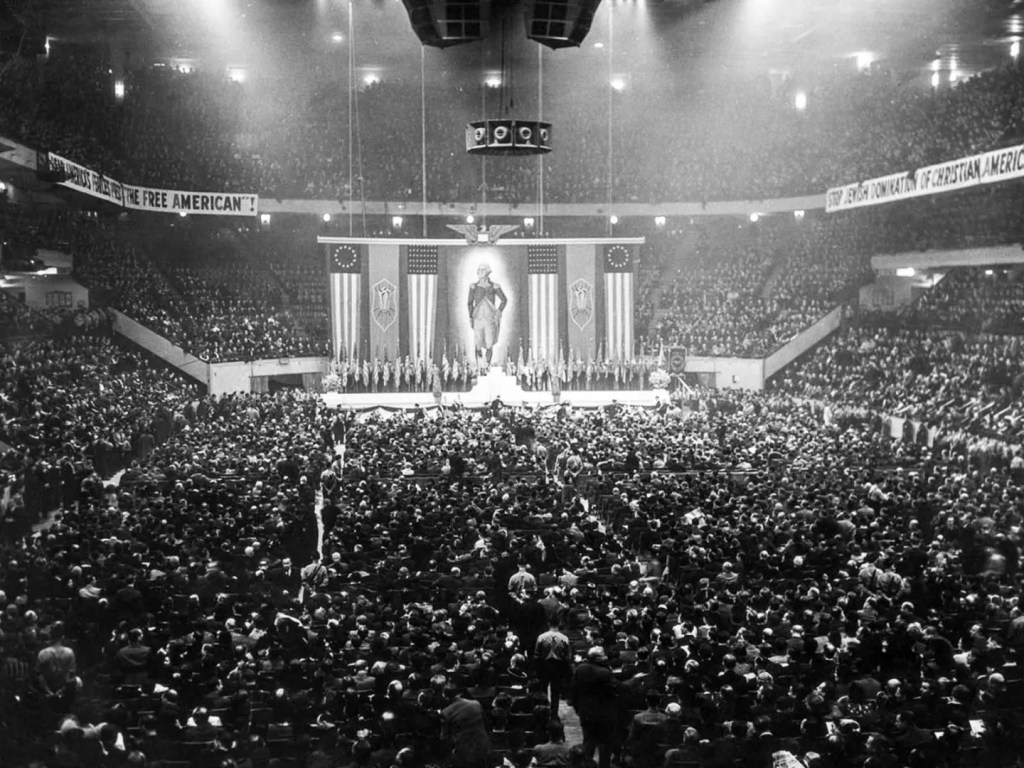
On 20 February 1939, one of the most unsettling political events in American history took place in Madison Square Garden in New York City. More than 20,000 people gathered beneath a striking display of American flags and swastikas to attend a mass rally organized by the German American Bund, a group dedicated to promoting Nazi ideology within the United States. Occurring only months before the outbreak of the Second World War, the rally exposed the presence of fascist sympathies within segments of American society while also demonstrating the strength of democratic opposition.
Historical Context: America and Extremism in the 1930s
The rally must be understood within the broader political and economic turmoil of the 1930s. The Great Depression had shaken confidence in democratic institutions across the world. Economic insecurity, unemployment, and social unrest encouraged the rise of authoritarian movements that promised national renewal and stability. In Europe, Adolf Hitler had consolidated power in Germany, presenting fascism as an alternative to both liberal democracy and communism.
In the United States, while most citizens rejected Nazism, certain social currents made extremist rhetoric resonate with some audiences. Isolationism remained strong, many Americans feared communism, and antisemitic attitudes existed within parts of society. The German American Bund sought to capitalize on these sentiments by portraying Nazism as compatible with American values rather than as a foreign ideology.
Founded in 1936 from earlier pro-Nazi organizations, the Bund attempted to mobilize Americans of German descent while appealing to broader nationalist audiences. By early 1939, however, membership was declining, and its leader, Fritz Julius Kuhn, hoped a dramatic public demonstration would restore momentum and legitimacy.
The Rally as Political Theatre
The event was carefully staged as a spectacle. Advertised as a “Pro-American Rally,” it was timed near George Washington’s birthday and framed as a patriotic gathering rather than an explicitly Nazi demonstration.
Inside the arena, symbolism blended American nationalism with fascist imagery. A massive portrait of George Washington hung behind the stage, flanked by swastikas and American flags. Uniformed Bund members marched in disciplined formations, and attendees performed Nazi salutes while patriotic music played.
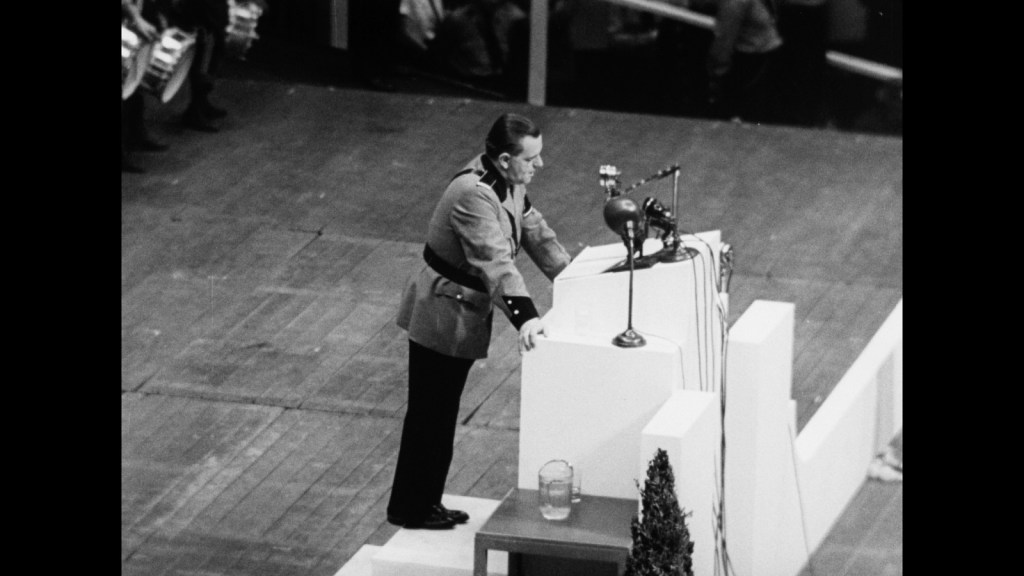
This fusion of symbols was deliberate propaganda. Speakers claimed that Nazism represented “true Americanism,” accusing Jews, communists, and liberal politicians of undermining the nation. Kuhn’s speech attacked President Franklin D. Roosevelt, echoing conspiracy theories and rhetoric common in Nazi Germany.
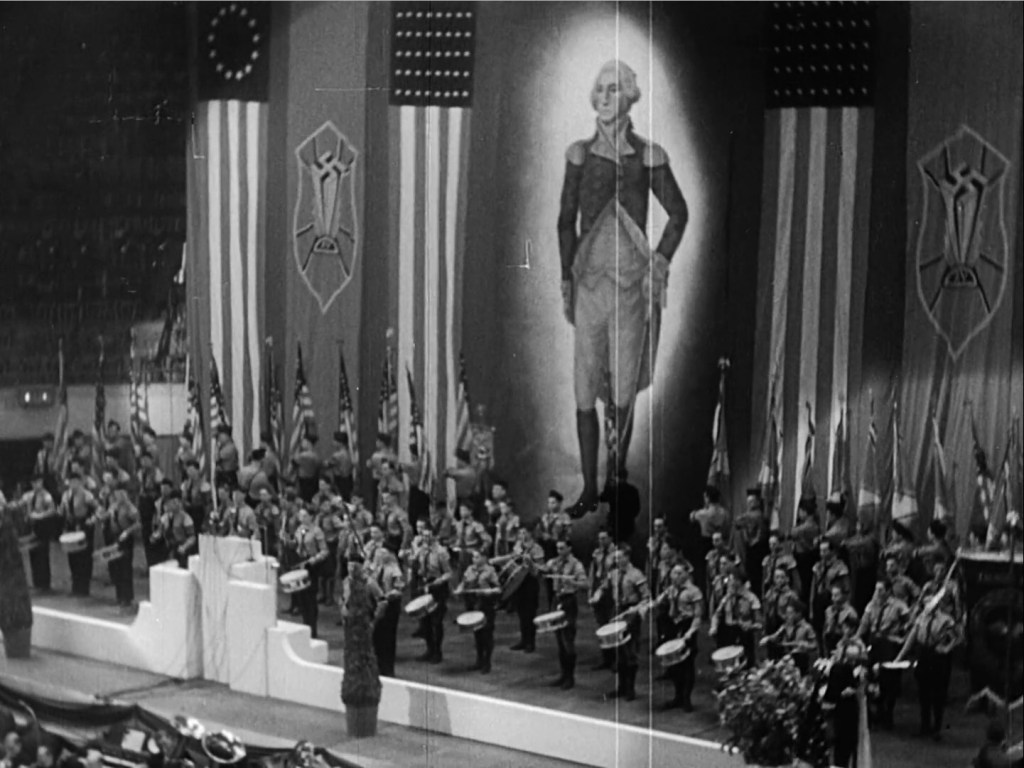
The rally’s choreography mirrored fascist mass gatherings in Europe. Precision marching, dramatic lighting, and collective chanting created a sense of unity and emotional intensity. The goal was not simply persuasion but transformation—encouraging participants to feel part of a powerful political movement.
Protest and Resistance Outside
While thousands filled Madison Square Garden, an even larger crowd gathered outside to oppose them. Roughly 100,000 anti-Nazi protesters surrounded the venue, forcing city authorities to deploy thousands of police officers to prevent violence.
A dramatic confrontation occurred during the rally when Isadore Greenbaum, a Jewish plumber from Brooklyn, rushed the stage shouting denunciations of Nazism. Bund guards beat him before police intervened and removed him. Though arrested for disorderly conduct, his protest became symbolic of individual resistance to authoritarianism.
The demonstrations outside revealed that, although fascist sympathies existed, opposition to them was widespread and deeply felt among the American public.
Free Speech and Democratic Tensions
One of the most controversial aspects of the rally was that city officials allowed it to proceed legally. New York’s mayor, Fiorello La Guardia, defended the decision on constitutional grounds, arguing that freedom of speech required tolerating even offensive and hateful political expression.
This decision illustrated a fundamental dilemma in democratic societies: protecting civil liberties can sometimes provide platforms for movements hostile to democracy itself. Authorities believed that suppressing the rally might strengthen the Bund by allowing it to claim persecution, whereas public exposure would reveal its extremism.
In many respects, this calculation proved accurate. News coverage showing thousands of Americans giving Nazi salutes shocked the nation and generated widespread condemnation.
Decline of the Bund
Rather than strengthening the movement, the rally marked the Bund’s peak. Soon afterward, investigations revealed that Kuhn had embezzled organizational funds. His conviction and imprisonment in 1939 severely damaged the group’s credibility.
As tensions in Europe escalated and war approached, American public opinion turned sharply against Nazi Germany. After the United States entered World War II in 1941, the Bund rapidly disintegrated, and many of its leaders faced prosecution or detention.
Historical Significance
The 1939 rally remains historically important for several reasons:
Evidence of Domestic Fascism:
It demonstrated that authoritarian ideology could attract support even within an established democracy.
Propaganda Strategy:
The Bund’s attempt to merge nationalism with extremist ideology illustrated how political movements use familiar symbols to normalize radical ideas.
Democratic Resistance:
The massive protests showed that opposition to fascism outweighed support, highlighting civic engagement as a defense against extremism.
The Visibility Effect:
Public exposure weakened the Bund by revealing the true nature of its ideology to a broader audience.
The Nazi rally at Madison Square Garden in 1939 stands as a stark reminder that democratic societies are not immune to authoritarian movements. The event exposed how extremist ideology can cloak itself in patriotic language and exploit moments of social anxiety. Yet it also demonstrated the resilience of democratic culture—through protest, public scrutiny, and legal accountability.
Ultimately, the rally serves both as a warning and a lesson: democracy depends not only on laws and institutions but on citizens willing to confront and reject movements that seek to undermine its fundamental principles.
Sources
https://newspapers.ushmm.org/events/american-nazis-rally-in-new-york-city
https://www.npr.org/sections/codeswitch/2019/02/20/695941323/when-nazis-took-manhattan
https://en.wikipedia.org/wiki/1939_Nazi_rally_at_Madison_Square_Garden
Donation
Your readership is what makes my site a success, and I am truly passionate about providing you with valuable content. I have been doing this at no cost and will continue to do so. Your voluntary donation of $2 or more, if you are able, would be a significant contribution to the continuation of my work. However, I fully understand if you’re not in a position to do so. Your support, in any form, is greatly appreciated. Thank you. To donate, click on the credit/debit card icon of the card you will use. If you want to donate more than $2, just add a higher number in the box left from the PayPal link. Your generosity is greatly appreciated. Many thanks.
$2.00

 History of Sorts
Leave a comment