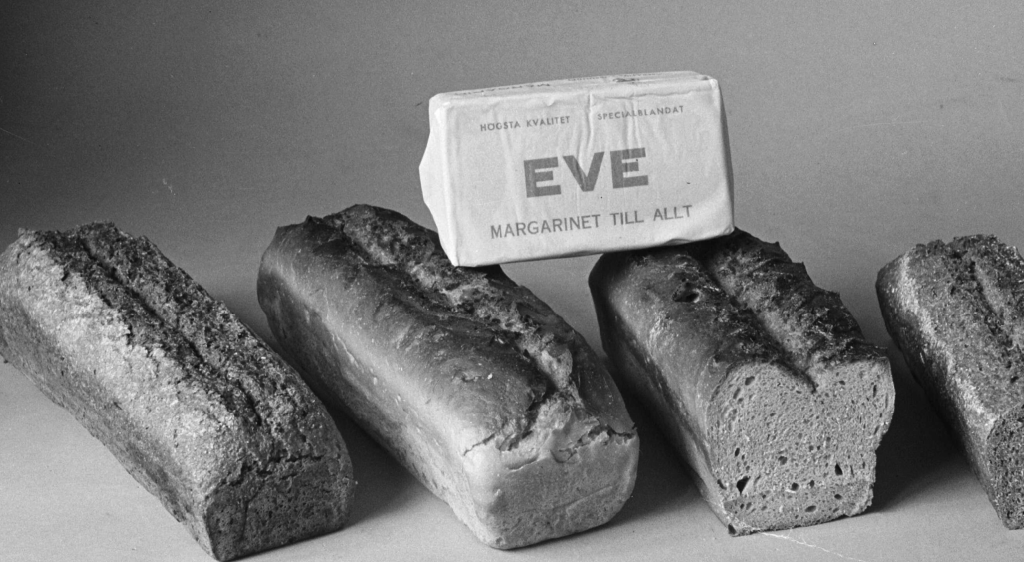
The Swedish white bread was a great gift to the Dutch population. Unfortunately, it was only a brief bright spot, and the winter of 1944–45 was not only extremely harsh but also very long-lasting.
Swedish White Bread
At the end of January 1945, the Red Cross transported flour from Sweden by ship. Only a month later could the legendary Swedish white bread be baked and distributed by Dutch bakers and bakeries.
The Hunger Winter
In October 1944, the population of the large cities in the western Netherlands had to survive on one kilogram of potatoes and one loaf of bread per person per week. At that time, the south of the Netherlands had already been liberated. Because of the general railway strike and the frozen rivers and canals, these rations became even smaller during the Hunger Winter.
Approximately 20,000 people died from starvation and cold during the Hunger Winter. As a sixteen-year-old boy, Van Duin experienced that harsh winter in The Hague:
“I once paid 250 guilders for a loaf of bread on the black market. That’s how great the shortage was. Because of the lack of food, my sense of taste had completely dulled; I hadn’t eaten anything good for half a year. Those sugar beets hurt your throat. We also ate wallpaper paste for weeks. Tapioca. We made porridge from it. A friend of my father owned a wallpaper shop. That’s where we got it when my father weighed only 47 kilos. It tasted terrible, and later we discovered it contained arsenic. But it filled your stomach, and that was the only thing that mattered.”
During the Hunger Winter, not only did the quantity of food decrease, the quality also deteriorated. Baker Piet Vlaming baked bread throughout the war in his bakery in Grootebroek.
“During the war I baked some real rubbish. Terrible for a craftsman, baking bread that doesn’t taste good. People brought their own flour to us. The flour was mixed with green peas, ground tulip bulbs, and sometimes even straw.”
The bakers faced more problems than bad-tasting bread. There was no electricity for the machines and no fuel for the ovens.
“So we pruned and split trees and basically threw anything combustible into the ovens. We did this together with all the bakers in the village because it was better to keep just one oven burning.”
Reports about the severe conditions in the large western cities led Prime Minister Gerbrandy in London to request permission for food aid. On 16 December 1944, he wrote to General Eisenhower that “the Dutch government cannot accept that corpses will be liberated.” The Allies agreed to limited food relief, and the Red Cross took charge of the operation. At the end of January 1945, three cargo ships filled with flour arrived from neutral Sweden at the port of Delfzijl. From there, the flour was slowly distributed across the Netherlands.
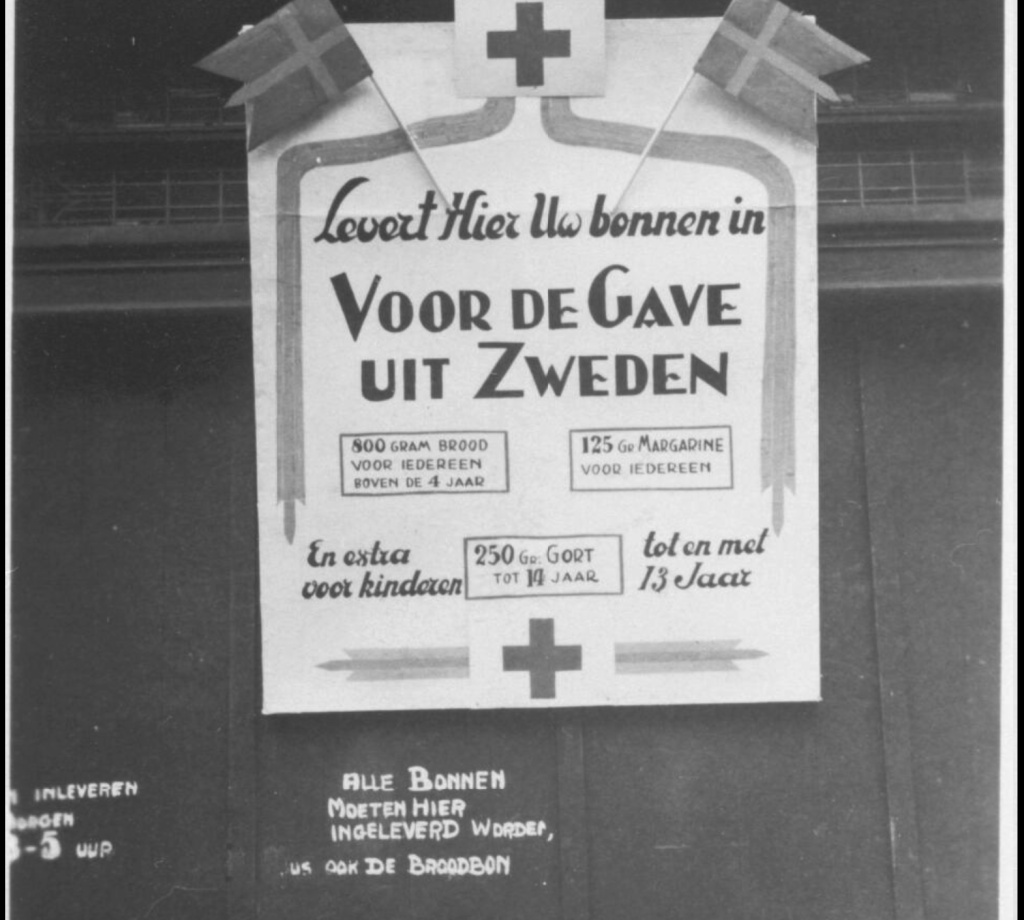
Half a loaf and a packet of margarine
From 27 February onward, bakers began baking Swedish white bread. Baker Vlaming said:
“Then came the Swedish white bread. It was simply white bread, but made from good flour, and we were no longer used to that. Wonderful to work with.”
Electricity was reconnected for baking the Swedish white bread — though not in every bakery. One central bakery was designated per region.
“I was the central bakery. The kneading machine could finally work again. We worked day and night. Six bakers from the village worked in shifts. After the war we were competitors again, of course, but at that moment we worked side by side.” According to Vlaming, customers were already lining up the next morning. Everyone over the age of four received half a Swedish white loaf and a small packet of Swedish margarine. Many said it tasted better than cake.
Memories of the bread brought back strong emotions. In many homes, rituals developed. Every day mothers carefully cut a slice for everyone, or children were allowed to decide for themselves how to divide their half loaf over the week. Van Duin photographed the Swedish white bread:
“With my father’s Leica camera I took a photo of the Swedish white bread — a kind of still life. You see the bread and the butter beside it. And strangely, there is also a vase with tulips. In hindsight that’s odd, because until then they had been our food.”
Mr. Schimmel, who grew up in The Hague, also remembers the Swedish white bread:
“The bread arrived at the beginning of March. I remember it exactly because on 3 March our street burned down after the Bezuidenhout bombing. I saw everyone fleeing outside, and most people had the Swedish white bread clutched under their arms. That was our most precious possession. Money no longer had any value. Only food had value. And the delicious Swedish white bread was the most valuable of all.”
sources
https://www.verzetsmuseum.org/nl/kennisbank/voedselhulp
https://anderetijden.nl/aflevering/391/Geschenk-uit-de-hemel-de-mythe-van-het-Zweeds-wittebrood
 History of Sorts
Leave a comment