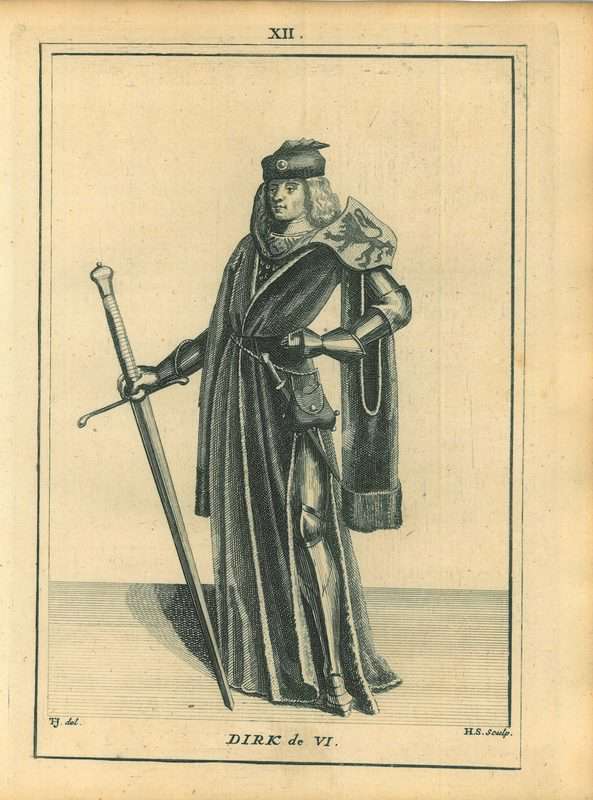
Dirk VI served as the Count of Holland from 1121 until his death in 1157. Succeeding his father, Floris II, at the age of seven, he initially ruled under the regency of his mother, Petronilla of Lorraine. His reign was defined by a delicate balancing act: acknowledging the Bishop of Utrecht as his overlord while simultaneously working to expand Holland’s territorial footprint.
A landmark achievement occurred in 1126 when Emperor Lothar III—Dirk’s maternal uncle—transferred the counties of Oostergo and Westergo from the Bishopric of Utrecht to Holland. Beyond politics, Dirk was a man of his era’s faith; in 1138, he embarked on a pilgrimage to Jerusalem. He married Sophie of Rheineck, the heiress of Bentheim, a union that secured his lineage through several children, including his successor, Floris III. Despite internal family strife and a violent rebellion led by his brother, Dirk’s legacy is one of steady consolidation for the nascent county.
Early Life and Regency
Birth and Inheritance
Born around 1114, Dirk VI was the eldest son of Floris II (known as “Floris the Fat”) and Petronilla of Lorraine. When his father passed away on March 2, 1121, the seven-year-old Dirk inherited the County of Holland through primogeniture. This inheritance included the core territories of Holland and the County of Maasland, along with various feudal obligations to the Holy Roman Emperor.
The Regency of Petronilla
Due to Dirk’s youth, Petronilla assumed immediate control as regent. She was a formidable leader who defended Holland’s interests through active diplomacy and administrative oversight until Dirk reached maturity around 1131. Even after he came of age, Petronilla remained a powerful influence. She was a notable patron of the church, founding Rijnsburg Abbey in 1133, where she eventually took vows and was buried in 1144.
Her regency was marked by a strategic use of her family ties to Emperor Lothar III. By securing imperial grants for Frisian lands, she countered the influence of the Bishopric of Utrecht, though her reluctance to relinquish power occasionally created tension with her son.
The Rebellion of Floris the Black
Origins of the Conflict
The most significant challenge to Dirk’s early rule came from his younger brother, Floris “the Black.” Born around 1115, Floris exploited the lingering unrest in West Frisia to challenge Dirk’s authority. By 1129, Floris had aligned himself with Frisian rebels who resisted the taxation and land rights imposed by the counts of Holland.
The situation grew dire when Floris gained temporary legitimacy, receiving recognition as Count of Holland from Emperor Lothar III and several regional lords between 1129 and 1131. This split the loyalties of Holland’s vassals and threatened to fracture the county entirely.
Military Campaigns and Resolution
The fraternal rivalry escalated into open warfare in 1132. Supported by West Frisian insurgents, Floris launched a direct insurrection. Dirk responded with a punitive military campaign into West Frisia to suppress the uprising and dismantle his brother’s power base.
The conflict reached a violent conclusion on October 26, 1132, in Utrecht. Floris was killed in battle by Godfrey and Hermann of Kuyk. With his brother’s death, the rebellion collapsed, allowing Dirk to reclaim undisputed control over his territories. Free from imperial contestation, Dirk spent the remainder of his reign stabilizing the borders and solidifying the authority of the House of Holland.
Military Campaigns and Recognition Disputes
Between 1129 and 1131, the legitimacy of Dirk’s rule was severely undermined by the open revolt of his brother, Floris “the Black.” Floris managed to secure recognition as the rightful Count of Holland from Holy Roman Emperor Lothair III and influential local lords like Andreas of Kuyk. This period of fractured loyalty forced Dirk to spend his early years as count fighting to reclaim his authority.
The conflict reached a tipping point in 1132 when the West Frisians launched an insurrection in support of Floris. Dirk responded with a punitive military campaign into West Frisia, utilizing skirmishes and the targeting of rebel strongholds to reassert dominance. This era of internal strife ended abruptly on October 26, 1132, near Utrecht, when Floris was killed by the brothers Godfrey and Hermann of Kuyk.
Resolution and Retribution
Though Floris had been his rival, his death at the hands of the Cuijk family demanded a response. Dirk mobilized a powerful coalition—including Emperor Lothair III and the counts of Kleve and Gelre—to avenge his brother. In 1133, this force invaded the Cuijk territories, razing their family castle and driving the brothers into exile.
Peace was eventually restored after the Emperor’s death in 1137. The Cuijk brothers were permitted to return as vassals, with Herman donating lands and building a new fortress at Grave. With his internal opposition eliminated, Dirk was finally able to govern a unified Holland.
Internal Affairs and Governance
Ecclesiastical Relations
Dirk’s governance was characterized by a pragmatic, often opportunistic, relationship with the Church. He maintained the traditional acknowledgment of the Bishop of Utrecht as his suzerain, but he used his imperial connections to tilt the scales in his favor. This was most evident in 1126, when the Emperor transferred control of Oostergo and Westergo from the Utrecht bishopric to Dirk, significantly expanding the county’s reach.
Piety and the Pilgrimage of 1138
In 1138, reflecting the crusading fervor of the 12th century, Dirk undertook a pilgrimage to Jerusalem. This journey served to bolster his prestige and spiritual standing during a time of relative domestic peace. The trip had a lasting impact on his family; his eldest son, born around this time, was nicknamed “Peregrinus” (the Pilgrim) in honor of the event.
Dirk’s personal devotion was also reflected in his family’s clerical ties. Several of his children entered the church, including his sons Boudewijn and Dirk, who both eventually served as Bishops of Utrecht, and his daughter Sophia, who became the Abbess of Rijnsburg.
External Relations and Imperial Ties
A Loyal Imperial Vassal
Throughout his reign, Dirk VI operated as a loyal and strategically placed vassal of the Holy Roman Empire. His power was deeply rooted in his kinship with Emperor Lothair III. This blood relation was the primary driver behind the 1126 territorial grants that bolstered Holland’s northern borders.
Marriage and Influence
His marriage to Sophia of Rheineck further solidified his standing. Sophia belonged to a prominent Rhenish noble family with strong ties to the Salian and Hohenstaufen courts. This union aligned Holland’s interests with the imperial elite, ensuring that Dirk remained a favored figure within the Empire’s complex feudal hierarchy.
Dirk VI died on August 5, 1157, and was buried at Egmond Abbey, the traditional resting place of the Gerulfing dynasty. He left behind a county that was far more stable and geographically expansive than the one he had inherited as a child.
sources
 History of Sorts
Leave a comment