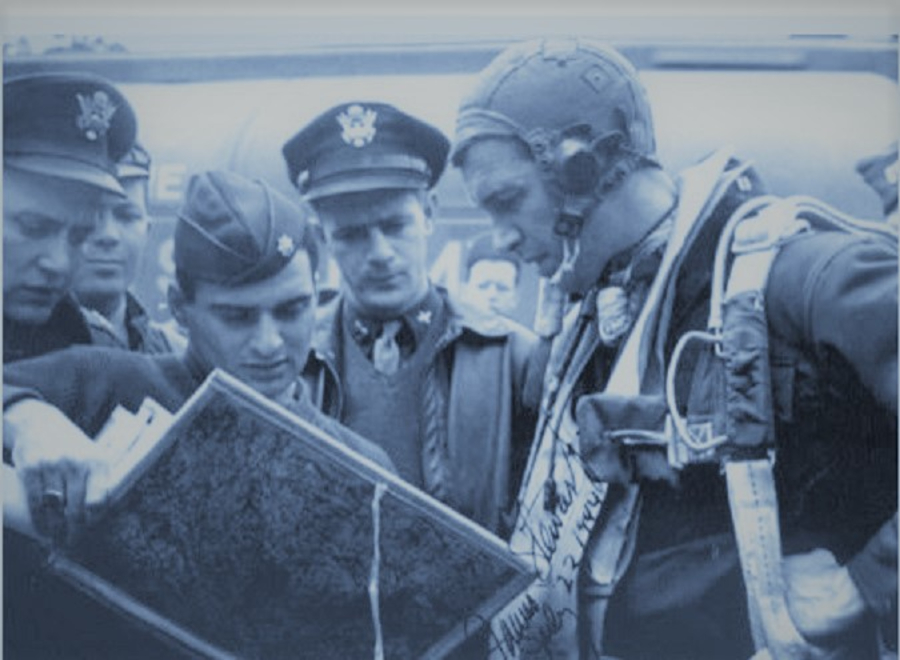
Stewart’s draft number was 310, and when he appeared before Draft Board No. 245 in West Los Angeles in February 1941, the 6’3” actor weighed just 138 pounds—five pounds under the minimum requirement. He was rejected for service.
Undeterred, Stewart took matters into his own hands. Aware he was nearing the age limit for flight school, he returned home and deliberately increased his calorie intake to gain weight. When he reapplied to the Army Air Corps shortly thereafter, he had added just enough to meet the physical standards. While many sought to avoid the draft, Stewart actively pursued military service, becoming the first major Hollywood star to enlist before the United States entered World War II.
On March 22, 1944, Major James “Jimmy” Stewart flew one of the most significant missions of his military career.
Leading the 2nd Combat Bombardment Wing, Stewart commanded a massive formation of B-24 Liberators in a high-stakes daylight raid on Berlin. This was his 12th combat mission, and it came during a period of intense aerial warfare where the “Mighty Eighth” Air Force was systematically dismantling the German industrial machine.
When James Stewart flew his twelfth combat mission over Nazi Germany, the moment encapsulated a rare convergence of Hollywood fame and the stark realities of total war. By that stage in his military service, Stewart was no longer merely a recognizable face from films; he had become a fully committed officer in the United States Army Air Forces, entrusted with significant responsibility. Leading elements of the 2nd Bomb Wing in an attack on Berlin, Stewart’s role underscored both his competence as a commander and the broader strategic importance of the Allied bombing campaign.
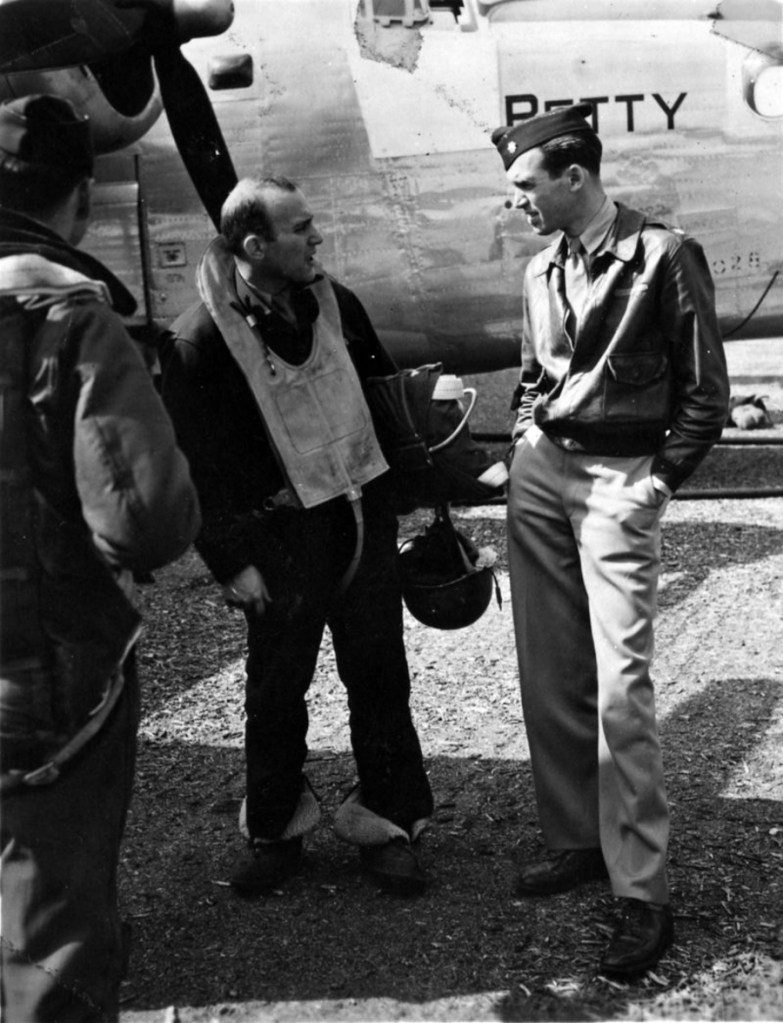
This mission took place within the larger context of the Allied effort to cripple Germany’s industrial and military infrastructure. Berlin, as the heart of the Nazi regime, represented a critical and heavily defended target. By the time of Stewart’s twelfth mission, the risks were well understood: anti-aircraft fire (flak), enemy fighter interception, mechanical failure, and the ever-present uncertainty of survival. Unlike the controlled environment of a film set, the skies over Berlin offered no second takes. Each decision carried immediate and often irreversible consequences.
Stewart’s leadership during this operation was particularly significant. As a mission leader, he was responsible not only for navigating to the target but also for maintaining formation integrity among the bombers—a crucial factor in maximizing defensive firepower and bombing accuracy. The 2nd Bomb Wing’s success depended on disciplined coordination under extreme pressure. Stewart’s calm demeanor and methodical approach helped ensure that the formation stayed cohesive despite intense enemy resistance. His performance reflected a deep understanding of both the technical and human dimensions of aerial warfare.
What makes this moment especially compelling is the contrast between Stewart’s pre-war identity and his wartime service. Before enlisting, he had already achieved stardom in Hollywood, known for roles that emphasized sincerity and moral clarity. Yet during the war, he deliberately avoided leveraging his celebrity status for safer assignments. Instead, he insisted on flying combat missions, gradually rising in rank through demonstrated merit. By his twelfth mission, he had already begun to earn the respect of his peers not as an actor in uniform, but as a capable and reliable officer.
The attack on Berlin also illustrates the psychological demands placed on bomber crews. Missions over heavily defended territory were among the most dangerous in the European theatre. Crew members faced not only physical injuries but also cumulative stress from repeated exposure to life-threatening raids. Stewart’s presence as a leader carried symbolic weight; his willingness to share the same risks as his men reinforced unit cohesion and morale. In this sense, his leadership extended beyond tactical execution to include the intangible but critical domain of trust.
“I was scared. Anybody who says they weren’t scared is either a liar or there’s something wrong with them.” — James Stewart, reflecting on his time over Germany.
Stewart eventually retired from the U.S. Air Force Reserve in 1968 as a Brigadier General, making him the highest-ranking actor in American military history.
James Stewart’s legacy reaches far beyond Hollywood. He was a genuine patriot who stepped away from a successful acting career to serve his country, facing real danger on the front lines. His courage, dedication, and leadership continue to inspire generations.
sources
https://en.wikipedia.org/wiki/James_Stewart
https://ww2aircraft.net/forum/threads/jimmy-stewart-bomber-pilot-by-starr-smith.33397/
 History of Sorts
Leave a comment