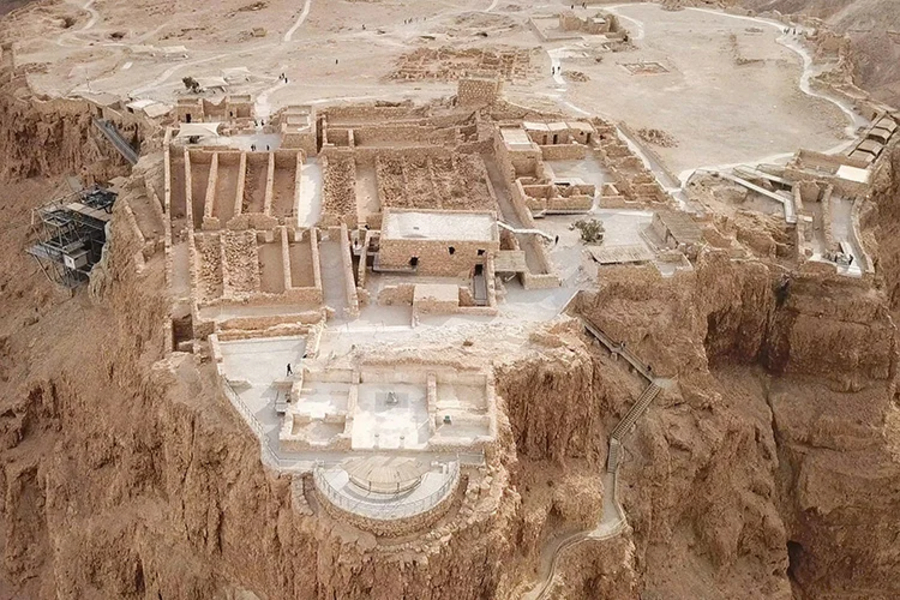
The fall of Masada in 79 AD (some sources give another date)stands as one of the most symbolically charged episodes of the ancient world, marking the dramatic conclusion of the First Jewish–Roman War. Perched atop a rugged plateau overlooking the Dead Sea, Masada was not merely a fortress—it was a final refuge, a political statement, and ultimately, a site of profound tragedy.
Originally fortified by Herod the Great in the first century BCE, Masada was engineered as both a palace and a stronghold. Its natural defenses—sheer cliffs and limited access routes—were reinforced with casemate walls, storehouses, and sophisticated water systems. Herod intended it as a sanctuary against both internal revolt and external invasion, but decades later, it would serve a very different purpose.
During the Jewish revolt against Rome, a group of Jewish rebels known as the Sicarii seized Masada and transformed it into their last bastion. As Roman forces gradually crushed resistance across Judea, culminating in the destruction of Jerusalem in 70 AD, Masada remained one of the final holdouts. For Rome, leaving such a defiant enclave untouched was unacceptable; for the rebels, surrender was equally unthinkable.
The Roman siege, led by the governor Lucius Flavius Silva, was a methodical demonstration of imperial military engineering. Roman legions constructed a circumvallation wall encircling the mountain, effectively cutting off escape and supply lines. Their most remarkable feat was the massive siege ramp built against the western side of the plateau—a gradual incline of earth and stone that allowed them to bring a battering ram to the fortress walls. This project, carried out over several months under harsh desert conditions, exemplified Roman persistence and logistical superiority.
Inside Masada, the defenders faced dwindling resources and the inevitability of defeat. According to the account of Flavius Josephus, the rebels, led by Eleazar ben Ya’ir, chose mass suicide over capture when it became clear the Romans would breach the defenses. In a final act of collective resolve, they destroyed their possessions, killed their families, and ultimately took their own lives, leaving only a handful of survivors to recount the events.
When Roman troops finally entered the fortress, they encountered silence rather than resistance. The victory was total, yet hollow: there were no prisoners to parade, no final battle to commemorate. Instead, Masada became a stark symbol of the costs of resistance and the extremes of human conviction.
Historically, the fall of Masada represents more than the end of a military campaign. It encapsulates the asymmetry between imperial power and local resistance, illustrating how Rome’s organizational capacity could overcome even the most formidable natural defenses. At the same time, the narrative of Masada—shaped largely by Josephus—raises enduring questions about historical memory, martyrdom, and the line between heroism and despair.
In modern times, Masada has taken on renewed cultural and national significance, particularly in Israeli identity, where it is often invoked as a symbol of resilience and the determination to avoid subjugation. Yet the story also invites a more nuanced reflection: the fall of Masada was not simply a tale of bravery, but a complex moment where ideology, survival, and inevitability collided.
Thus, on that day in 79 AD, Masada did not merely fall—it entered the realm of legend, where history and meaning intertwine, continuing to provoke debate about the nature of resistance, the ethics of sacrifice, and the enduring shadow of empire.
sources
https://en.wikipedia.org/wiki/Masada
https://aeon.co/essays/decoding-the-ancient-tale-of-mass-suicide-in-the-judaean-desert


Leave a Reply