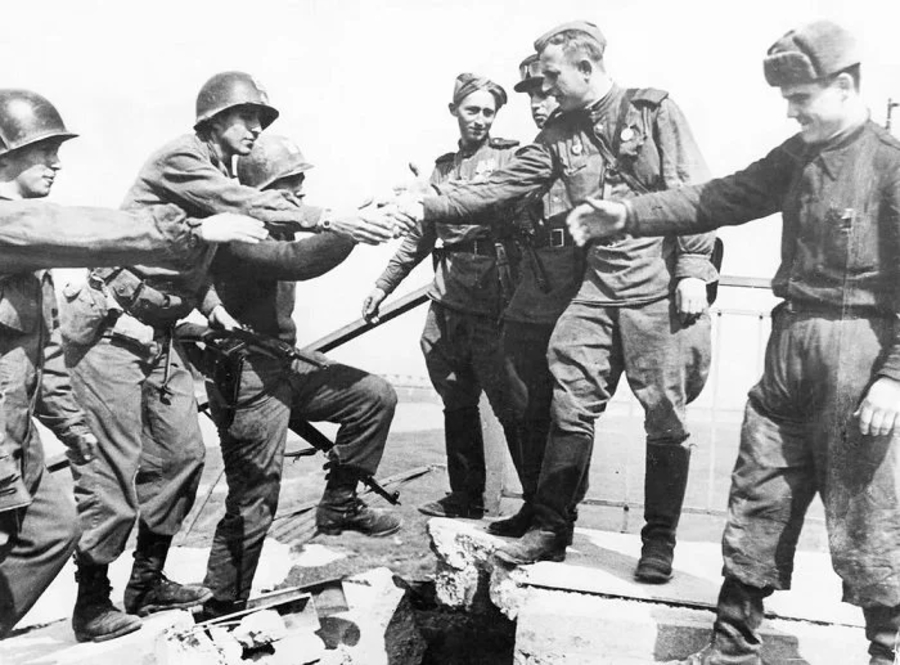
Elbe Day, observed on April 25, commemorates a pivotal moment near the close of World War II in Europe when American and Soviet forces met along the Elbe River in Germany in 1945. This encounter represented far more than a tactical milestone; it symbolized the collapse of Nazi Germany and the temporary unity of two vastly different powers against a common enemy.
By the spring of 1945, Allied forces were closing in on Germany from both the west and the east. American troops, advancing through western Germany, and Soviet forces, pushing relentlessly from the east after years of brutal conflict, were both nearing Berlin. On April 25, soldiers of the U.S. 69th Infantry Division and the Soviet Red Army’s 58th Guards Rifle Division made contact near the town of Torgau on the Elbe River. Photographs of American and Soviet soldiers shaking hands atop the destroyed bridge at Torgau quickly became iconic, capturing a rare moment of camaraderie between two nations that would soon become adversaries.
The meeting effectively split Nazi Germany into northern and southern halves, hastening the end of the war in Europe. Within weeks, Adolf Hitler would be dead, and Germany would surrender unconditionally on May 8, 1945. In this sense, Elbe Day stands as a tangible marker of the war’s imminent conclusion and the success of Allied coordination despite ideological differences.
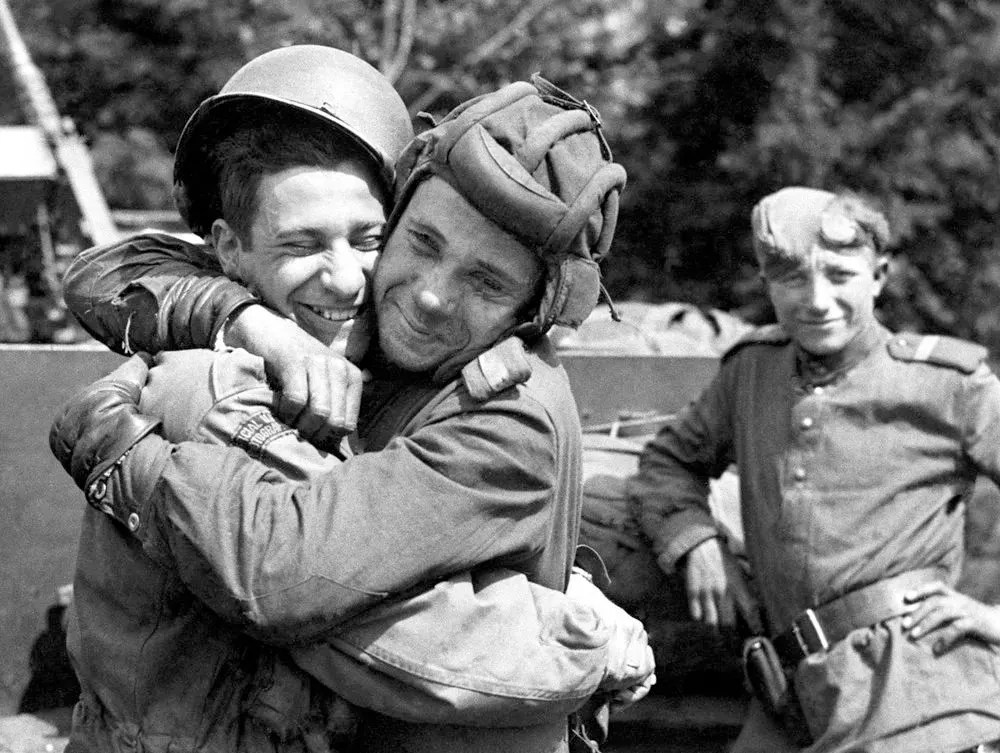
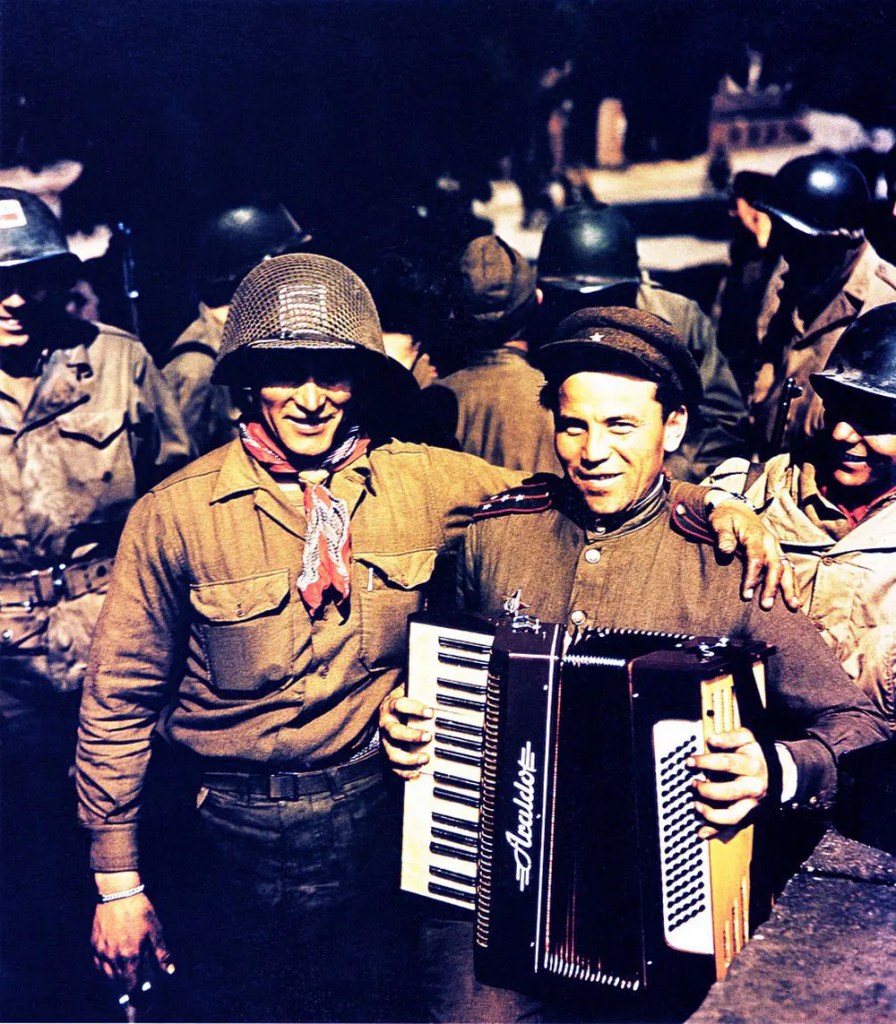
However, the deeper significance of Elbe Day lies in its symbolism. For a brief moment, the alliance between the United States and the Soviet Union appeared strong and hopeful. Soldiers on both sides reportedly exchanged small gifts, shared food, and celebrated together. These interactions reflected a shared relief after years of devastating conflict and suggested the possibility of continued cooperation in rebuilding a shattered world.
Yet this optimism proved short-lived. The ideological divide between capitalism and communism soon reasserted itself, giving rise to the Cold War. Within a few years, the wartime allies were locked in political, military, and economic rivalry that would shape global affairs for decades. In hindsight, Elbe Day can be seen as both a high point of Allied unity and a fleeting moment before the onset of a new kind of conflict.
Today, Elbe Day is remembered as a reminder of what cooperation between nations can achieve, even under the most difficult circumstances. It underscores the importance of dialogue, mutual respect, and shared goals in overcoming global challenges. While the alliance it represents was temporary, the lesson it offers remains enduring: that even the deepest differences can be set aside in pursuit of a common good.
Lt. Bill Robertson of the 273rd Regiment, 69th Infantry Division, drove into the town of Torgau on the morning of April 25 knowing he might encounter Soviet troops. He had been instructed to greet them as allies—Gen. Courtney Hodges, commander of the First U.S. Army, had ordered his men to “treat them nicely.” Yet Robertson was unprepared for the precise protocol agreed upon months earlier at Yalta by President Franklin Roosevelt, Soviet leader Joseph Stalin, and British Prime Minister Winston Churchill.
According to that plan, the first American soldiers to make contact were to fire a green star shell, while the Soviets would respond with a red one. Robertson and the three men in his patrol had no such means of signaling. Instead, they improvised: lacking an American flag, they painted a crude version of the Stars and Stripes onto a white sheet and raised it as best they could.
On the Soviet side, Lt. Alexander Sylvashko viewed the scene with suspicion. The sight of four men waving a makeshift flag struck him as a possible ruse—perhaps German soldiers attempting deception. Though he fired a red star shell, no green signal came in return.
Cautiously, Sylvashko sent a soldier, Andreev, to approach the Americans. The two sides met at the center of a partially destroyed bridge over the Elbe River. There, Robertson and Andreev exchanged an awkward embrace and raised their hands in the “V for Victory” sign—a simple gesture marking a moment of immense historical significance.
The following day, a formal ceremony brought together dozens of soldiers from both armies at the same site. They swore a joint oath in memory of those who had fallen:
“In the name of those who have fallen on the battlefields, those who have left this life, and in the name of their descendants, the way to war must be blocked.”
On that shattered bridge, American and Soviet soldiers forged something new—a symbolic bridge between nations, built on shared sacrifice and victory.
The troops mingled as comrades, embracing one another and exchanging buttons, stars, and patches from their uniforms. This exchange of souvenirs soon extended to senior officers. Soviet Marshal Ivan Konev presented U.S. General Omar Bradley with a prized Don stallion, while Bradley awarded Konev the Legion of Merit and gifted him a jeep. Marshal Georgy Zhukov later honored Supreme Allied Commander Dwight D. Eisenhower with the Order of Victory, the Soviet Union’s highest decoration; Eisenhower, in turn, presented Zhukov with the Legion of Honor.
sources
http://news.bbc.co.uk/onthisday/hi/dates/stories/april/27/newsid_3563000/3563723.stm
https://en.wikipedia.org/wiki/Elbe_Day
https://www.joyvspicer.com/joy-blog/2023/4/23/this-day-in-history-elbe-day


Leave a comment