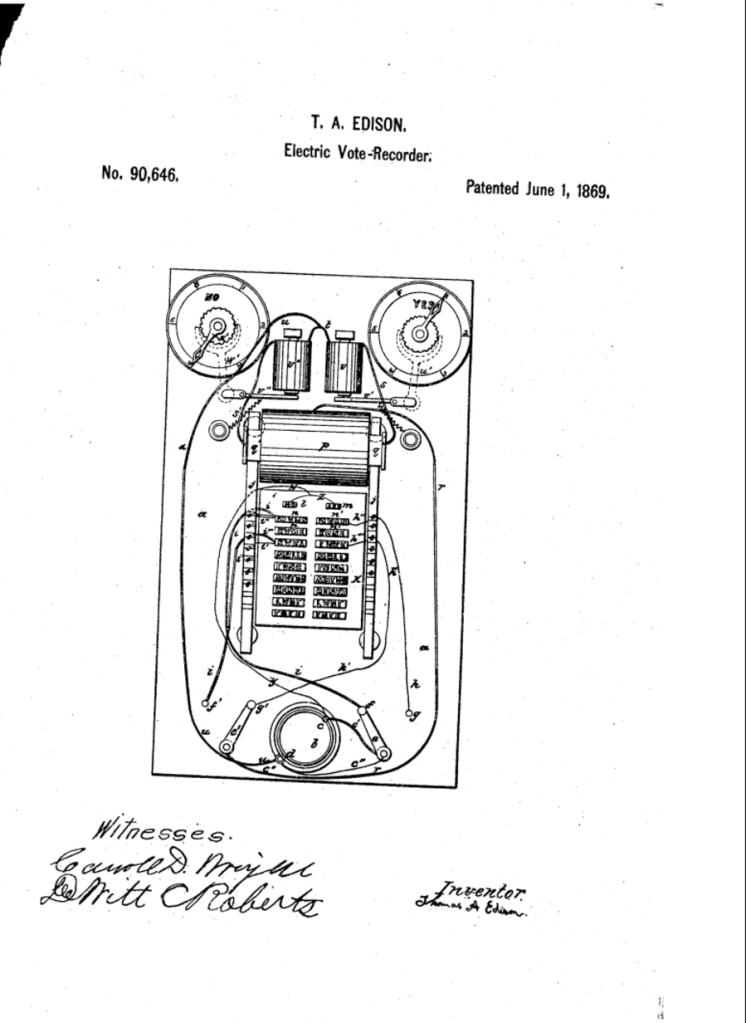
U.S. Patent No. 90,646 stands as one of the most important milestones in the history of technology: it was Thomas Alva Edison’s first patented invention.
Granted on June 1, 1869, the patent covered an “Improvement in Electrographic Vote-Recorders.” Edison developed the device at just 22 years old while working as a telegraph operator. His goal was ambitious—to transform the way legislative bodies, including the U.S. Congress, recorded votes.
The Invention: A Faster Way to Vote
Before Edison’s invention, legislative voting was a slow and labor-intensive process. During a roll-call vote, a clerk would call each member’s name individually and record their verbal response. A single vote could take up to 45 minutes to complete.
Edison believed telegraphic technology could reduce this process to mere seconds.
How It Worked
Individual Voting Switches
Each legislator’s desk was equipped with a switch that could be set to either “Yes” or “No.”
Central Recording Machine
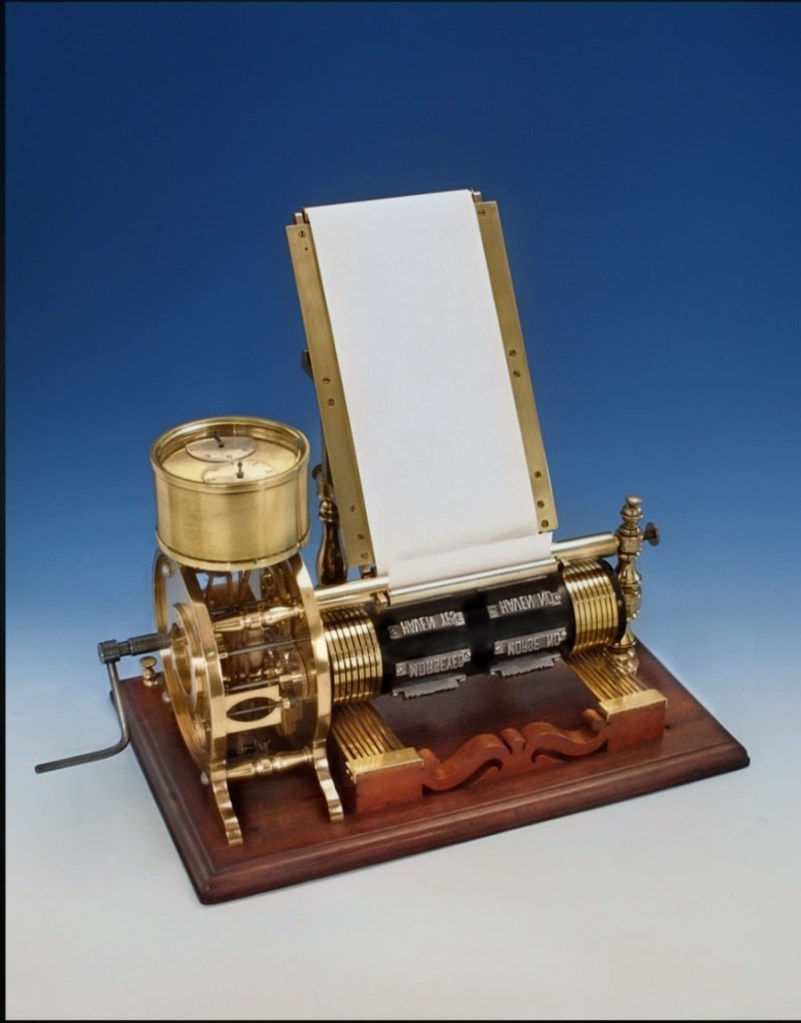
At the clerk’s desk, a central recorder contained a metal cylinder wrapped in chemically treated paper. The paper was printed with legislators’ names under two columns: “Yes” and “No.”
Electronic Vote Transmission
When the clerk activated the system by turning a crank, an electric current traveled through wires connecting every legislator’s desk to the central recorder.
Automatic Vote Recording
The electrical current triggered an electrochemical reaction. A metal stylus marked the treated paper next to each legislator’s name, either by dissolving a coating or altering the paper’s color. At the same time, mechanical dials displayed a running tally of the votes.
The result was a near-instantaneous and highly accurate voting system—decades ahead of its time.
The Political Rejection: “Too Fast” for Congress
Confident in the invention’s potential, Edison traveled to Washington, D.C., to demonstrate the prototype before a committee of the U.S. House of Representatives.
The response was devastating.
According to Edison’s later recollections, the committee chairman rejected the device outright, telling him:
“Young man, if there is any invention on earth that we don’t want down here, it is this. One of the greatest safeguards of minority rights in Congress is the slowness of parliamentary procedure, and the roll-call is used to delay legislation. Your instrument would prevent that.”
The problem was not that the machine failed—it worked exactly as intended.
Congressional procedure often relied on the lengthy roll-call process. Lawmakers used the time to negotiate, persuade colleagues, delay legislation, build coalitions, and employ parliamentary tactics. By reducing voting time from nearly an hour to a few seconds, Edison’s invention eliminated a tool many politicians considered essential.
In other words, the technology solved a problem that its intended users did not want solved.
The Failure That Shaped Edison’s Future
Congress declined to adopt the vote recorder, and state legislatures showed little interest as well. The invention was a commercial failure, leaving Edison discouraged and financially strained.
Yet the experience became one of the most influential lessons of his career.
Edison realized that technical ingenuity alone was not enough. Successful inventions had to address genuine market demand and solve problems that customers actually wanted solved.
The lesson permanently shaped his approach to innovation. From that point forward, Edison focused on creating products with clear commercial applications rather than inventions that were merely clever or technologically impressive.
Years later, he summarized the philosophy that emerged from this early failure:
“Anything that won’t sell, I don’t want to invent. Its sale is proof of utility, and utility is success.”
Soon afterward, Edison returned to telegraphy and developed an improved stock ticker. The invention was a commercial success, earning him approximately $40,000—a fortune at the time—and providing the capital that helped launch the laboratories and enterprises that would make him one of history’s most prolific inventors.
Ironically, Edison’s first patent failed not because it was flawed, but because it was too effective. The invention offered a technological solution to a problem that politics had no interest in eliminating—a lesson that shaped one of the greatest inventive careers in history.
sources
https://www.thehenryford.org/collections/explore/artifact/251711?AssetId=THF11607


Leave a Reply