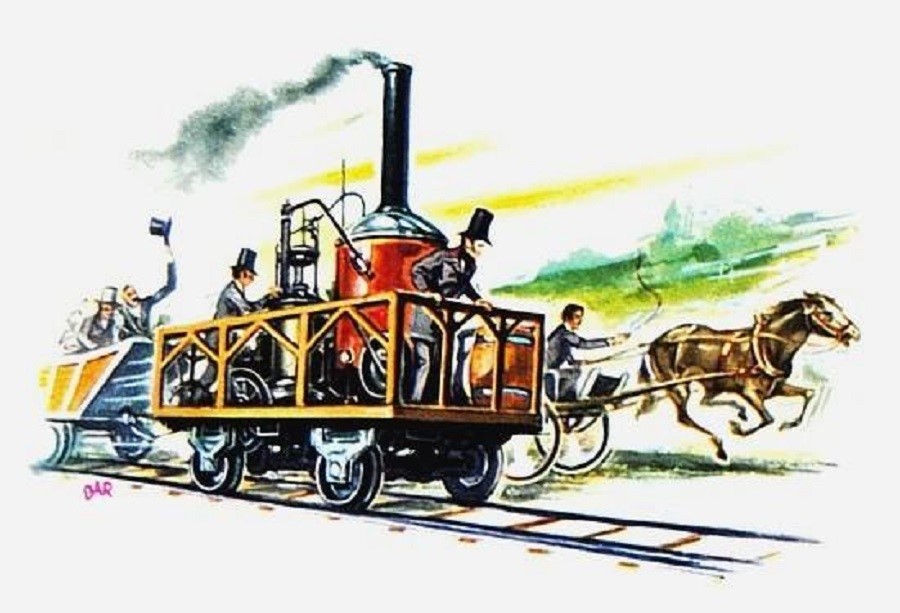
On August 28, 1830, an extraordinary contest took place on the tracks of the Baltimore and Ohio Railroad (B&O) in Maryland. It was not a conventional horse race, nor was it a competition between two locomotives. Instead, a living horse found itself competing against one of the most remarkable inventions of the Industrial Revolution: Peter Cooper’s tiny steam locomotive, the Tom Thumb. Although the horse ultimately won, the race became an important symbol of the coming transformation of transportation from animal power to steam.
A World Still Powered by Horses
In 1830, railroads were still a relatively new technology in the United States. The Baltimore and Ohio Railroad had been established in 1827 and was among the country’s earliest railroads. Its initial operations relied heavily on horses, which pulled railroad cars along the tracks.
This was hardly surprising. For centuries, horses had been the principal source of mechanical power for transportation on land. A horse could pull a wagon, carriage or railway car without the enormous expense and complexity associated with a steam engine.
Yet the limitations of animal power were becoming increasingly obvious. Horses became tired, required food and rest, and could not maintain high speeds indefinitely. Steam engines, by contrast, promised continuous mechanical power.
The B&O therefore had a keen interest in determining whether steam locomotives could replace horses.
Enter Peter Cooper and the Tom Thumb
One of the people fascinated by this possibility was Peter Cooper, a New York inventor and businessman. Cooper believed that steam locomotion could provide the B&O with a faster and more efficient means of moving passengers and freight.
He constructed a remarkably small locomotive that became known as the Tom Thumb. It was crude by later standards, but it represented an important technological experiment. The locomotive was designed to demonstrate that steam power could successfully operate on the B&O’s relatively primitive track.
On August 28, Cooper demonstrated the locomotive on the railroad’s line between Baltimore and Ellicott’s Mills, now Ellicott City. The little machine attracted considerable attention. According to later accounts, it was capable of reaching roughly 10–15 miles per hour, an impressive speed for such an experimental machine
The Tom Thumb also carried passengers, including B&O directors, giving them an opportunity to experience the strange sensation of being pulled along the rails by a machine rather than by horses.
The Challenge
During the return journey, the Tom Thumb encountered a horse-drawn railroad car. The horse was reportedly a powerful gray belonging to a local stagecoach operation. What happened next became one of the most famous stories in American railroad history.
The horse and the locomotive were placed on parallel tracks, and an impromptu race began.
At first, the horse had the advantage. The Tom Thumb needed time to build up steam, while the horse could immediately accelerate. But as pressure increased inside Cooper’s boiler, the little locomotive began to gain ground.
According to the traditional account, the Tom Thumb gradually overtook the horse. The passengers reportedly cheered as the strange mechanical machine surged ahead. For a brief moment, it appeared that the future of transportation had arrived—and that the future was winning.
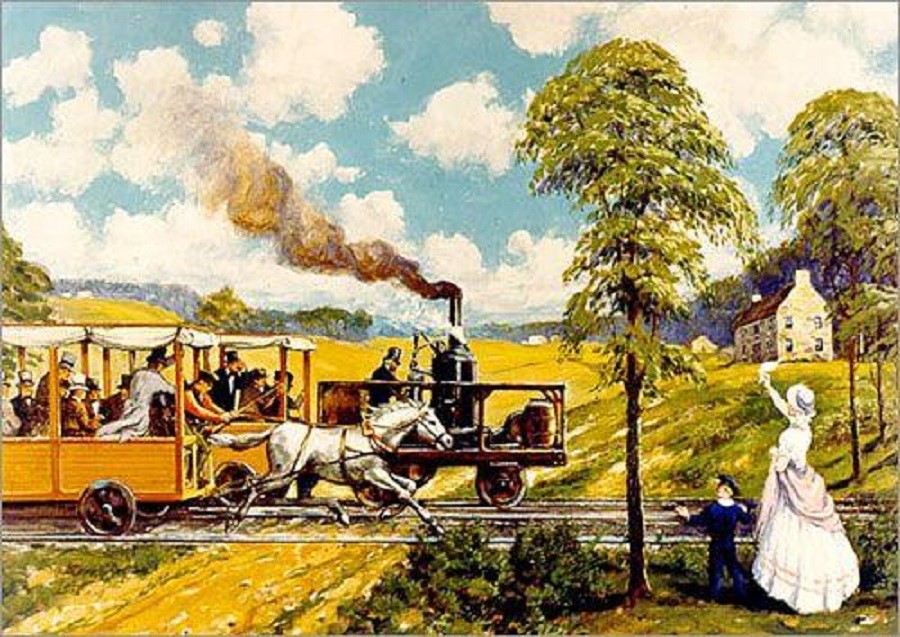
Then disaster struck.
The Mechanical Failure
Just when the Tom Thumb seemed certain to win, a leather belt driving the locomotive’s blower slipped from its pulley. The blower was essential to maintaining the draft needed to keep the fire burning efficiently. Without it, the locomotive began to lose power.
The horse immediately regained the advantage.
Cooper desperately attempted to repair the mechanism while the locomotive slowed. Accounts describe him burning or injuring his hands as he struggled to replace the belt. Eventually he managed to restore the mechanism, but by then the horse had established too great a lead.
The horse crossed the finish ahead of the locomotive.
The horse had won.
Yet the apparent defeat of the Tom Thumb turned out to be one of the most consequential “losses” in the history of transportation.
The Horse Won the Race—But Steam Won the Future
The B&O directors were not discouraged by the mechanical failure. Quite the opposite: they had witnessed something far more important than the result of the race.
The Tom Thumb had demonstrated that a small steam locomotive could accelerate rapidly, haul passengers and negotiate curves while maintaining a speed that could challenge a horse-drawn train. The fact that the locomotive had been stopped by a mechanical failure rather than an inherent inability to compete was particularly significant.
The experiment helped convince the railroad’s management that steam power was the future.
Within a remarkably short time, the B&O moved away from dependence on horses. By 1831, steam locomotives were beginning to replace animal power on the railroad.
The transformation was part of a much larger revolution. Railways powered by steam would soon spread throughout the United States and Europe, dramatically reducing travel times and making it possible to transport enormous quantities of goods and people over long distances.
A Story with a Historical Caveat
There is, however, an important qualification to the famous story.
Although August 28, 1830, is widely given as the date of the race, the event was not documented at the time in the way that modern readers might expect. The best-known account was related decades later, particularly in an 1868 lecture by John H. B. Latrobe, a prominent figure associated with the B&O. The B&O Railroad Museum notes that the famous race has never been conclusively substantiated by contemporary documentation.
Some historical sources have suggested other dates, including August 25 or September 28, 1830. Thus, historians generally treat the race as a famous and plausible episode whose precise circumstances remain uncertain.
That uncertainty does not diminish its historical importance. Whether every detail occurred exactly as the traditional story describes, the Tom Thumb itself was real, and Peter Cooper’s locomotive really did demonstrate the potential of steam power on the B&O.
The Symbolism of the Race
The story has endured because it perfectly captures a pivotal moment in history.
On one side was the horse—a symbol of thousands of years of human civilization, transportation and agricultural labor. On the other was the steam locomotive—a noisy, smoky and seemingly unnatural machine representing the Industrial Revolution.
The horse won the contest, but the machine won the argument.
Within a generation, railways would become one of the defining technologies of the nineteenth century. Steam locomotives would cross mountains, connect cities and eventually span entire continents. The horse would remain enormously important, but its dominance over long-distance transportation was beginning to disappear.
The irony is therefore irresistible: the horse that defeated the first American steam locomotive was technically the winner, but historically it was the loser.
Conclusion
The alleged race of August 28, 1830, between a horse-drawn railroad car and Peter Cooper’s Tom Thumb represents far more than an amusing contest between an animal and a machine. It symbolizes the moment when an old form of transportation confronted the new industrial age.
The horse had the advantage of simplicity. It needed no boiler, no coal, no belts and no mechanical engineer. When the locomotive failed, the horse simply kept running.
But the Tom Thumb offered something the horse could never provide: mechanical power that could ultimately be multiplied, sustained and integrated into a vast industrial transportation system.
The gray horse may have crossed the finish line first. But in the larger race between animal power and steam power, the little Tom Thumb had already pointed toward the future.
On August 28, 1830, the horse won the race—but the steam locomotive won the century.
Sources:
https://www.fhwa.dot.gov/rakeman/1830.htm
https://www.onthisday.com/articles/horse-in-race-against-a-train


Leave a comment