Because today is International Day of the Disappeared
There are few things more unsettling than a person who simply disappears.
When someone dies, however tragically, there is usually a funeral, a grave, a place where flowers can be laid, and eventually—however painful—some measure of acceptance. When a person vanishes without trace, none of those things necessarily exists. Families can be left suspended between hope and despair, returning again and again to the same questions: Where are they? What happened to them? Who knows the truth?
Ireland has experienced a particularly painful chapter in this history. Over several decades, women and girls have disappeared from streets, roadsides, towns and rural communities, leaving behind families who have spent years—and sometimes entire lifetimes—searching for answers.
Some cases have been solved. Some have resulted in convictions. Others remain shrouded in uncertainty. Among the most haunting are a group of disappearances, particularly those of the 1990s, which became woven into Ireland’s collective memory and gave rise to the term “the Vanishing Triangle.”
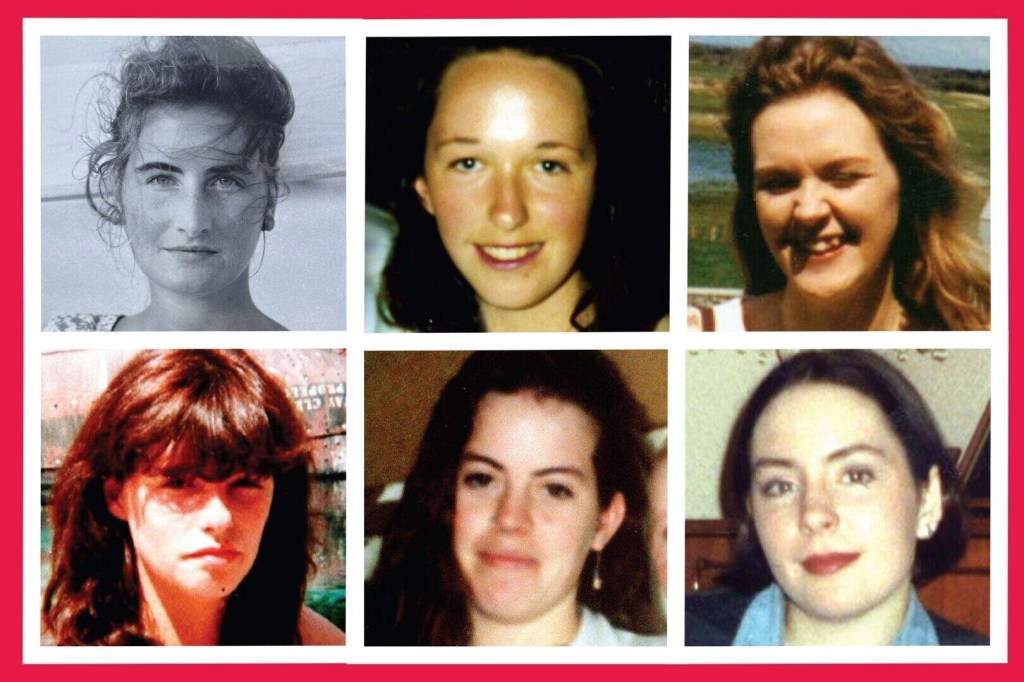
The names remain familiar: Annie McCarrick, Eva Brennan, Imelda Keenan, Jo Jo Dullard, Fiona Pender, Ciara Breen, Fiona Sinnott and Deirdre Jacob.
Their stories are often discussed together, but they were not a single story. Each woman had her own life, family, friendships, ambitions and hopes. Each disappearance was its own tragedy.
And although the expression Vanishing Triangle has become synonymous with these cases, Ireland’s history of missing women extends far beyond it. It includes women who disappeared in earlier decades, women whose remains were eventually found, women whose cases remain unresolved, and women whose lives were obscured by the institutions and social attitudes of an earlier Ireland.
What does it mean to be missing?
It is important to distinguish between missing persons generally and those cases in which a disappearance remains unexplained for years or decades.
People go missing for many reasons. Some leave voluntarily. Some become lost or suffer accidents. Others disappear because of personal crises, vulnerability or mental-health difficulties. Some are victims of crime.
The vast majority of missing-person reports do not become decades-long mysteries.
The statistics demonstrate the scale of the wider issue. According to An Garda Síochána, there were 11,889 missing-person reports in 2025, involving 4,177 individual people. At the end of that year’s reporting period, 48 people remained missing. During the first half of 2026, 2,381 people were reported missing, with 45 remaining missing in the statistics available at the end of July.
These figures are an important reminder that a missing-person investigation is not automatically a murder investigation.
But some disappearances possess circumstances that make the possibility of foul play impossible to ignore.
In several of the cases discussed here, Gardaí eventually concluded that the missing women were likely victims of murder, even though their remains have never been recovered. For their families, the absence of a body has meant the absence of certainty.
That uncertainty can be its own form of torment.
The Vanishing Triangle
The term Vanishing Triangle emerged in the 1990s as a number of young women disappeared from an area broadly encompassing parts of Leinster.
The expression suggested a geographical pattern—and with it came fear.
Young women who had once travelled alone, hitchhiked, accepted lifts from strangers or walked home after socialising began to reconsider how they moved around the country. The disappearances became part of the consciousness of an entire generation.
The cases most commonly associated with the 1990s group are:
- Annie McCarrick, disappeared in 1993
- Eva Brennan, disappeared in 1993
- Imelda Keenan, disappeared in 1994
- Jo Jo Dullard, disappeared in 1995
- Fiona Pender, disappeared in 1996
- Ciara Breen, disappeared in 1997
- Fiona Sinnott, disappeared in 1998
- Deirdre Jacob, disappeared in 1998
Their circumstances were different, and there is no established evidence that a single perpetrator was responsible for all eight disappearances.
That distinction is important.
The accumulation of cases naturally led to speculation about a serial offender. Gardaí investigated whether links existed between some of the disappearances, and in 1998 established Operation TRACE to examine the possibility that a serial killer might be operating.
But a pattern is not proof of a common perpetrator.
The danger of the Vanishing Triangle narrative is that it can turn eight individual women into a single mystery. Yet these women were never merely pieces of a larger puzzle.
They were people.
Annie McCarrick
Annie McCarrick was an American national living in Dublin when she disappeared on 26 March 1993.
She left her home in Sandymount intending to go walking in the Enniskerry area. Garda records state that there were sightings of a woman matching her description on a bus travelling towards Enniskerry and later at Johnny Fox’s pub in Glencullen.
Then she vanished.
For more than three decades, her fate remained unknown.
In 2025, Gardaí significantly intensified the investigation. A man in his sixties was arrested on suspicion of her murder, and searches were carried out at a residence in Clondalkin. He was subsequently released without charge, while the investigation continued.
The developments demonstrated that the passage of time does not necessarily bring an investigation to an end.
But for Annie’s family, the central question remains painfully simple:
What happened to Annie?
There has been no grave, no confirmed final resting place and no definitive account of what happened to her.
Only the silence that has lasted for more than three decades.
Eva Brennan
Eva Brennan disappeared in Dublin in 1993.
Her case is often discussed alongside Annie McCarrick’s because both women disappeared during the same year, contributing to the growing perception that something unusual was happening to women in and around Dublin.
Eva was last seen in the Dublin area and was never found.
Her disappearance illustrates one of the most painful aspects of a long-term missing-person case: the absence of a body can leave a family trapped between two incompatible realities.
There is the rational recognition that something terrible may have happened.
And there is the tiny, almost impossible hope that perhaps the person is still alive.
That ambiguity can survive for decades.
Imelda Keenan
Imelda Keenan disappeared in Waterford in 1994.
She was a young woman apparently going about an ordinary day when her life suddenly vanished from the historical record.
Like the other women, Imelda became far more than a photograph circulated in a missing-person appeal. She was a daughter, sister and friend—a person whose absence permanently altered the lives of those who knew and loved her.
Her disappearance remains unresolved.
For her family, the years have not provided the answer they have spent decades seeking.
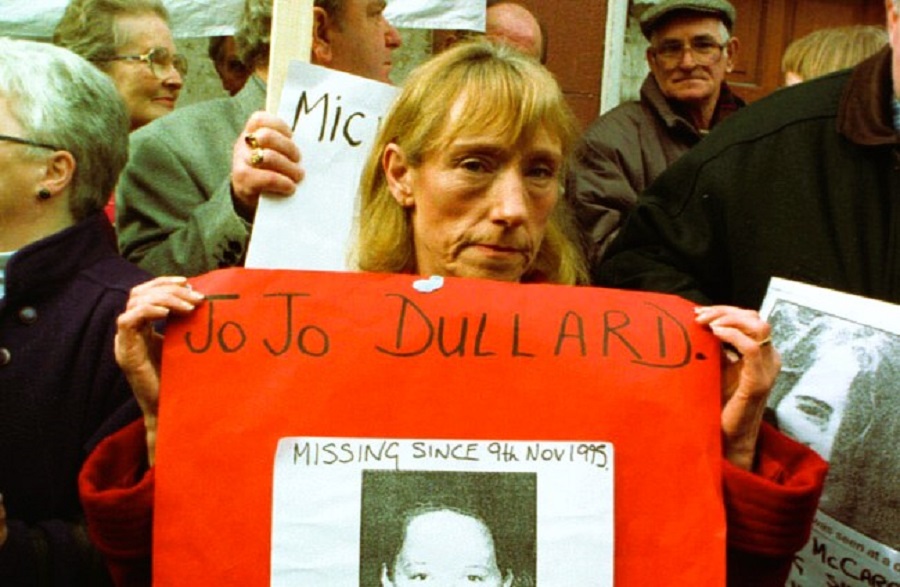
Jo Jo Dullard
Perhaps no name is more closely associated with Ireland’s missing women than Jo Jo Dullard.
Joanna “Jo Jo” Dullard was 21 years old when she disappeared in November 1995.
Her final journey has become one of the most familiar—and haunting—stories in Ireland’s missing-person history.
She had been in Dublin and was travelling towards her home in Kilkenny. After missing her bus, she travelled to Naas and subsequently accepted lifts southwards. She eventually reached Moone, County Kildare, where she used a public telephone to contact a friend.
Then another lift arrived.
Jo Jo disappeared.
Her case became one of the defining mysteries of modern Ireland.
In 2020, Gardaí formally reclassified the investigation as a murder inquiry, reflecting their belief that she had probably met with foul play.
Yet there was still no body.
And without a body, one fundamental question remained:
Where was Jo Jo Dullard?
In 2026, almost thirty-one years after her disappearance, Gardaí conducted further searches in County Wicklow near the Wicklow–Kildare border. The operation involved technical ground surveying, excavation and forensic examination. The searches concluded in July, although Gardaí did not disclose the operational results.
The passage of time has not brought the investigation to an end.
Nor has it ended Jo Jo’s family’s search for answers.
Fiona Pender
The disappearance of Fiona Pender is particularly heartbreaking.
Fiona was 25 years old, lived in Tullamore and was seven months pregnant when she disappeared on 23 August 1996.
She was last seen at approximately 6 a.m. at her flat on Church Street. According to Gardaí, she had spent the previous day shopping for baby clothes with her mother and was looking forward to the birth of her child.
The contrast between those ordinary preparations for motherhood and what followed is devastating.
Fiona never came home.
Her disappearance ultimately became a murder investigation, but her remains have never been found.
Gardaí have spent decades investigating the case. Thousands of documents and reports have been gathered, more than 300 statements taken, and five people have been arrested and detained in connection with the investigation. No one has been brought to justice for her disappearance and presumed murder.
In 2025, searches and forensic examinations were conducted at locations in Counties Offaly and Laois.
August 2026 marked thirty years since Fiona disappeared.
But Fiona was never simply another name in a list of missing women.
She was a young woman preparing to become a mother.
The child she was carrying would be born into a world in which Fiona herself was already absent.
Ciara Breen
Ciara Breen disappeared from Dundalk in 1997.
Her disappearance became another part of the growing number of cases that caused Irish society to question whether something more sinister was happening.
The circumstances of the disappearances varied, and no proven connection has established that one person was responsible for them all.
Nevertheless, the accumulation of cases was frightening.
One woman disappearing could be dismissed as an isolated tragedy.
Two might still be coincidence.
But when the disappearances accumulated across several years, fear became part of everyday life.
For families, however, the statistics and theories were secondary.
There was only one question:
Where was Ciara?
Fiona Sinnott
Fiona Sinnott disappeared in 1998.
Her case became part of the public consciousness surrounding the so-called Vanishing Triangle, but for her family the terminology meant very little.
A media phrase could not describe their loss.
A geographical label could not explain what had happened.
And statistics could not bring Fiona home.
For families confronted with a disappearance, the demand is brutally simple:
Find her.
That is the central purpose underlying every missing-person investigation.
Deirdre Jacob
Deirdre Jacob was only 18 years old when she disappeared on 28 July 1998.
She was last seen near her home at Roseberry, Newbridge, County Kildare, at approximately 3 p.m. Gardaí subsequently classified her disappearance as a murder investigation after new information emerged.
Deirdre had just completed her first year at St Mary’s University, Twickenham, in London.
She was eighteen.
She had a future ahead of her.
Then, in the middle of an ordinary summer afternoon, she disappeared.
In 2026, Gardaí conducted extensive searches in County Wicklow in connection with the investigations into the disappearances and suspected murders of Deirdre and Jo Jo Dullard. The searches concluded in July, although Gardaí did not publicly release the operational results.
More than a quarter of a century later, Deirdre’s family is still waiting.
Why were so many women missing in the 1990s?
The answer is complicated.
It is tempting to look backwards and construct a single explanation: a serial killer, a criminal network or some mysterious geographical phenomenon.
The reality is almost certainly more complex.
Ireland in the 1990s was changing rapidly. The country was becoming wealthier, more urbanised and increasingly connected to the outside world. Yet many older habits remained.
Young people travelled differently from today.
Mobile phones were not ubiquitous.
There was no smartphone location tracking.
No WhatsApp message saying, “I’m here.”
No Google Maps location shared instantly with a friend.
Outside the major cities, public transport could be infrequent. Hitchhiking and accepting lifts were more commonplace than they are today. A young woman could disappear from the road network without leaving behind the vast digital trail that would almost automatically be created in the twenty-first century.
These technological differences are crucial when considering why some investigations became so difficult.
The absence of forensic certainty
Modern investigations benefit enormously from technology.
DNA profiling, CCTV, mobile-phone records, GPS data, digital communications, financial records, automated number-plate recognition and sophisticated forensic archaeology can all provide evidence that simply did not exist—or was not readily available—in the 1990s.
Investigators once had to reconstruct a person’s final movements largely through eyewitness testimony.
Memory fades.
Witnesses die.
Buildings are demolished.
Roads are altered.
Vehicles disappear.
Land changes hands.
Forests grow.
Evidence that might have been decisive in 1995 can become extraordinarily difficult to locate three decades later.
That is one reason the continued investigation of Ireland’s missing women is so significant.
Time makes the work harder.
But time does not necessarily make the truth impossible to find.
The families left behind
Perhaps the greatest tragedy of a missing-person case is that the disappearance does not end when the police investigation slows.
It continues every day.
A family may keep a missing person’s room untouched.
They may continue to answer the telephone hoping for news.
They mark birthdays.
Christmas.
Anniversaries.
Decades pass, yet a mother can still think about the daughter who never came home.
A sibling can still remember the sound of her voice.
A photograph can remain frozen in time while everyone around it grows older.
For families of missing people, grief can become suspended between hope and loss. There is no certainty that allows mourning to follow its familiar course.
There may be no funeral.
No grave.
No final goodbye.
Only an unanswered question.
The women who were found
The story should also include women whose remains were eventually discovered.
Their cases demonstrate that disappearance does not necessarily mean that a person has vanished forever. Sometimes the truth emerges years—or even decades—later.
RTÉ has highlighted earlier cases including Phyllis Murphy, who disappeared in 1979 and whose body was subsequently discovered in woodland, as well as women such as Antoinette Smith, Patricia Doherty and Marie Kilmartin, whose remains were eventually located.
These cases demonstrate why searches continue.
A landscape that appears empty may conceal evidence.
A place that seems insignificant may hold the answer to a mystery that has lasted for decades.
And somewhere beneath the surface, the past can sometimes remain stubbornly present.
Ireland’s older history of “missing” women
There is another, very different meaning to the phrase Ireland’s missing women.
For much of the twentieth century, Irish women could effectively disappear from public life through institutionalisation.
Unmarried pregnant women were frequently sent—or pressured into going—to Mother and Baby Homes, county homes and related institutions. Others spent years in Magdalene Laundries.
These women did not necessarily disappear in the literal sense.
But their identities, choices and personal histories could be obscured.
The State’s Commission of Investigation into Mother and Baby Homes examined institutions and practices covering 1922 to 1998. Its work documented the experiences of thousands of women and children and exposed the consequences of a society in which unmarried motherhood carried profound stigma.
The Government described the historical environment as one marked by a deeply oppressive culture in which unmarried mothers and their children were stigmatised and deprived of agency.
This is an important distinction.
The women associated with the Vanishing Triangle disappeared under circumstances involving unexplained disappearances and suspected crimes.
The women who entered Ireland’s institutional system were subjected to a different kind of disappearance: their identities, choices and histories could be controlled, hidden or suppressed.
The circumstances were profoundly different.
But both histories concern women whose voices were, in different ways, lost.
Larry Murphy: The Suspect at the Centre of the Mystery
No discussion of Ireland’s missing women can avoid the name Larry Murphy.
Murphy became one of the most notorious figures associated with the Vanishing Triangle, not because he was ever convicted of killing any of the missing women, but because of the extraordinary circumstances of his own crime and the geographical and circumstantial links that subsequently drew Garda attention to him.
In February 2000, Murphy abducted a young woman from a car park in Carlow. He drove her to County Wicklow, where he raped and severely assaulted her. He subsequently attempted to strangle and suffocate her. She survived only because two hunters unexpectedly came upon Murphy and interrupted the attack. Murphy fled, but was identified and arrested shortly afterwards. In 2001, he pleaded guilty to charges including kidnapping, rape and attempted murder and was sentenced to 15 years’ imprisonment. (RTÉ)
The location and nature of that crime immediately attracted attention. Murphy was from Baltinglass, County Wicklow, and his attack took place in the same broad geographical area in which several of the women had disappeared during the 1990s. His behaviour also demonstrated that he was capable of abducting a woman, transporting her against her will, sexually assaulting her and attempting to kill her.
For investigators, that could not simply be ignored.
Operation TRACE
In 1998, even before Murphy’s conviction, Gardaí had established Operation TRACE, a specialised investigation intended to examine whether a serial offender might have been responsible for some of the disappearances. The cases under scrutiny included Annie McCarrick, Jo Jo Dullard, Fiona Pender, Ciara Breen, Fiona Sinnott and Deirdre Jacob. (RTÉ)
Murphy’s arrest in 2000 therefore occurred against an already established background of anxiety about a possible predator operating in the region.
Gardaí subsequently cross-referenced evidence from Murphy’s case with information gathered during Operation TRACE. In 2001, they wanted to question Murphy about the disappearances of six women. Annie McCarrick and Deirdre Jacob had disappeared in areas where Murphy had lived, worked or spent considerable time. (RTÉ)
The similarities were disturbing.
Here was a man who had demonstrated a willingness to abduct a woman, sexually assault her and attempt to kill her. He lived in the geographical heart of the area associated with several disappearances. And his crime had occurred only a few years after the women began disappearing.
But suspicion is not proof.
Deirdre Jacob
The strongest and most persistent connection between Murphy and a missing woman is the case of Deirdre Jacob.
Deirdre was 18 when she disappeared from near her home in Newbridge, County Kildare, on 28 July 1998. She was last seen in broad daylight. Gardaí now investigate her disappearance as a murder.
Murphy has long been regarded by investigators as the prime suspect in Deirdre’s presumed murder. Gardaí believe that he was in the Newbridge area on the day she disappeared. There have also been reported sightings and other information concerning a man and a vehicle in the area, although the available evidence has never been sufficient to establish Murphy’s guilt. (The Irish Times)
In 2018, cold-case investigators travelled to Britain to question Murphy about Deirdre’s disappearance. He did not substantively engage with them. In 2021, Gardaí sent a file concerning the investigation to the Director of Public Prosecutions, with Murphy identified as the chief suspect, but no prosecution followed because the available evidence was not considered sufficient to support charges. (The Irish Times)
That distinction is essential.
Larry Murphy has not been convicted of killing Deirdre Jacob. He has not been charged with her murder.
He remains a person of investigative interest because of the evidence and information assembled over the years, not because a court has established his responsibility.
Claims made in prison
The suspicion surrounding Murphy was intensified by accounts from former prisoners who said that he had claimed to have killed women.
According to reporting by The Irish Times, former prisoners told Gardaí that Murphy had claimed to have murdered, possibly twice. One account alleged that he described abducting a young woman near Newbridge on the day Deirdre disappeared, under the pretext of asking for directions, before assaulting and killing her.
Such allegations are potentially significant, but they must be treated cautiously. They are second-hand claims about statements allegedly made by Murphy, rather than independently established evidence that he committed the murder. Gardaí did not obtain sufficient evidence to charge him.
This is precisely where the history of the Vanishing Triangle can become blurred between evidence and mythology.
What about Jo Jo Dullard?
Murphy’s name has also frequently been associated with Jo Jo Dullard, but this connection requires particular caution.
Jo Jo disappeared in November 1995 after travelling south from Dublin and making a telephone call from a public phone box in Moone, County Kildare. She accepted a lift and was never seen again.
For years, public discussion often connected her disappearance with Murphy simply because he was suspected in other cases.
But Garda and investigative assessments do not establish that Murphy killed Jo Jo.
Indeed, recent reporting indicates that investigators regard the circumstances of Jo Jo’s disappearance as different from those surrounding Deirdre Jacob. Gardaí believe Jo Jo was likely abducted by an unknown man who encountered her while she was attempting to get home.
Jo Jo’s family has also strongly rejected the idea that Murphy should automatically be regarded as a suspect in her disappearance. Her sister Mary Phelan has specifically argued that the repeated association of Murphy with Jo Jo’s case was incorrect.
The 2026 Wicklow searches
The Murphy connection became significant again in 2026, when Gardaí began extensive searches at a disused quarry in County Wicklow near the Kildare border.
The search concerned the investigations into the presumed murders of both Deirdre Jacob and Jo Jo Dullard. Gardaí had received information alleging that something had been buried at the site decades earlier. The information was considered sufficiently specific and credible to warrant a major excavation.
The location was significant because it was close to where Murphy lived in the 1990s. The quarry was only a few kilometres from Kilranelagh, where Murphy was eventually interrupted while attacking the woman he had abducted in 2000.
Gardaí returned to the area for a further search in June 2026, acting on intelligence that Murphy had been involved in suspicious activity there around the time Deirdre disappeared. The Defence Forces conducted technical ground surveying before excavation work resumed.
The searches subsequently concluded in July 2026, with Gardaí stating that the families had been updated and that further assessment of the site was continuing. No public announcement established that human remains belonging to either woman had been found.
The significance of the operation therefore lies not in a dramatic conclusion but in what it demonstrates: more than a quarter of a century after the disappearances, investigators are still pursuing specific information about what may have happened to these women.
A disturbing coincidence—or something more?
The question remains one of the great unresolved issues surrounding Ireland’s missing women.
Was Murphy simply a violent sexual offender who happened to live in the same region as several women who disappeared?
Or did he know more about one or more of those disappearances than he has ever admitted?
There is no definitive public answer.
The evidence against Murphy is strongest in relation to Deirdre Jacob, where he has long been regarded by Gardaí as the prime suspect. But even there, suspicion has not translated into a prosecution.
The wider group of disappearances is even more complicated.
Gardaí have increasingly concluded that the women did not necessarily share the same killer. Recent reporting indicates that investigators believe Fiona Sinnott, Ciara Breen, Fiona Pender and Annie McCarrick were likely killed by men known to them, while the circumstances of Deirdre Jacob and Jo Jo Dullard are considered different, involving apparently opportunistic predatory attacks.
That is an important development in understanding the Vanishing Triangle.
The disappearances may have formed a geographical pattern without forming a single criminal conspiracy.
The term Vanishing Triangle describes where the women disappeared.
It does not necessarily explain why they disappeared or who was responsible.
The uncomfortable legacy of Larry Murphy
Larry Murphy remains an unsettling figure because his known crime provides a glimpse into what investigators feared might have been happening to some of Ireland’s missing women.
His victim survived.
Others did not—or at least have never been found.
That difference is haunting.
Had the two hunters not appeared in the Wicklow mountains in February 2000, Murphy’s victim might have become another missing woman. Instead, she survived and Murphy was caught.
The incident demonstrated that the apparent impossibility of solving a disappearance could sometimes be overcome by the smallest of circumstances: two people taking a walk, arriving at the right place at the right time, seeing something suspicious and intervening.
For the families of Ireland’s missing women, that thought is both hopeful and agonising.
Somewhere, perhaps, someone saw something.
Someone remembers a vehicle.
Someone remembers a conversation.
Someone noticed a man behaving strangely.
Someone may have heard something and dismissed it at the time.
And somewhere in the landscape of Leinster there may still be evidence of what happened.
The story of Larry Murphy should therefore be included in the history of Ireland’s missing women—but not as a convenient solution to a mystery that has never been solved.
He is an important suspect in the investigation into Deirdre Jacob’s disappearance and has been investigated in relation to other cases. He is a convicted rapist and attempted murderer whose known crime occurred in the heart of the region associated with the Vanishing Triangle.
However it is important to note that, he has never been charged with the disappearance or murder of any of the missing women, and there is no proven evidence that he was responsible for them
The danger of turning tragedy into folklore
There is another danger surrounding Ireland’s missing women: the transformation of real human tragedies into mythology.
The phrase Vanishing Triangle is memorable.
It is evocative.
But the women themselves must never disappear behind the mythology.
They were not characters in a mystery.
They were not symbols.
They were not simply names on a list.
They were people.
Annie McCarrick had friends.
Jo Jo Dullard had a family.
Fiona Pender was preparing for motherhood.
Deirdre Jacob was beginning adult life.
Each woman had ordinary hopes, routines and relationships that were abruptly interrupted.
When their stories are reduced to the question “Who was the killer?”, something important is lost.
The question should also be:
Who were these women?
A changing approach to old cases
One of the most encouraging developments of recent years has been the willingness of Gardaí to revisit investigations that once appeared almost impossible to solve.
Cases that had spent decades classified as missing-person investigations have been re-examined as suspected murders.
Old evidence can be subjected to new forensic techniques.
Previously overlooked information can be reassessed.
Advances in forensic archaeology can make searches more sophisticated.
And investigators can appeal once again to people who may have been unwilling—or afraid—to speak decades earlier.
The recent searches connected to Jo Jo Dullard and Deirdre Jacob demonstrate that commitment. Gardaí conducted extensive searches in 2026 while continuing to appeal for information.
The same determination is evident in the investigation into Fiona Pender’s disappearance, now three decades old.
And the 2025 developments in the Annie McCarrick investigation demonstrate that even cases more than thirty years old can still produce new investigative activity.
Time has not erased these women from the work of investigators.
Nor should it.
The unanswered question
Ireland’s missing women represent more than one kind of absence.
There are women whose physical whereabouts remain unknown: women who left home, walked down a road, travelled somewhere or accepted a lift and never returned.
And there are women from an earlier Ireland whose identities were obscured by institutions, stigma and secrecy.
The circumstances are profoundly different, and they should not be conflated.
Yet there is a common thread:
silence.
For decades, silence surrounded unmarried mothers.
Silence surrounded institutional abuse.
Silence surrounded missing women.
And silence can protect those responsible for wrongdoing.
That is why remembering names matters.
It is why archives matter.
It is why investigations must remain open when credible evidence exists.
And it is why families continue to speak.
The women must not be forgotten
In 2026, some of Ireland’s most notorious missing-women cases remain active investigations.
Fiona Pender has been missing for thirty years.
Annie McCarrick has been missing for more than thirty-three years.
Jo Jo Dullard disappeared more than thirty years ago.
Deirdre Jacob disappeared in 1998.
Their families have endured something almost impossible for anyone who has not experienced it to comprehend: grief without certainty.
The continuing searches are therefore about more than solving crimes.
They are about restoring something that disappeared along with these women—the possibility of an ending.
A body can be buried.
A funeral can be held.
A verdict can be reached.
A family can mourn.
But when someone disappears without trace, the story remains unfinished.
And so Ireland continues to search.
Not for legends.
Not for mysteries.
Not for stories to tell around a fire.
But for Annie, Eva, Imelda, Jo Jo, Fiona, Ciara, Fiona and Deirdre—women whose lives were interrupted and whose families still deserve answers.
Because a person does not cease to matter simply because decades have passed.
And a woman does not become less worthy of being found because the world has learned to live without her.
Ireland remembers its missing women because they are not merely missing from the landscape. They are missing from their families, from their communities, and from the unfinished history of the country itself.
Sources:
https://www.telegraph.co.uk/news/2023/11/07/six-silent-killings-irelands-vanishing-triangle-sky
https://en.wikipedia.org/wiki/Ireland%27s_Vanishing_Triangle
https://www.garda.ie/en/missing-persons
https://en.wikipedia.org/wiki/International_Day_of_the_Disappeared
https://www.irishexaminer.com/news/spotlight/arid-41797223.html
https://www.ontheditch.com/larry-murphy-grew-up
https://en.wikipedia.org/wiki/Larry_Murphy_(criminal)
https://www.thejournal.ie/jo-jo-dullard-mary-phelan-murder-moone-6540650-Nov2024


Leave a Reply