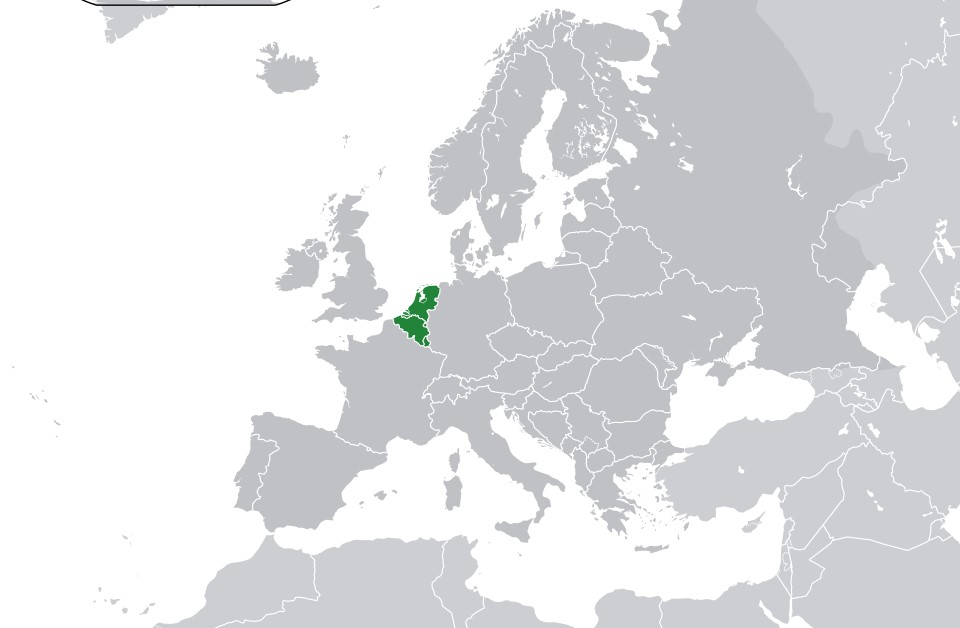
The Benelux is often described as one of the earliest experiments in European integration. Today, the name is familiar: Belgium, the Netherlands and Luxembourg cooperating economically and politically as neighbouring states. Yet the origins of the Benelux lie not in the prosperous post-war Europe we know today, but in the uncertainty and devastation of the Second World War.
The foundation of the Benelux was a remarkable wartime decision. While Nazi Germany occupied Belgium, the Netherlands and Luxembourg, representatives of the three governments—living in exile in London—began imagining a different future for their countries. They concluded that closer economic cooperation could strengthen their independence, encourage prosperity and make a return to the destructive economic nationalism of the interwar years less likely.
The Benelux therefore emerged from a combination of wartime necessity, economic pragmatism and a growing belief in European cooperation.


Europe Before the Benelux
Before the Second World War, Belgium, the Netherlands and Luxembourg were independent states with closely connected economies, but they maintained separate customs systems, currencies and economic policies.
The First World War had already demonstrated the vulnerability of small European countries caught between larger powers. The economic crisis of the 1930s made matters worse. Protectionism became widespread as governments attempted to shield domestic industries from foreign competition. Tariffs, quotas and currency restrictions hindered international trade.
The three countries were particularly vulnerable because of their size and geographical position. Belgium and Luxembourg were heavily industrialised, while the Netherlands possessed an important trading, shipping and agricultural economy. Their economies complemented one another, but political and economic barriers prevented them from fully exploiting that relationship.
There had already been attempts at closer cooperation. Belgium and Luxembourg had established the Belgian-Luxembourg Economic Union in 1921, creating a particularly close economic relationship between the two countries.
The Netherlands initially remained outside such arrangements. The experience of the interwar period, however, gradually demonstrated the advantages of regional economic cooperation.
Then came 1940.
The German Occupation
In May 1940, Nazi Germany invaded the Low Countries.
Belgium, the Netherlands and Luxembourg were occupied within weeks. Their governments and monarchs took different paths into exile, but all three countries established or maintained governments in London.
The occupation transformed the political thinking of many European leaders.
The old assumption that each country could simply pursue its own economic interests was increasingly questioned. The war demonstrated the enormous power of Germany and the vulnerability of smaller European states. Cooperation offered a means of increasing their collective economic strength.
London consequently became an unlikely laboratory for post-war European reconstruction.
The governments-in-exile were not merely waiting for liberation. They were already discussing what the political and economic order of post-war Europe should look like.
Among those discussions was a deceptively simple question:
What if Belgium, the Netherlands and Luxembourg removed many of the economic barriers between them?
The Birth of the Idea
The Netherlands, Belgium and Luxembourg began negotiations during the war concerning closer economic cooperation.
The three governments recognised that their economies were deeply interconnected. Their geographical proximity made trade between them natural, but tariffs and other restrictions created unnecessary obstacles.
There was also a political dimension.
All three were relatively small states situated close to Germany. Greater economic cooperation could provide them with a stronger collective position in post-war Europe.
The idea was therefore not simply about trade.
It was about security through cooperation.
A prosperous and interconnected Low Countries would be better equipped to withstand future economic pressure from larger neighbours. At the same time, economic integration could help prevent the return of the intense nationalism and protectionism that had contributed to Europe’s instability during the interwar period.
The London Agreement of 1944
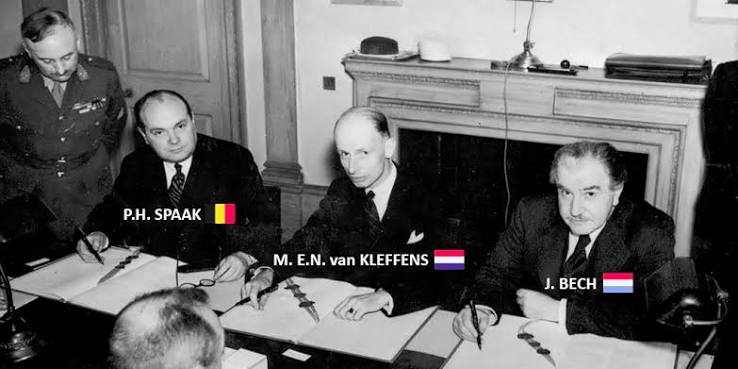
The decisive step came during the final years of the war.
On 5 September 1944, the governments of Belgium, the Netherlands and Luxembourg signed the Benelux Customs Convention in London.
The agreement established plans for a customs union between the three countries.
The timing was extraordinary.
On the very day that the agreement was signed, much of Belgium was being liberated by Allied forces. Brussels itself would be liberated the following day, 6 September.
The Netherlands, however, was still largely occupied, and Luxembourg had only just begun to emerge from German occupation.
The agreement was therefore an act of political foresight. The three governments were negotiating not merely for the present but for the Europe that would emerge after the war.
The name Benelux was formed from the first parts of the three countries’ names:
Belgium
Netherlands
Luxembourg
It was a practical name for a practical experiment.
What Was the Customs Union?
The central principle was straightforward: the three countries would progressively eliminate customs barriers between themselves while establishing a common external tariff toward countries outside the union.
This was significant.
Instead of treating their borders as economic barriers, Belgium, the Netherlands and Luxembourg would increasingly treat the three economies as part of a single trading area.
The agreement also reflected an important post-war principle: economic interdependence could be a source of stability.
The countries were not surrendering their sovereignty. They remained independent states. Rather, they were voluntarily coordinating aspects of their economic policy because they believed cooperation served their common interests.
This distinction would become enormously important in the later development of European integration.
From Agreement to Reality
The 1944 agreement could not immediately transform the three economies.
The war was still raging.
The Netherlands would not be completely liberated until 1945, and the country suffered enormous economic damage, particularly during the Hunger Winter of 1944–45. Infrastructure had been destroyed, transport networks were disrupted and economies throughout Western Europe faced shortages of fuel, food and raw materials.
Nevertheless, preparations for economic cooperation continued.
The Benelux Customs Union came into operation on 1 January 1948.
This made it one of the earliest functioning post-war customs unions in Europe.
It was an important achievement because European governments were still struggling with the enormous task of reconstruction.
The Benelux countries were demonstrating that independent European states could voluntarily remove economic barriers without eliminating their political independence.
Why Was the Benelux Important?
The importance of the Benelux extends far beyond the three countries themselves.
It became a prototype for European integration.
Belgium, the Netherlands and Luxembourg were effectively demonstrating several principles that would later become central to the European project:
- reducing barriers to trade;
- coordinating economic policy;
- creating common institutions;
- increasing economic interdependence;
- resolving disputes through cooperation rather than confrontation;
- strengthening smaller states through collective action.
The Benelux was therefore a kind of European integration in miniature.
It also gave its member states experience in working together institutionally. Officials had to learn how to coordinate policies, negotiate compromises and manage economic relationships that crossed national borders.
Those lessons would prove valuable when wider European organisations began to emerge.
The Benelux and the European Coal and Steel Community
The next major step toward European integration came in 1950, when French Foreign Minister Robert Schuman proposed placing French and German coal and steel production under a common authority.
Belgium, the Netherlands and Luxembourg supported the initiative.
In 1951, the three Benelux countries joined France, West Germany and Italy in establishing the European Coal and Steel Community (ECSC).
This was a crucial development.
Coal and steel were not chosen randomly. They were the basic materials of industrial production and warfare. Bringing these industries under shared management was intended to make another Franco-German war materially more difficult.
The Benelux countries therefore became important participants in the first major institutional step toward what would eventually become the European Union.
The experience of the Benelux helped demonstrate that economic cooperation between sovereign states was not merely theoretical.
It could work.
The Treaty of Rome
In 1957, Belgium, the Netherlands and Luxembourg again joined France, West Germany and Italy, this time in signing the Treaties of Rome.
One of these treaties established the European Economic Community (EEC).
The objective was considerably broader than the original Benelux customs union. The EEC sought to create a common market among its members, progressively eliminating barriers to trade and allowing greater movement of goods, services, people and capital.
The Benelux countries had effectively moved from being pioneers of regional integration to becoming pioneers of a much larger European experiment.
There was an important historical irony here.
The Benelux had begun as a practical response to the economic and political vulnerability of three small countries. Within little more than a decade, its underlying principles were being applied to a much larger European community.
From Customs Union to Benelux Union
The Benelux itself did not disappear when the EEC was established.
Instead, cooperation continued and developed.
The Benelux Economic Union Treaty, signed in 1958, expanded cooperation beyond customs arrangements. It entered into force in 1960.
Over subsequent decades, cooperation increasingly covered areas such as the movement of people, transport, environmental policy, security and cross-border cooperation.
In 2008, the three countries signed a new treaty creating the Benelux Union, reflecting the changing nature of their cooperation.
The Benelux had consequently evolved from a customs arrangement into a broader framework for regional cooperation.
A Remarkable Historical Transformation
The story of the Benelux is remarkable because its origins can be traced directly to the darkest years of European history.
In 1940, Belgium, the Netherlands and Luxembourg had been occupied by Nazi Germany.
Their governments had been forced into exile. Their populations endured occupation, persecution, economic exploitation and, in the Netherlands, catastrophic wartime deprivation.
Yet while the war continued, their governments were already planning a different future.
Instead of rebuilding the old pre-war system of economic nationalism, they chose cooperation.
That decision reflected a fundamental change in European thinking.
The lesson drawn from two world wars was not simply that countries needed stronger armies. It was that political stability could be reinforced through economic interdependence.
If countries traded more freely, shared institutions and developed common interests, they would have more reasons to cooperate than to compete destructively.
The Legacy of the Benelux
The Benelux was small in geographical size, but its historical significance was enormous.
Belgium, the Netherlands and Luxembourg demonstrated that national sovereignty and international cooperation did not necessarily have to be opposites. Independent countries could voluntarily pool aspects of their economic power while retaining their individual identities.
The arrangement also provided a practical testing ground for ideas that would later become fundamental to the European Union.
In that sense, the Benelux was both a product of the Second World War and a response to it.
The war had demonstrated the dangers of division, economic nationalism and the vulnerability of small states. The Benelux attempted to create the opposite: cooperation, interdependence and collective strength.
Its foundation in wartime London on 5 September 1944 was therefore much more than the signing of a customs agreement.
It represented a vision of what Europe might become after the guns fell silent.
Three small countries, devastated and occupied by war, were already looking beyond the conflict. They were preparing to turn their shared geographical position into an economic advantage and their common vulnerability into a reason for cooperation.
The Benelux was one of the first bricks in the foundation of modern European integration.
https://en.wikipedia.org/wiki/Benelux
https://www.benelux.int/en/publication/info-sheet-the-benelux-union
https://mfsva.gouvernement.lu/en/dossiers.gouvernement2024+en+dossiers+2018+benelux.html
https://en.wikipedia.org/wiki/London_Customs_Convention
Donation
Your readership is what makes my site a success, and I am truly passionate about providing you with valuable content. I have been doing this at no cost and will continue to do so. Your voluntary donation of $2 or more, if you are able, would be a significant contribution to the continuation of my work. However, I fully understand if you’re not in a position to do so. Your support, in any form, is greatly appreciated. Thank you. To donate, click on the credit/debit card icon of the card you will use. If you want to donate more than $2, just add a higher number in the box left from the PayPal link. Your generosity is greatly appreciated. Many thanks.
$2.00


Leave a Reply