A look at the historical facts for anyone questioning Jewish indigeneity to Israel and Jerusalem.
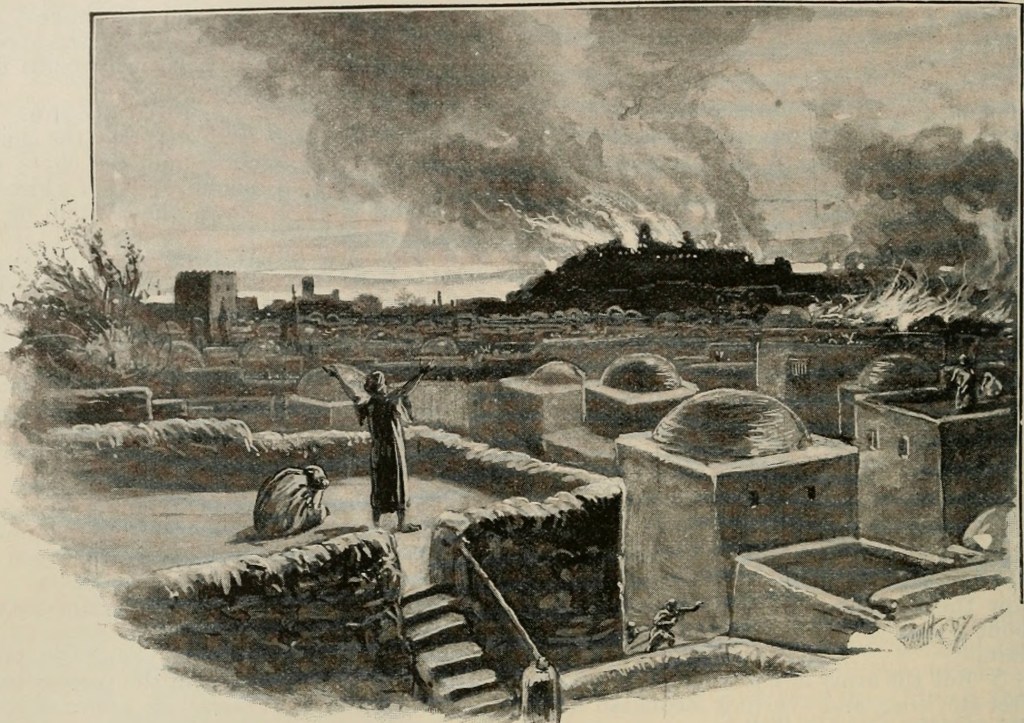
The Siege of Jerusalem, 587 BC
The Siege of Jerusalem in 587 BC was one of the decisive events in the history of the ancient Kingdom of Judah. It marked the destruction of Jerusalem by the Babylonian Empire under King Nebuchadnezzar II, the end of Judah as an independent kingdom, and the beginning of the Babylonian Exile.
The crisis began when King Zedekiah of Judah rebelled against Babylonian rule, encouraged by hopes of Egyptian assistance. Nebuchadnezzar responded by sending his army against Judah. Jerusalem, heavily fortified and strategically important, became the principal target. Babylonian forces surrounded the city and established a blockade designed to cut off food and supplies.
The siege lasted for roughly eighteen months. Conditions inside Jerusalem deteriorated rapidly as famine took hold. The biblical books of 2 Kings and Jeremiah describe desperate conditions, while archaeological evidence confirms the widespread destruction associated with the Babylonian conquest. Despite the suffering, the defenders continued to resist until the city’s defenses finally collapsed.
In the summer of 587 BC, Babylonian troops breached the walls. Zedekiah attempted to escape with his forces but was captured near Jericho. According to the biblical account, he was brought before Nebuchadnezzar at Riblah, where his sons were executed before he was blinded and taken in chains to Babylon.
Jerusalem itself suffered catastrophic destruction. The Temple of Solomon, the religious and political heart of Judah, was burned, along with the royal palace and other major buildings. Much of the city’s population was killed, deported, or scattered, while a poorer population was left behind to cultivate the land.
The fall of Jerusalem was far more than a military defeat. For the people of Judah, the destruction of the Temple and the loss of their kingdom represented a profound religious and national catastrophe. Yet the exile also became a formative period in Jewish history. In Babylon, displaced communities preserved their traditions, scriptures, and identity, while reflecting on why their kingdom had fallen.
The Babylonian conquest therefore transformed Jerusalem from the capital of a small independent kingdom into the symbol of a people living in exile. Its destruction in 587 BC became one of the defining turning points of ancient Jewish history—and the memory of that catastrophe would profoundly shape Judaism for centuries to come.
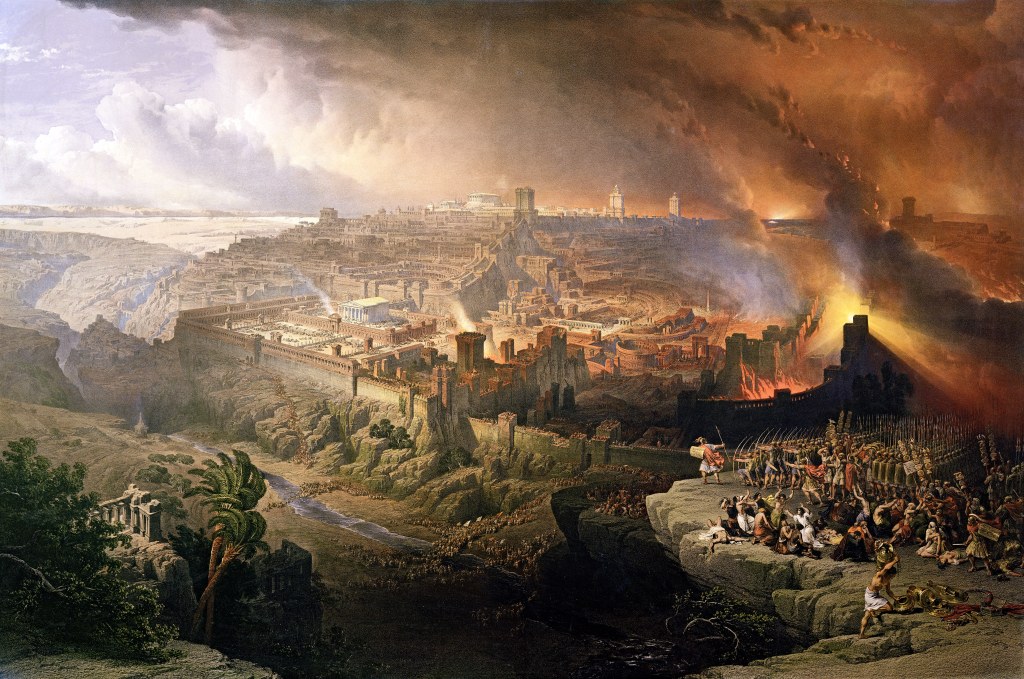
The Siege of Jerusalem, 70 CE
The Siege of Jerusalem in 70 CE was the decisive event of the First Jewish–Roman War and one of the most consequential sieges of the ancient world. It ended with the destruction of Jerusalem and the Second Temple, marking a profound turning point in Jewish history and demonstrating the overwhelming military power of the Roman Empire.
The revolt against Rome had begun in 66 CE, when tensions between the Jewish population of Judaea and Roman authorities erupted into open rebellion. After several years of fighting, the Roman emperor Nero appointed the experienced general Titus Flavius Vespasianus, later Emperor Vespasian, to suppress the revolt. In 69 CE, Vespasian became emperor, and command of the campaign passed to his son Titus.
In the spring of 70 CE, Titus advanced on Jerusalem with several Roman legions. The city was crowded with defenders and pilgrims who had gathered for the Passover festival. Jewish resistance was fierce, but the defenders were divided among competing factions, weakening their ability to coordinate their defence.
The Romans surrounded the city and constructed siege works to prevent escape and the arrival of supplies. Hunger and disease soon became as deadly as the fighting itself. According to the Jewish historian Josephus, conditions inside the city became catastrophic as food supplies disappeared. Despite this, the defenders continued to resist.
Titus gradually breached Jerusalem’s outer defences and forced his way toward the Temple complex. In August, Roman soldiers captured the Temple precinct. During the fighting, the Second Temple was set ablaze. Although Josephus presents the destruction as something Titus attempted to prevent, the circumstances remain debated by historians. The Temple was ultimately destroyed, and its loss transformed Jewish religious and political life.
The Romans then destroyed much of the city and killed or enslaved large numbers of its inhabitants. The Arch of Titus in Rome later commemorated the victory, famously depicting Roman soldiers carrying away the Temple’s sacred menorah.
The fall of Jerusalem did not immediately end Jewish resistance; the fortress of Masada held out until 73 or 74 CE. Nevertheless, the destruction of Jerusalem in 70 CE effectively ended the organised revolt. For Rome, it was a military victory. For the Jewish people, it was a catastrophe whose religious and historical consequences continue to resonate more than nineteen centuries later.
The siege remains one of the clearest examples of how warfare, internal division, starvation and overwhelming military force can combine to bring about the destruction of a city. Above all, the destruction of the Second Temple permanently altered the course of Judaism, helping shape the development of Rabbinic Judaism and Jewish life in the centuries that followed.
66 CE: The First Jewish–Roman War begins.
67–68 CE: Vespasian campaigns in Galilee and Judaea, capturing major rebel strongholds.
69 CE: Vespasian becomes emperor; his son Titus takes command of the campaign against Jerusalem.
Spring 70 CE: Titus arrives before Jerusalem, probably around April, shortly before or during Passover.
April–May: The Romans encircle the city and begin systematic assaults on its outer fortifications.
May–June: Roman forces capture the Third Wall and then the Second Wall, progressively penetrating the city.
June–July: The Romans construct siege works and a circumvallation wall, cutting Jerusalem off from outside supplies. Starvation becomes increasingly severe.
Late July: Roman forces breach the First Wall and gain access to the fortified Temple and upper city.
9–10 Av, approximately 4–5 August 70 CE: The Second Temple is destroyed by fire during the fighting. The precise circumstances remain debated.
August–September: Roman forces continue clearing and destroying the remaining parts of Jerusalem, including the Upper City.
September 70 CE: Organised resistance in Jerusalem ends, although Jewish resistance elsewhere continues.
73/74 CE: The fall of Masada marks the conventional endpoint of the First Jewish–Roman War.
Sources
https://warfarehistorynetwork.com/article/the-fall-of-jerusalem-in-70-ce-a-story-of-roman-revenge
https://en.wikipedia.org/wiki/Siege_of_Jerusalem_(70_CE)
https://dirkdeklein.net/wp-content/uploads/2026/09/185a7-lam002-siege_of_jerusalem-587bc.pdf


Leave a comment