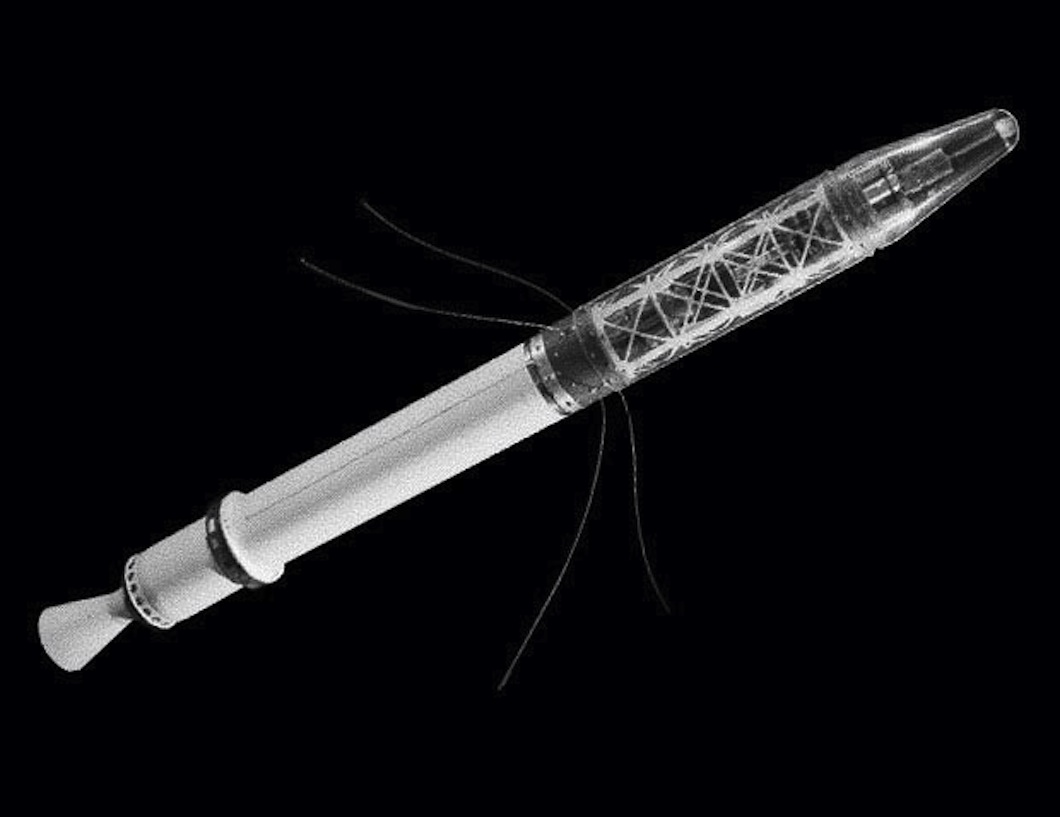
Explorer 1 was the first satellite of the United States, launched as part of its participation in the International Geophysical Year. The mission followed the first two satellites the previous year; the Soviet Union’s Sputnik 1 and 2, beginning the Cold War Space Race between the two nations.
Explorer 1 was launched on January 31, 1958 at 22:48 Eastern Time (February 1, 03:48 UTC) atop the first Juno booster from LC-26 at the Cape Canaveral Missile Annex, Florida. It was the first spacecraft to detect the Van Allen radiation belt, returning data until its batteries were exhausted after nearly four months. It remained in orbit until 1970, and has been followed by more than 90 scientific spacecraft in the Explorer series.
Explorer 1 was given Satellite Catalog Number 4, and the Harvard designation 1958 Alpha 1,the forerunner to the modern International Designator.

The first two jolts came courtesy of the Soviet Union, which launched the first-ever artificial satellite, Sputnik 1, on Oct. 4, 1957, and followed that up a month later by lofting a dog named Laika to orbit, aboard the Sputnik 2 craft.

The United States tried to answer on Dec. 6, 1957, with a satellite launch of its own. But the rocket carrying the nation’s first would-be spacecraft, the 3.5-lb. (1.6 kilograms) Vanguard Test Vehicle 3, burst into flames shortly after liftoff, live on national TV.
But the 30.7-lb. (13.9 kg) Explorer 1 was not just a space-race publicity stunt; the satellite performed groundbreaking science work as it orbited Earth. It spotted fewer high-energy cosmic rays than expected, leading Explorer 1 principal investigator James Van Allen to suggest that the satellite’s detector had been overwhelmed by charged particles trapped in Earth’s magnetic field. [Space Race: Could the U.S. Have Beaten the Soviets into Space?]
Van Allen was right. The Explorer 3 spacecraft, which launched on March 26, 1958, confirmed the existence of these bands of radiation, which are now known as the Van Allen belts. (Explorer 2 had launched three weeks earlier but failed to reach orbit because of a rocket malfunction.)
The satellite was designed and built by engineers at the Jet Propulsion Laboratory (JPL) in Pasadena, California. Today, JPL is one of NASA’s flagship centers, but NASA didn’t even exist when Explorer 1 lifted off; the space agency was officially established six months later, on July 29, 1958, and began operations on Oct. 1 of that year.

Donation
Your readership is what makes my site a success, and I am truly passionate about providing you with valuable content. I have been doing this at no cost and will continue to do so. Your voluntary donation of $2 or more, if you are able, would be a significant contribution to the continuation of my work. However, I fully understand if you’re not in a position to do so. Your support, in any form, is greatly appreciated. Thank you. To donate, click on the credit/debit card icon of the card you will use. If you want to donate more than $2, just add a higher number in the box left from the PayPal link. Your generosity is greatly appreciated. Many thanks.
$2.00


 History of Sorts
Leave a reply to dirkdeklein Cancel reply