
I had written two blogs about these children previously, but since their story is such an uplifting one, I decided to revisit it once again. I also stumbled upon a few new photos.
Hoensbroek Castle, one of the largest castles in the Netherlands, served as a children’s home for 120 children under government guardianship starting from December 23, 1942. These children were from the Meerzicht children’s home near Velsen, which was managed by the Congregation of Sisters of the Poor Child Jesus. The Meerzicht children’s home had to be vacated due to the construction of the Atlantikwal by the Germans. Hoensbroek Castle was liberated by the American army on September 18, 1944. The children continued to stay at the castle until May 1946. During that time, NSB and SS men were also accommodated there after the liberation.
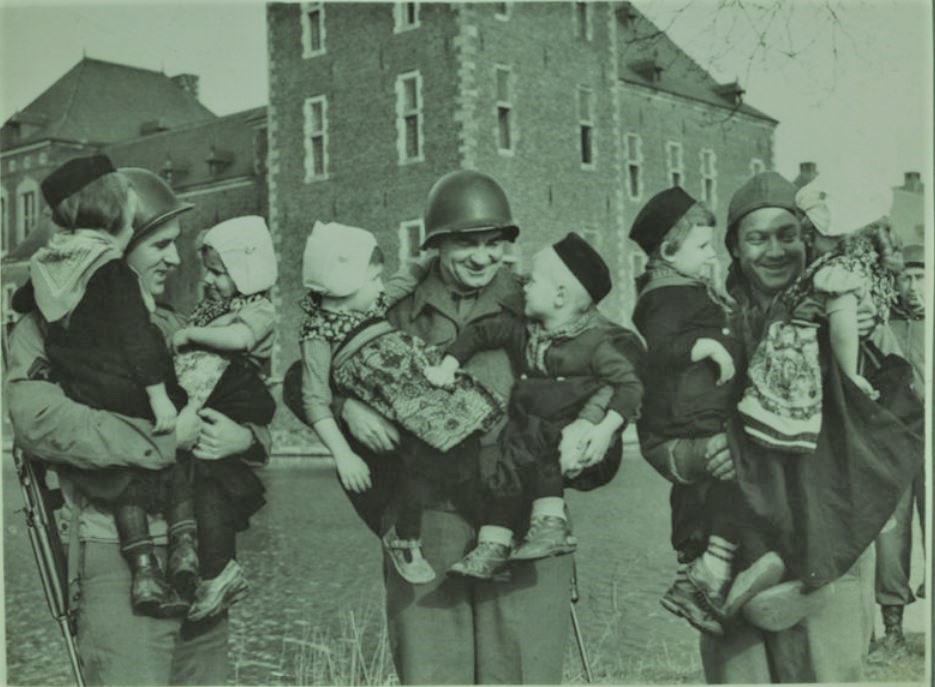
The young Dutch children, no older than three years, were delighting GIs in the courtyard of Hoensbroek castle. They are adorned in traditional costumes and perform a Dutch folk dance.
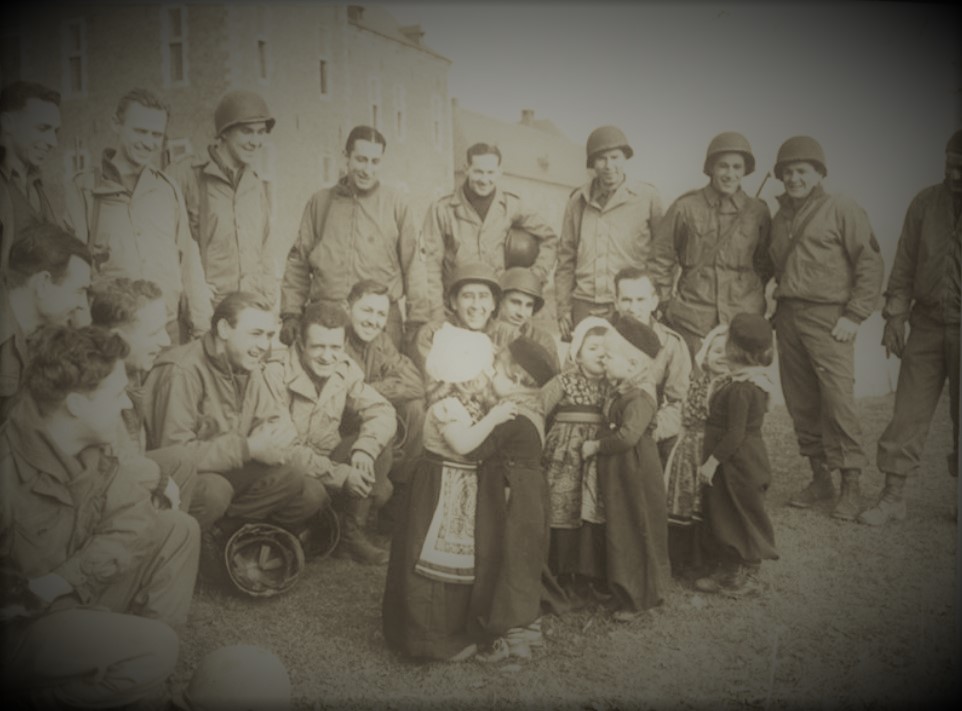
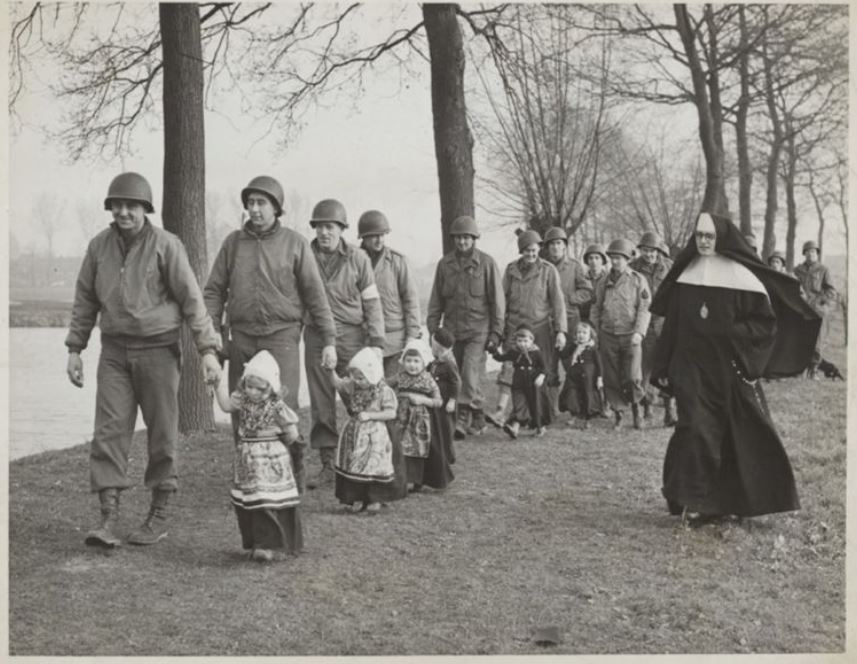
Hoensbroek Castle was home to 145 Dutch children, who were cared for by nuns. American GIs assisted the nuns by taking the three-year-olds for walks.
From left to right, Walter Ward of Newark, Thomas McMorrow of Brooklyn and James Firman of Delaware, Ohio.
In October 1942, the German occupiers had ordered the boarding school’Meerzicht’ in Velsen to be evacuated. It was going to be demolished because it would be directly in the line of fire. The Germans were going to build a 5 km-long defense line, and the boarding school was on its way.
Frantically, the nuns looked for alternative accommodation. In December 1942, they were offered the castle of Hoensbroek. They moved in on December 23, just in time for the Christmas celebrations. For the children, the distance between Velsen and Hoensbroek was about 200km, which must have felt like moving to the other side of the world.
Velsen would only be liberated in May 1945. In fact, technically, it was only liberated on May 7, 1945, which was two days after the official liberation day in the Netherlands. However, the southern part of the Netherlands was liberated in September 1944. Hoensbroek was liberated on September 17, 1944. This means the children were not only freed earlier, but they were also spared the awful famine of 1944/45 winter.
The children lived relatively undisturbed in the castle, which had been declared unsuitable for the German army several times. However, a few days before liberation, there were a few nervous moments.
Some SS men who were on leave from battle in France. had stayed in the adjacent farm and had been throwing hand grenades in the canals surrounding the castle, just for fun. They had also been walking around naked.
On September 12, 1944, a highly placed SS officer visited the castle for inspection; he was told there was no room. His reply was not to worry about that; the SS would make some room while he was looking around at the yard where the children were playing at the time. But he left.
The following day, another highly placed SS officer, who had a limp, came to the castle, but he, too, left.
The mayor made a false statement, claiming that there had been an outbreak of Polio in the castle. Therefore, it was not suitable as quarters for the German troops. The Germans didn’t care.
But on September 17, 1944, the Allied troops liberated Hoensbroek and its castle.
After months of fighting fierce battles, this must have been the most adorable way ever for the US troops to spend their days taking these adorable toddlers for a walk; only a few days earlier, the Germans had uttered a threat to kill the children.
The castle had also functioned as a shelter for some local people. Still, they left on September 18, shortly after the liberation.
After the liberation, the outbuildings were requisitioned for housing prisoners, including NSB and later SS. By the end of 1945, more than 800 had been captured. Posts with wire mesh and barbed wire were installed in the courtyard, and coils of barbed wire were laid along the canals to prevent swimming over. A guardhouse was placed on the square for armed military surveillance. It is not an ideal combination: a children’s home in the Castle Building, prisoners in the farms, and barbed wire in between.
The Dutch government and the Allied forces sentenced them to work in the coal mines, mainly in the Maurits and the Emma (which was located near Hoensbroek).
The last children and sisters left on June 2, 1946.


Sources
https://www.oorlogsbronnen.nl/thema/Kasteel%20Hoensbroek
Donation
I am passionate about my site and I know you all like reading my blogs. I have been doing this at no cost and will continue to do so. All I ask is for a voluntary donation of $2, however if you are not in a position to do so I can fully understand, maybe next time then. Thank you. To donate click on the credit/debit card icon of the card you will use. If you want to donate more then $2 just add a higher number in the box left from the PayPal link. Many thanks.
$2.00

 History of Sorts
Leave a comment