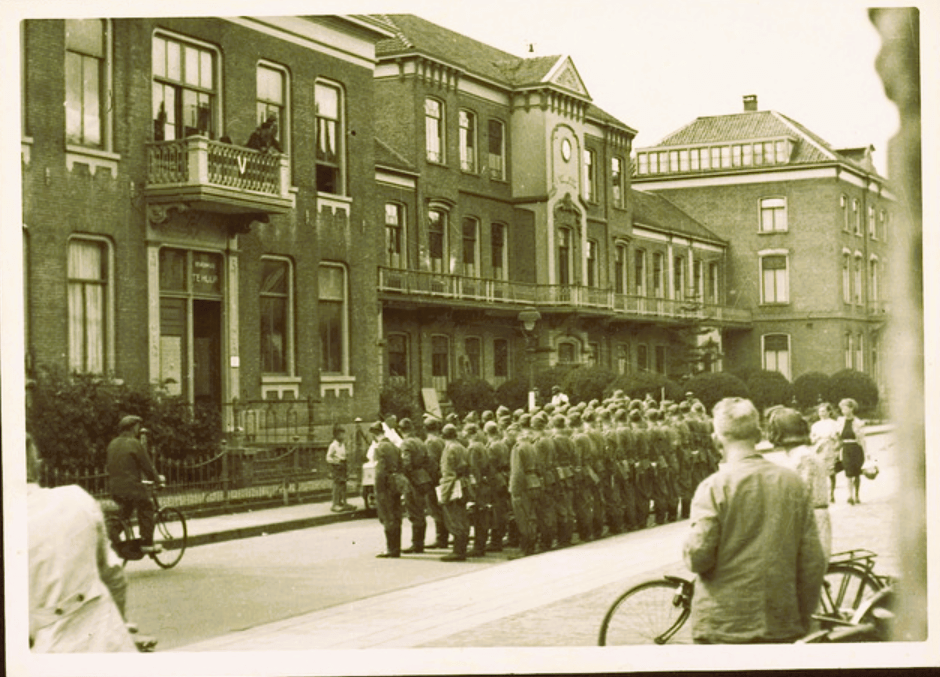
Doetinchem is a city and municipality in the east of the Netherlands, situated along the Oude IJssel (Old IJssel) River in a part of the province of Gelderland.
The school protests in Doetinchem took place after the dismissal of Jewish civil servants on November 21, 1940. After the Aryan declaration, all Jewish civil servants, including teachers, were first suspended and then dismissed. On November 26, 1940, students at the Lyceum in Doetinchem protested against the dismissal of two Jewish teachers and the Aryan declaration in general.
In the autumn of 1940, the German occupiers began a series of measures to separate Dutch Jews from the rest of the Dutch population. The first measure was the removal of Jews from the municipal air protection services. A ban on ritual slaughter followed this. Before October 26, 1940, all teachers had to submit an Aryan declaration. An order from the German occupier fired all those who refused to obey, and immediately in November, the occupier began to fire Jewish teachers.
Protests
All university teachers had to provide an Aryan declaration under penalty of dismissal. The best-known example of protest against this is the Cleveringa speech.
—Protest address by Professor Cleveringa
The address was given on November 26, 1940, by Professor Rudolph Pabus Cleveringa, Dean of the Faculty of Law, in protest against Professor E.M. Meijers’s dismissal as a professor at the (State) University of Leiden.
“I am standing here today, at a time when you would expect to find a different person before you—your and my teacher, Professor Meijers. The reason for this is a letter that he received this morning directly from the Department of Education, Arts, and Sciences, informing him of the following, As directed by the State Commissioner for the occupied territory of the Netherlands, pertaining to non-Aryan government staff and those of equal status, I inform you that with effect from today, you are discharged from your position as professor at the State University of Leiden. The State Commissioner has determined that those concerned for the time being retain the entitlement to their salary (including allowances, etc.).
“I pass on this message to you, stark as it is, and make no attempt to qualify it further. I fear that any words I could find—however I might choose them, would fail to convey the grievous and bitter emotions that this message has aroused in me and in my colleagues, and, I am convinced, also in you and in countless other people within and—in so far as this comes to their notice—beyond our borders.
“I believe I am relieved of any need to interpret these emotions because I sense that the same thoughts and feelings are being communicated back and forth between us, without the need for words, yet completely and precisely understood by all of us. It is not for the purpose of any such interpretation that I request permission to address a few words to you; if I had no other aim than to emphasize our state of mind, I would, I believe, have no better instrument than to end here and to leave you to the icy oppressiveness of the horrifying silence that would immediately descend upon us. Nor shall I, with my words, try to direct your thoughts towards those people who were the originators of this letter, the contents of which I have reported to you. Their very act speaks for itself.
“All I desire is to remove them from our sight, leaving them beneath us, and to direct your eyes upwards to the resplendent figure of the person to whom we owe our presence here.
“I believe it is appropriate at this point in time that we should again try to bring to mind who it is, that an authority resting on no other foundation than itself, can carelessly brush aside after thirty years of service; who it is whom we see forced to interrupt his work in this manner. I say to you: this is what I wish to do, but at the same time as expressing this desire, I am also faced with the awareness that my wish can never be fully realised because the greatness of such a man as Meijers cannot be captured in just a few minutes and with just a few words. I can do no more than attempt with a few sentences, a few references, and a few lines to produce an image that may serve as a suggestion for receptive spirits, and of course, that applies to all of you. Because of what you have heard from others and what you yourselves have already experienced, each of you to some degree appreciates Meijers’ significance for his University, his people, and his country, and each of you is open to the awareness of this.”
In addition to this well-known speech by Cleveringa, a professor at Leiden University, there have also been smaller protests that are less anchored in the collective memory. A Gelderland example was the student strike at the Municipal Lyceum in Doetinchem. On November 26, it was announced that the Jewish teachers Cauveren (classical languages) and Hoek (physics and chemistry) had been dismissed by the Germans. This announcement was followed by a short-lived strike by the Doetinchem students.

Gerrit de Leeuw
One of the students and strikers at the time, Gerrit de Leeuw, talks about the strike in Doetinchem in the TV series De Beschiking by Loe de Jong:
“I was at school here in November 1940, fifth or fourth grade. I don’t even remember. That morning, I was here early, and on the street, there was not the usual noise of school children but a defeated mood. Everyone stood together in groups, with dejected faces, broken as it were—like people who have just buried their father or mother and feel that emptiness. They stood and did nothing until the bell rang. And there was a murmur, like ‘we don’t do it, we don’t go to school, we don’t take this from those bastards who take our teachers away from us.’ And without making any further fuss about it, they stood on the other side of the sidewalk, the entire school—one big group in silence. Don’t demonstratively have fun, like ‘let’s have fun doing this’. But only out of torture that this school—that this small community was destroyed.
“I don’t know how long we stood there. After an hour, the rector came and spoke to us. ‘I understand your sadness—we and the teachers feel the same way, but do not continue this demonstration because you are endangering the school. And you can’t save the dismissed Jewish teachers. You did your duty, and this demonstration was right!
”We went inside, we didn’t know any other solution. And I don’t see another way yet.”
Sources
https://mijngelderland.nl/inhoud/verhalen/schoolprotest-in-doetinchem#!#customCarouselDetail
Donations
Your readership is what makes my site a success, and I am truly passionate about providing you with valuable content. I have been doing this at no cost and will continue to do so. Your voluntary donation of $2 or more, if you are able, would be a significant contribution to the continuation of my work. However, I fully understand if you’re not in a position to do so. Your support, in any form, is greatly appreciated. Thank you. To donate, click on the credit/debit card icon of the card you will use. If you want to donate more than $2, just add a higher number in the box left from the PayPal link. Your generosity is greatly appreciated. Many thanks.
$2.00
 History of Sorts
Leave a comment