
The Law for the Prevention of Hereditarily Diseased Offspring, enacted in Nazi Germany on July 14, 1933, was a vital component of the regime’s eugenics and racial hygiene policies. The law aimed to prevent the birth of individuals deemed genetically unfit by mandating the sterilization of people with various supposed hereditary conditions.
- Compulsory Sterilization:
- The law mandated the sterilization of individuals diagnosed with certain conditions considered hereditary. These conditions included schizophrenia, manic-depressive disorder, congenital epilepsy, Huntington’s chorea, hereditary blindness and deafness, severe physical deformities, and chronic alcoholism.
- Establishment of Genetic Health Courts:
- Special courts, known as “Hereditary Health Courts,” were established to review cases and decide who should be sterilized. These courts comprised judges and medical professionals who evaluated the evidence and made binding decisions.
- Appeal Process:
- Individuals had the right to appeal the court’s decision, but the final judgment often upheld the original ruling. The appeals process was designed more as a formality than as a genuine avenue for contesting decisions.
- Role of Medical Professionals:
- Doctors and other health professionals were required to report cases they encountered that might qualify for sterilization. Medical confidentiality was overridden by the obligation to enforce the law.
Implications and Impact
- Widespread Sterilizations:
- The law led to the sterilization of approximately 400,000 people by the end of the Nazi regime. This massive campaign had a profound impact on individuals and families, causing significant psychological and physical harm.
- Foundation for Further Euthanasia Programs:
- The principles established by this law laid the groundwork for more radical measures, including the T4 Program, which aimed at the systematic murder of those deemed “life unworthy of life,” such as the mentally ill and physically disabled.
- Violation of Human Rights:
- The law represented a gross violation of human rights, stripping individuals of bodily autonomy and subjecting them to invasive procedures without their consent. It was part of a broader strategy to engineer a racially “pure” and “healthy” population, reflecting the extreme and inhumane ideologies of Nazi eugenics.
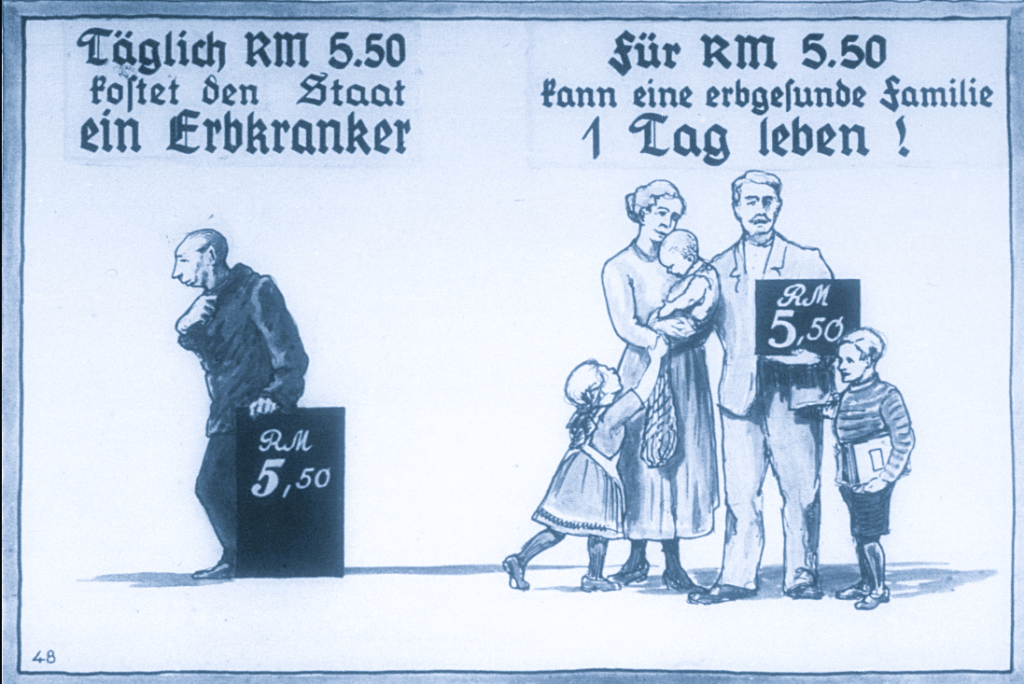
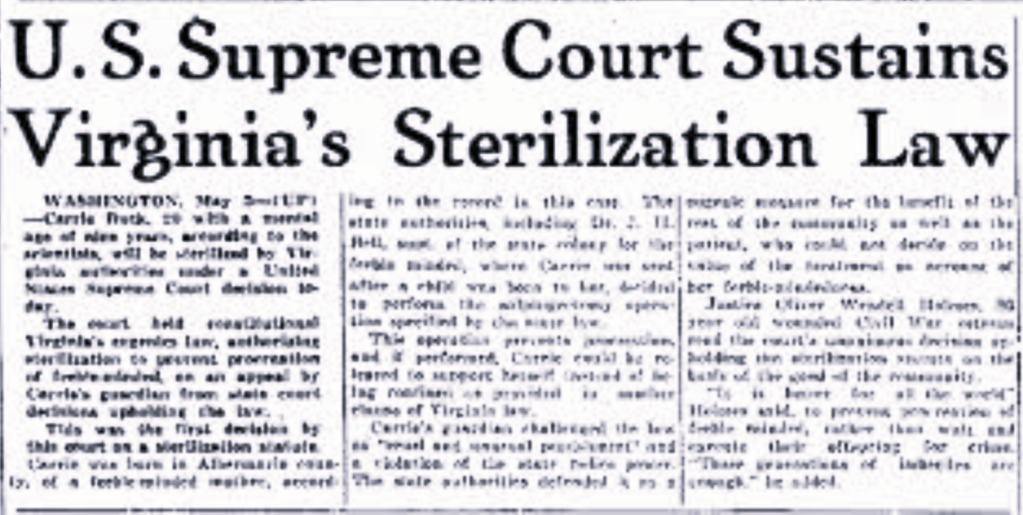
The primary inspiration for the Nazi eugenics laws was a combination of pre-existing eugenics theories and practices from around the world, especially those from the United States, and a unique ideological framework rooted in Nazi racial theory. By the early 20th century, the United States had already enacted several sterilization laws aimed at preventing those deemed “unfit” from reproducing. Indiana passed the first sterilization law in 1907, and by the time the Nazis came to power, over 30 states had similar laws.
Following is a translation of the law for the prevention of hereditarily diseased offspring
Law for the Prevention of Offspring with Hereditary Diseases (July 14, 1933)
The Reich government has passed the following law, which is hereby promulgated:
Par 1.
Anyone suffering from a hereditary disease can be sterilized by a surgical operation if, according to the experience of medical science, there is a high probability that his offspring will suffer from serious physical or mental defects of a hereditary nature.
Anyone suffering from any of the following diseases is considered hereditarily diseased under this law: 1. Congenital mental deficiency, 2. Schizophrenia, 3. Manic-depression, 4. Hereditary epilepsy, 5. Hereditary St. Vitus’ Dance (Huntington’s Chorea), 6. Hereditary blindness, 7. Hereditary deafness, 8. Serious hereditary physical deformity.
Furthermore, anyone suffering from chronic alcoholism can be sterilized.
Par. 2.
Applications for sterilization can be made by the individual to be sterilized. If this person is legally incompetent, has been certified on account of mental deficiency, or is not yet 18, a legal representative has the right to make an application on this person’s behalf but needs the consent of the court of guardians to do so. In other cases of limited competency, the application needs to be approved by the legal representative. [ . . . ]
Par. 3.
Sterilization can also be requested by the following: 1. the state physician. 2. In the case of inmates of hospitals, nursing homes, and penal institutions, by the head thereof.
Par. 4.
The application is to be made to the office of the Eugenics Court; it can either be made in writing or dictated to the court. The facts upon which the application is based should be supported by a medical certificate or confirmed in some other way. The office must inform the state physician of the application.
Par. 5.
Responsibility for the decision rests with the Eugenics Court that has jurisdiction over the district in which the person to be sterilized officially resides.
Par. 6.
The Eugenics Court is to be attached to a district court [Amtsgericht]. It consists of a district court judge acting as chairman, a state physician, and another physician certified by the German Reich and particularly well trained in eugenics. [ . . . ]
Par. 7
(1) The proceedings before the Eugenics Court are not public.
(2) The Eugenics Court must institute the necessary investigations; it can hear witnesses and experts, and can order the personal appearance and medical examination of the person to be sterilized, and can cause him to be brought before them if he absents himself without excuse. For the crossexamination and swearing-in of witnesses and experts and for the exclusion and refusal of persons connected with the law, the regulations for the conduct of civil trials are applicable mutatis mutandis. Doctors heard as witnesses or experts are bound to speak, without consideration for professional secrecy. Legal and administrative authorities, as well as institutions for the care of the sick have to give information to the Eugenics Court on demand.
Par. 8
The Court has to decide according to its free conviction, taking into account the whole result of the case and of the hearing of witnesses. The decision is to be reached by a majority vote after verbal discussion. The decision is to be put down in writing and to be signed by the members taking part in reaching the decision. It must give the reasons for deciding on or rejecting the sterilization. The decision is to be communicated to the person who made the application, to the civil service doctor as well as to the person whose sterilization has been applied for, or, if the latter has not the right to make an application, to his or her legal representative.
Par. 9
The persons designated in par. 8, sentence 5, can within one month after its communication, file an objection to the decision with the office of the Eugenics Court; this objection can either be in writing or can be dictated to it. The objection has a postponing effect. The Eugenics High Court decides on the objection. Against the failure to observe the time limit for objections it is permissible to put things back to their previous state, making use of the regulations for the conduct of civil trials where applicable.
Par. 10
[This institutes a Eugenics High Court, made up in the same way as the ordinary Eugenics Court and having the power of making a final decision.]
Par. 11
(1) The surgical operation necessary for sterilization may only be carried out in an institute for the sick, by a doctor approved by the German Reich. He may undertake the operation only when the decision ordering the sterilization has been finally confirmed. The supreme authority of the province prescribes the hospitals and doctors entrusted with the process of sterilization. The operation may not be carried out by a doctor who has made the application or who has taken part in the trial as a judge.
(2) [The doctor carrying out the operation must send a written report to the civil service doctor.]
Par.12.
Once the Court has decided on sterilization, the operation must be carried out even against the will of the person to be sterilized, unless that person applied for it himself. The state physician has to attend to the necessary measures with the police authorities. Where other measures are insufficient, direct force may be used.
[ . . . ]
This law comes into effect on January 1, 1934.
Berlin, July 14, 1933.
The Reich Chancellor
Adolf Hitler
The Reich Minister of the Interior
Frick
The Reich Minister of Justice
Dr. Gürtner
Source of English translation: Law for the Prevention of Offspring with Hereditary Diseases (July 14, 1933). In US Chief Counsel for the Prosecution of Axis Criminality, Nazi Conspiracy and Aggression. Volume 5, Washington, DC: United States Government Printing Office, 1946, Document 3067-PS, pp. 880-83. (English translation accredited to Nuremberg staff; edited by GHI staff.)
Sources
https://ghdi.ghi-dc.org/docpage.cfm?docpage_id=2422
Donation
I am passionate about my site and I know you all like reading my blogs. I have been doing this at no cost and will continue to do so. All I ask is for a voluntary donation of $2, however if you are not in a position to do so I can fully understand, maybe next time then. Thank you. To donate click on the credit/debit card icon of the card you will use. If you want to donate more then $2 just add a higher number in the box left from the PayPal link. Many thanks.
$2.00
 History of Sorts
Leave a comment