
I am a great believer that people should investigate their past before they pass judgment on others. There were many Dutch who did good during World War II; many risked their lives and sometimes gave their lives to help or save their Jewish neighbors. However, on the other hand, there were also many, and probably more, who didn’t see the Nazis as occupiers, but as an opportunity to better themselves.
The phenomenon of Dutch volunteers joining the Waffen-SS during World War II is a complex and multifaceted issue, encompassing elements of ideology, coercion, and opportunism. The Waffen-SS, the military arm of the Nazi Party’s SS organization, recruited thousands of non-German volunteers from occupied Europe, including the Netherlands. Understanding why Dutch citizens chose to enlist in the Waffen-SS requires an exploration of the historical, social, and personal factors that influenced their decisions, as well as an examination of the recruitment processes employed by the Nazis and the subsequent legacy of these volunteers. The key word here is volunteers; they didn’t have to join.
Nazi Germany invaded the Netherlands on May 10, 1940, and after a brief but intense conflict—it was occupied. The occupation resulted in significant political and social upheaval, providing fertile ground for Nazi propaganda and recruitment efforts. Several motives drove Dutchmen to join the Waffen-SS:
- Ideological Alignment: A segment of the Dutch volunteers were motivated by their alignment with Nazi ideology. The National Socialist Movement in the Netherlands (NSB), led by Anton Mussert, was the primary pro-German political party and played a crucial role in facilitating recruitment. These volunteers believed in the Nazi vision of a united Europe under German leadership, free of communism and dominated by the Aryan race.
- Anti-Communism: The fear of communism was a powerful motivator. The early 20th century saw the rise of communist movements across Europe, and for many, the Nazi regime represented a bulwark against the spread of Soviet influence. The Nazi invasion of the Soviet Union in 1941, Operation Barbarossa, further galvanized anti-communist sentiments and led to increased enlistment in the Waffen-SS.
- Economic and Social Pressures: The occupation brought about significant economic hardship. Some Dutchmen saw service in the Waffen-SS as a means to escape unemployment and poverty. Additionally, the German authorities offered incentives such as better rations, pay, and social benefits, which were appealing during times of scarcity.
- Adventure and Seduction: For younger men, the allure of military adventure and the social prestige associated with the Waffen-SS played a role. In a few cases, coercion and pressure from the occupying authorities also influenced their decisions. The Nazis employed propaganda and, at times, intimidation to bolster their ranks.
Both the Waffen-SS and the NSB systematically organized recruitment in the Netherlands. Propaganda played a significant role, with posters, pamphlets, and rallies designed to glorify the Waffen-SS and vilify its enemies. The recruitment campaigns emphasized the heroic and chivalrous image of the SS soldier, portraying the fight against Bolshevism as a noble cause.
Volunteers underwent rigorous training, initially in the Netherlands and later in SS training camps in Germany and occupied territories. The purpose of this training was to instill discipline, ideological fervor, and military proficiency. However, the quality of training and the combat readiness of these volunteers varied.
In July 1941, soldiers from the Dutch Volunteer Legion left for the Eastern Front. They were on their way to fight alongside the German army. On their train, they had written “To the Jewish corner” and “We’re going to get Stalin,” and they had drawn swastikas.
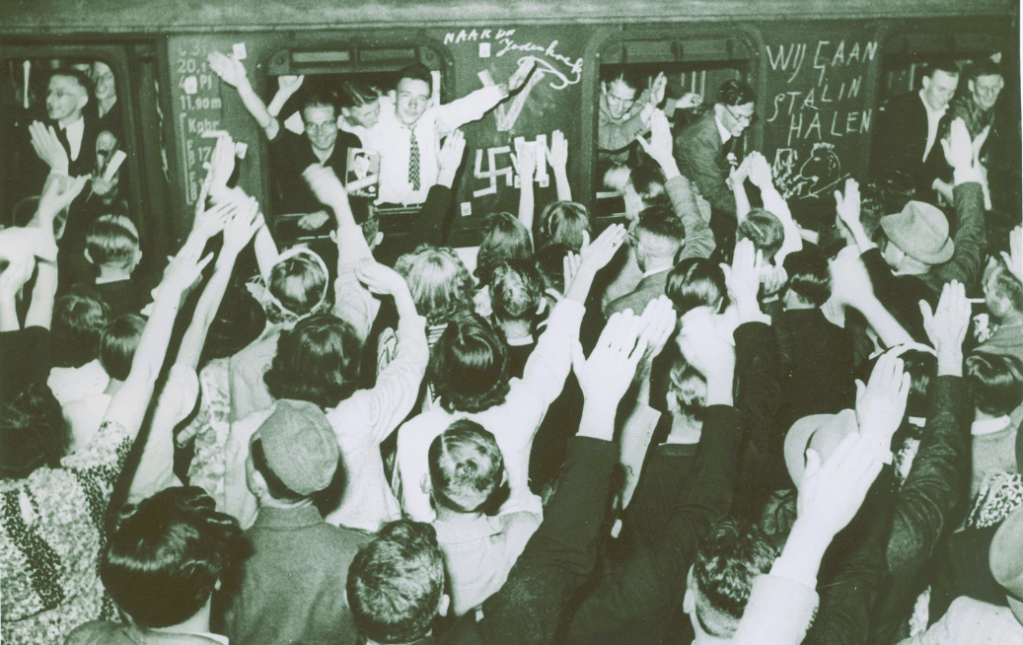
Dutch volunteers served in various units of the Waffen-SS, including the SS Division “Wiking” and the SS Division “Nordland.” They saw action on multiple fronts, particularly the Eastern Front, where they participated in some of the most brutal and significant battles of the war, such as the Siege of Leningrad and the Battle of Narva.
The performance of the Dutch Waffen-SS units was generally considered adequate despite the high number of casualties. Their involvement in war crimes and atrocities, particularly against civilian populations and partisans, is well-documented, contributing to the complex and often negative legacy of their service.
At the end of World War II, Dutch Waffen-SS volunteers faced severe repercussions. Many were captured by Allied forces and repatriated to the Netherlands, where they were tried for treason and collaboration. Sentences ranged from imprisonment to execution, and the social stigma of having served in the Waffen-SS persisted for decades.
The legacy of the Dutch volunteers in the Waffen-SS remains controversial in the Netherlands. Historians and society grapple with understanding and contextualizing their actions within the broader framework of the war and the occupation. Their legacy is a reminder of the complex interplay between ideology, coercion, and individual choice during times of conflict.
I spoke about the Dutch in this piece, but the fact is that every occupied country had collaborators and SS volunteers.
Sources
https://www.annefrank.org/en/timeline/79/dutch-volunteers-in-the-waffen-ss/
https://www.oorlogsbronnen.nl/bronnen?term=Nederlandse+SS
Donation
I am passionate about my site and I know you all like reading my blogs. I have been doing this at no cost and will continue to do so. All I ask is for a voluntary donation of $2, however if you are not in a position to do so I can fully understand, maybe next time then. Thank you. To donate click on the credit/debit card icon of the card you will use. If you want to donate more then $2 just add a higher number in the box left from the PayPal link. Many thanks.
$2.00
 History of Sorts
Leave a comment