The German assault on Liège, which commenced on August 5, 1914, and lasted until August 16, 1914, stands as the inaugural battle of World War I. This significant early confrontation set the stage for the brutal and protracted conflict that would engulf Europe for the next four years. The Battle of Liège exemplifies the strategic, tactical, and human dimensions of warfare, highlighting the complexities of military planning, the resilience of defenders, and the far-reaching implications of combat engagements.
Liège, a fortified Belgian city, was of immense strategic importance at the outset of World War I. The town was situated near the Belgian-German border and was integral to the German war strategy known as the Schlieffen Plan. The plan, devised by Count Alfred von Schlieffen, aimed to secure a rapid German victory over France by circumventing the heavily fortified Franco-German border and advancing through Belgium. The swift capture of Liège was crucial to this plan, as it would open the gateway to Belgium and facilitate a quick advance towards France, potentially avoiding a prolonged two-front war for Germany.
Liège was not an easy target; it was protected by a ring of twelve modern forts designed by the Belgian engineer Henri Alexis Brialmont. These forts were equipped with concrete bunkers, heavy artillery, and machine guns, creating a formidable defensive network. Despite being heavily outnumbered and facing a well-prepared and technologically advanced German army, the Belgian defenders were determined to hold their ground. King Albert I of Belgium had resolved to resist German aggression, underscoring Belgium’s commitment to its neutrality and sovereignty.
The German assault on Liège began on August 5, 1914, with an unexpected intensity. The Germans deployed a substantial force, including seven divisions and support from heavy artillery. They anticipated a swift victory, expecting the forts to crumble quickly under their onslaught. However, the Belgian defenders, led by General Gérard Leman, offered tenacious resistance. The initial German infantry assaults were met with fierce fire from the forts, inflicting significant casualties and stalling the German advance.
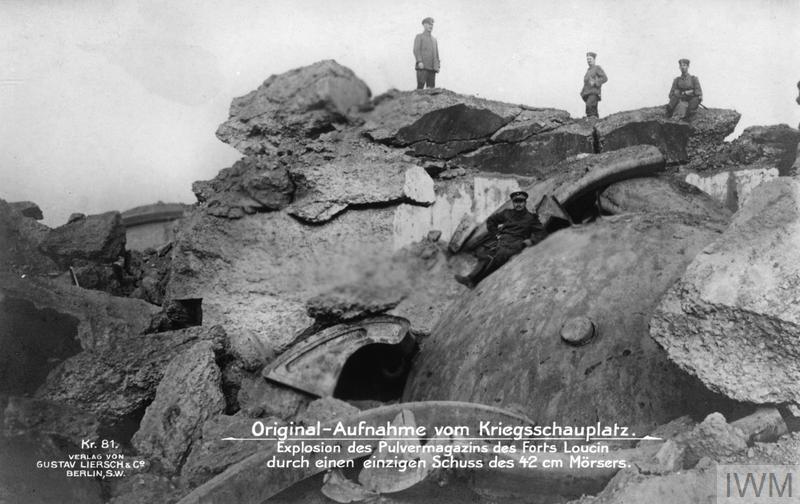
Unable to capture the forts through direct assault, the Germans resorted to a prolonged siege and brought up their heaviest artillery, including the formidable Big Bertha howitzers. These massive guns, capable of firing 420mm shells, began a relentless bombardment of the forts. The sheer destructive power of the German artillery gradually took its toll on the Belgian defenses. One by one, the forts succumbed to the intense shelling. The critical turning point came with the fall of Fort de Loncin on August 16, 1914, following a massive explosion in its ammunition depot caused by German artillery fire.
The Battle of Liège had several significant outcomes. Firstly, the Belgian resistance, although ultimately overcome, delayed the German advance into Belgium. This delay, though relatively brief, was strategically important as it provided the Allied powers—primarily France and the United Kingdom—precious time to mobilize their forces and organize a more effective defense.
Secondly, the defense of Liège served as a powerful propaganda victory for the Allies. The bravery and determination of the Belgian defenders were celebrated and highlighted as a symbol of resistance against aggression. This narrative bolstered Allied morale and underscored the righteousness of their cause.
Lastly, the battle exposed the harsh realities of modern warfare. The devastating effectiveness of heavy artillery, the resilience of fortified positions, and the high human cost of assaulting such defenses foreshadowed the protracted and grueling nature of World War I. The quick and decisive victories envisaged in pre-war military plans gave way to the prolonged stalemates and trench warfare that would define much of the conflict.
The German assault on Liège, the first battle of World War I, was a microcosm of the broader war to come. It illustrated the strategic imperatives and miscalculations of the belligerent powers, the courage and resilience of defenders, and the brutal effectiveness of modern military technology. The battle’s legacy is a testament to the complexities and tragedies of warfare, marking the beginning of a conflict that would reshape the world order and leave an indelible mark on history.
Sources
https://www.iwm.org.uk/collections/item/object/205331426
https://www.britannica.com/event/World-War-I/The-war-in-the-west-1914
https://military-history.fandom.com/wiki/Battle_of_Li%C3%A8ge
 History of Sorts
Leave a comment