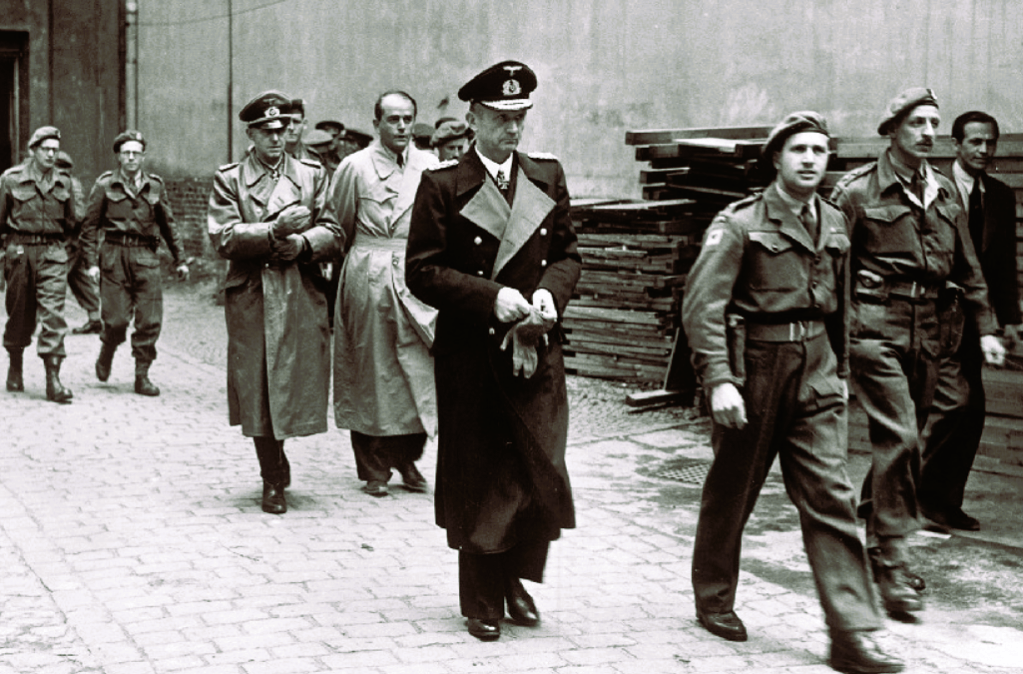
The Flensburg Government refers to a short-lived, provisional government of Nazi Germany that existed in the final days of World War II, from May 2 to May 23, 1945. Named after the town of Flensburg in northern Germany, near the Danish border, where it was headquartered, this government represented the last vestiges of the Third Reich following Adolf Hitler’s suicide on April 30, 1945. Led by Grand Admiral Karl Dönitz, it sought to navigate the collapse of Nazi Germany and manage the aftermath of the war. Despite its brief existence, the Flensburg Government is an essential episode in understanding the final chapter of Nazi rule and the transition to Allied occupation.
Background: The Fall of the Third Reich
By April 1945, Nazi Germany was facing inevitable defeat. Allied forces had breached German defenses on both the eastern and western fronts, with the Red Army advancing on Berlin and Western Allied forces pushing from the west. Within this context of total collapse, Adolf Hitler, who had retreated to his Führerbunker in Berlin, realized that his vision for a Nazi empire was irretrievably lost. On April 30, 1945, Hitler committed suicide, leaving a political vacuum that needed to be filled.
In his last will and testament, Hitler appointed Karl Dönitz, the commander of the German navy (Kriegsmarine), as his successor, entrusting him with the title of President of Germany (Reichspräsident) and Supreme Commander of the Armed Forces. Hitler’s choice of Dönitz was likely driven by the belief that the admiral could negotiate favorable terms with the Western Allies, given the naval officer’s reputation and Hitler’s hope that the Allies would continue to resist Soviet influence in Europe.

Formation of the Flensburg Government
After Hitler’s death, Dönitz quickly moved to establish a new government. He chose the town of Flensburg as his base of operations, primarily due to its proximity to Denmark and relative distance from the Soviet-occupied territories. Flensburg also housed the headquarters of the German navy, providing a semblance of military authority for the nascent government.
Dönitz’s government was composed of several high-ranking officials who had survived the final days of the Third Reich, including:
- Lutz Graf Schwerin von Krosigk: Appointed as the head of government and acting as the de facto chancellor, von Krosigk had been a key figure in the Nazi regime’s economic policy as the Minister of Finance. His role in the Flensburg Government was primarily to manage civilian affairs and attempt to negotiate with the Allies.
- Albert Speer: The Minister of Armaments and War Production under Hitler, Speer retained his role in the Flensburg Government. Despite his earlier importance in the Nazi regime, Speer’s influence was diminished, as the war effort was clearly lost.
- Wilhelm Keitel: As the Chief of the High Command of the Armed Forces (OKW), Keitel remained one of the top military leaders. However, his authority was largely symbolic as the German military was in disarray, with many units surrendering or disbanding.
- Alfred Jodl: As the Chief of Operations Staff of the OKW, Jodl was involved in the final military decisions made by the Flensburg Government, including negotiating surrenders.
Objectives and Actions of the Flensburg Government
The Flensburg Government had several key objectives, though its ability to achieve them was severely limited by the rapidly advancing Allied forces and the total collapse of German infrastructure:
- Negotiating Surrender: Dönitz and his government’s primary goal was to negotiate a partial or conditional surrender, particularly with the Western Allies, in the hope of securing better terms and possibly delaying or preventing Soviet occupation of as much German territory as possible. Dönitz sought to maintain some degree of sovereignty for the German state, even if it meant continuing the war against the Soviet Union.
- Managing the Aftermath of Defeat: With millions of German soldiers and civilians displaced, Dönitz’s government made significant efforts to manage the chaotic situation within Germany. This included not only organizing the surrender of military units and caring for refugees but also maintaining public order in areas still under German control, demonstrating the government’s commitment to its citizens.
- Coordinating the Evacuation: Dönitz and his government oversaw the evacuation of German soldiers and civilians from areas soon to be occupied by the Soviets, particularly from the eastern territories such as East Prussia and Pomerania. This operation, known as the “Baltic Evacuation,” had already begun before Hitler’s death and continued under the Flensburg Government’s direction.

The End of the Flensburg Government
Despite its efforts, the Flensburg Government was never recognized as a legitimate authority by the Allied powers. The Allies viewed the government as a continuation of the Nazi regime, which they were determined to dismantle completely. Moreover, by May 1945, the Allies had already agreed on the unconditional surrender of Germany and had little interest in negotiating with any remnants of Nazi leadership.
On May 7, 1945, Alfred Jodl, on behalf of the German High Command, signed the unconditional surrender of all German forces at Allied headquarters in Reims, France. The surrender was ratified in Berlin on May 8, marking the official end of World War II in Europe (V-E Day). However, Dönitz and the Flensburg Government continued to function for a brief period after this surrender, primarily managing the final dissolution of the German military and administrative apparatus.
On May 23, 1945, British forces entered Flensburg and arrested Dönitz, von Krosigk, and the remaining members of the government. This act formally marked the dissolution of the Flensburg Government. The members were detained and later faced various legal consequences during the Allied occupation and subsequent war crimes trials. Dönitz himself was tried at the Nuremberg Trials and sentenced to 10 years in prison for war crimes.
Legacy and Historical Significance
The Flensburg Government is often viewed as a symbolic and largely futile attempt by remnants of the Nazi regime to exert control and shape the post-war order. Its brief existence highlights the desperation and disarray that characterized the final days of Nazi Germany. Although it failed to achieve any meaningful political or military outcomes, the Flensburg Government is an important historical footnote, illustrating the complete collapse of the Third Reich, the transition to Allied occupation, and the eventual division of Germany.
Historically, the Flensburg Government represents the final chapter of Nazi rule and the transition to a new order in post-war Europe. It underscores the comprehensive nature of Germany’s defeat and the determination of the Allied powers to eradicate any remnants of Nazi authority. The government’s inability to achieve recognition or negotiate terms highlights the Allies’ commitment to unconditional surrender and the total dismantling of the Nazi state.
Sources
https://www.nationalww2museum.org/war/articles/nazi-germanys-leader-admiral-karl-donitz
https://www.forcesnews.com/news/wwii/remnants-nazi-power-75-years-flensburg-government
https://www.iwm.org.uk/collections/item/object/205205226
Donation
I am passionate about my site and I know you all like reading my blogs. I have been doing this at no cost and will continue to do so. All I ask is for a voluntary donation of $2, however if you are not in a position to do so I can fully understand, maybe next time then. Thank you. To donate click on the credit/debit card icon of the card you will use. If you want to donate more then $2 just add a higher number in the box left from the PayPal link. Many thanks.
$2.00
 History of Sorts
Leave a comment