
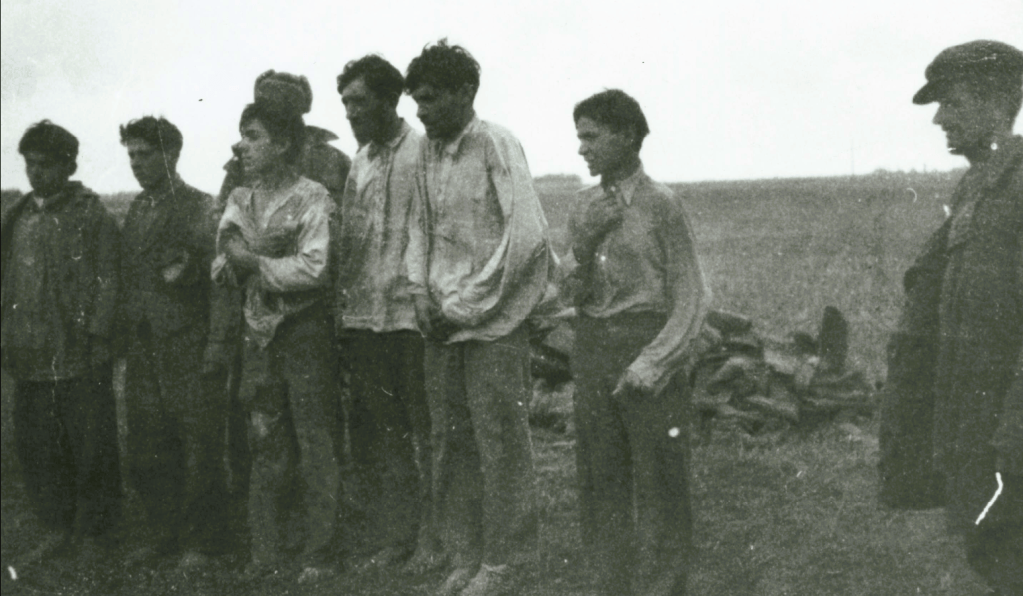
I have written about the Romani before, but I think it is important to remember that a great number of them were also tortured and murdered. The original caption of the picture above reads: “Humor behind the lines.
In a village in Poland, these tank drivers met a gypsy woman whose babbling was a funny diversion for them.” I think she was babbling because she was scared; there is something very menacing about the picture.
The Romani people, often referred to as “Gypsies” (a term now considered pejorative), were one of the many groups targeted by the Nazi regime during the Holocaust. The Nazis viewed the Romani as racially inferior, much like Jews, and subjected them to persecution, imprisonment, and mass murder. Auschwitz-Birkenau, the largest Nazi concentration and extermination camp, played a significant role in the genocide of the Romani people, which is referred to as the Porajmos (meaning “the Devouring” in Romani).
Nazi Ideology and the Persecution of the Romani People
The persecution of the Romani people was rooted in Nazi racial ideology, which categorized them as “racially inferior” and a threat to the purity of the so-called Aryan race. Heinrich Himmler, head of the SS and one of the architects of the Holocaust, issued the 1938 decree titled “The Fight Against the Gypsy Plague,” which laid the groundwork for the systematic identification and registration of Romani people across Nazi-occupied Europe. According to Nazi racial theory, the Romani were classified as “asocial” elements and a “racial problem,” much like Jews. The Romani were seen as dangerous outsiders because of their perceived nomadic lifestyle and cultural differences, making them a target for extermination.
Two main groups of Romani were persecuted: the Sinti, a subgroup living primarily in Germany and Western Europe, and the Roma, who were more prevalent in Eastern Europe, particularly in Poland, Hungary, Romania, and the Balkans. Both groups were rounded up, deported to ghettos and concentration camps, and systematically killed.

Auschwitz and the Romani Family Camp
In February 1943, a section of Auschwitz-Birkenau, known as the Zigeunerlager (Gypsy Family Camp), was established specifically for Romani prisoners. This camp, located in Sector BIIe of Birkenau, was unique in that it allowed Romani families to remain together, unlike the general practice in Auschwitz, where families were immediately separated. Between 23,000 and 23,600 Romani people, including men, women, children, and the elderly, were deported to Auschwitz from various parts of Europe, such as Germany, Austria, Poland, and the Netherlands.
The conditions in the Romani camp were dire. Overcrowded barracks, inadequate sanitation, insufficient food, and a lack of medical care led to high rates of disease, including typhus, tuberculosis, and dysentery. Malnutrition was rampant, and many prisoners died from starvation or the harsh conditions. The camp was a site of immense suffering, where entire Romani families—grandparents, parents, and children—perished together. Disease and malnutrition claimed thousands of lives, but they were not the only causes of death.

Medical Experiments on Romani Prisoners
One of the most infamous aspects of the Romani experience in Auschwitz was the inhumane medical experiments conducted on them by Dr. Josef Mengele, known as the “Angel of Death.” Mengele, a Nazi doctor stationed at Auschwitz, took a particular interest in Romani children, especially twins, for his pseudoscientific research into heredity and racial differences. His experiments were barbaric and frequently lethal. Mengele deliberately infected children with diseases, performed surgeries without anesthesia, and subjected them to unnecessary amputations. He also attempted to artificially change eye color by injecting chemicals into the eyes of children, leaving many blinded or disfigured.
These experiments were part of the broader Nazi obsession with eugenics and racial purity. Mengele sought to use Romani bodies as a testing ground for his racist theories, with little regard for human life. Many of the children who survived Mengele’s experiments were left with permanent physical and psychological scars, and countless others died as a result of his sadistic “research.”
The Liquidation of the Romani Camp
The most devastating event for the Romani in Auschwitz occurred on the night of August 2-3, 1944, known as “Zigeunernacht” or “Gypsy Night.” By that time, the Nazi regime had decided to eliminate the Romani camp entirely. On this night, SS guards entered the Romani family camp, and those who resisted were beaten or shot. Approximately 4,200 Romani men, women, and children were rounded up and sent to the gas chambers. The entire population of the camp was exterminated in one night, marking the brutal culmination of the Romani genocide at Auschwitz.
The liquidation of the Romani camp was part of a broader effort to rid Auschwitz of “unwanted” groups. Some Romani prisoners had been transferred to other camps for forced labor earlier in 1944, Still, those who remained met their deaths in the gas chambers of Birkenau. The massacre of August 2 is one of the most tragic and largely forgotten events of the Holocaust. Today, August 2, is commemorated as Roma Genocide Remembrance Day, a day to honor the memory of the Romani victims.
Total Death Toll and Broader Context of the Romani Genocide
It is estimated that around 20,000 Romani people died in Auschwitz, either through gassing, forced labor, starvation, disease, or medical experimentation. However, Auschwitz was only one site of Romani suffering. Across Nazi-occupied Europe, the Romani were subject to mass deportations, shootings, and extermination. In total, between 220,000 and 500,000 Romani people were murdered during the Holocaust, a genocide known as the Porajmos (meaning “the Devouring” in Romani).
The genocide of the Romani people, though significant, has long been overshadowed by the Jewish Holocaust. For many years, the suffering of the Romani was not fully acknowledged, and they did not receive the same level of post-war recognition or reparations. This was partly due to ongoing discrimination against Romani communities in post-war Europe, where they continued to face social marginalization and prejudice.
Aftermath and Recognition
After the war, Romani survivors faced a long struggle for recognition of their suffering. While Jewish survivors of the Holocaust were able to secure some reparations and public acknowledgment of their ordeal, the Romani remained largely forgotten in the post-war landscape. It was not until the late 20th century that the genocide of the Romani people began to receive more attention from historians and memorial institutions.
Today, there are increasing efforts to commemorate the Romani victims of the Holocaust. In several countries, memorials and educational programs have been established to remember the Romani who perished in Auschwitz and other camps. The history of the Porajmos is now more widely included in Holocaust education, and the Romani victims are honored alongside the millions of others who were murdered by the Nazi regime.
Conclusion
The story of the Romani people in Auschwitz is one of immense suffering, loss, and resilience. Though the Romani were subjected to some of the worst atrocities of the Holocaust, their history has often been neglected in the broader narrative of Nazi genocide. Auschwitz stands as a grim reminder not only of the Jewish Holocaust but also of the Nazi campaign to eliminate all groups they considered racially or socially undesirable, including the Romani. Their persecution at Auschwitz—through forced labor, starvation, disease, medical experimentation, and mass murder—is a central part of the Romani genocide. Remembering and honoring the Romani victims is essential to ensuring that the full scope of the Holocaust is understood and that such atrocities never happen again.
Sources
https://www.opensocietyfoundations.org/explainers/what-roma-genocide
https://encyclopedia.ushmm.org/content/en/article/genocide-of-european-roma-gypsies-1939-1945
https://www.travellerstimes.org.uk/features/josef-mengele-and-roma-and-sinti-holocaust
Donation
Your readership is what makes my site a success, and I am truly passionate about providing you with valuable content. I have been doing this at no cost and will continue to do so. Your voluntary donation of $2 or more, if you are able, would be a significant contribution to the continuation of my work. However, I fully understand if you’re not in a position to do so. Your support, in any form, is greatly appreciated. Thank you. To donate, click on the credit/debit card icon of the card you will use. If you want to donate more than $2, just add a higher number in the box left from the PayPal link. Your generosity is greatly appreciated. Many thanks.
$2.00
 History of Sorts
Leave a comment