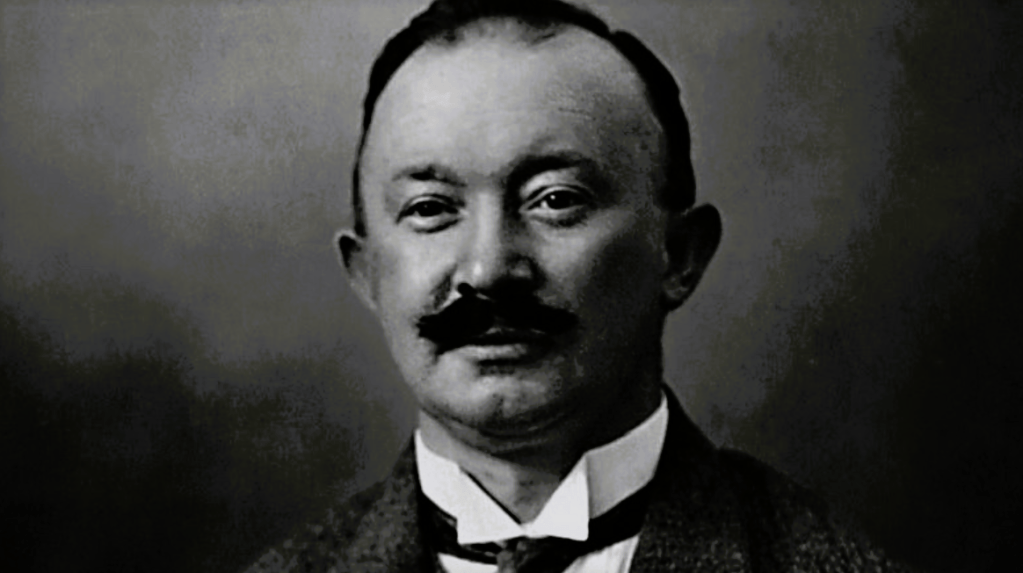
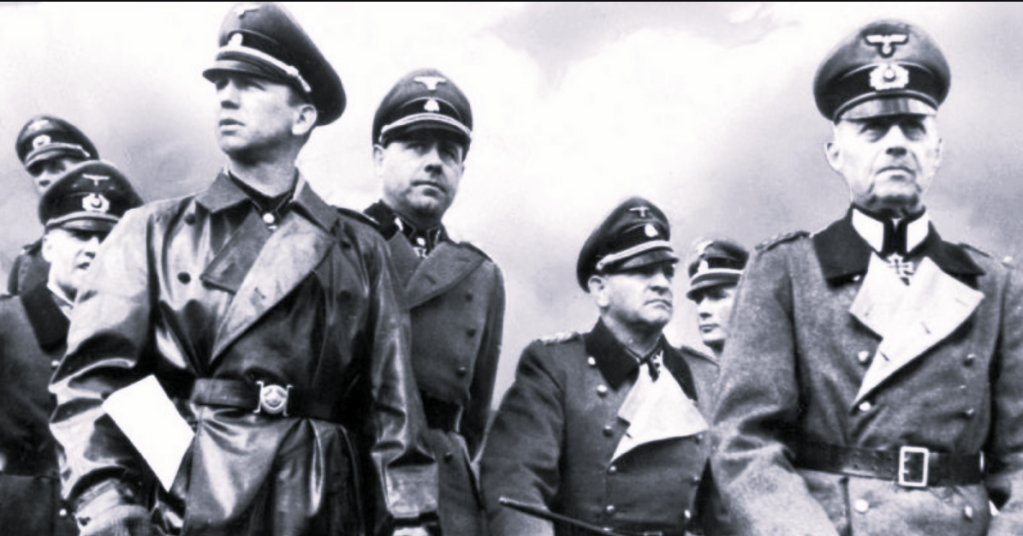
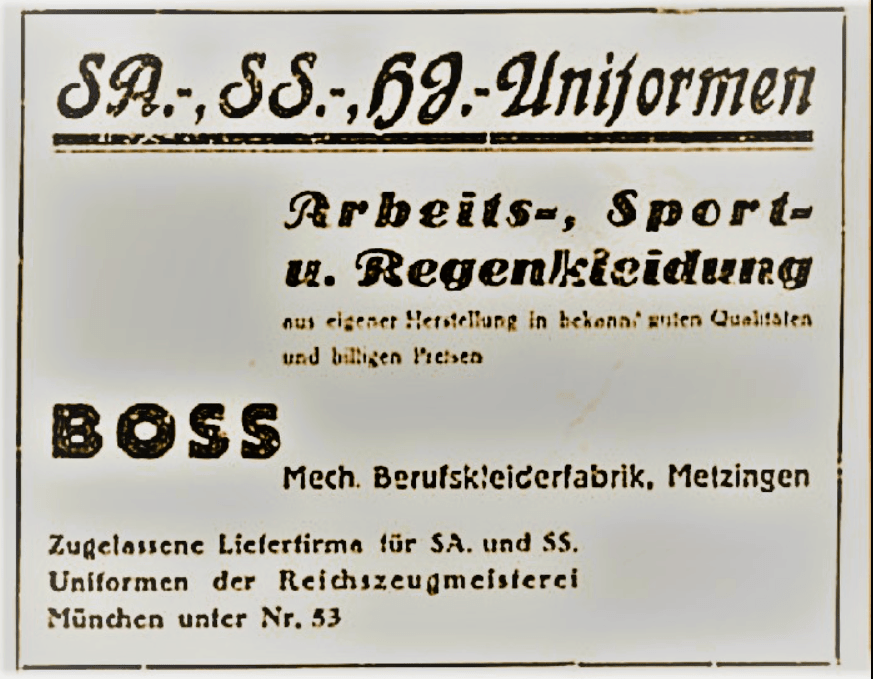
There is a common misconception that Hugo Boss designed the SS uniforms. In reality, the uniforms were designed by artist and senior SS officer Karl Diebitsch in collaboration with graphic designer Walter Heck. Their designs were largely based on earlier military styles, with only minor modifications. However, it was Hugo Boss who received the lucrative contract to produce these uniforms. A member of the Nazi party since 1931, by 1933, Boss was able to advertise that his company supplied clothing not just for the SS but also for the Hitler Youth and the SA. His affiliation with the Nazi regime brought him significant wealth.
During World War II, labor shortages forced many companies to rely on conscripted workers. Hugo Boss made the decision to use forced labor, employing around 140 Polish and 40 French workers under harsh conditions. Although his factory wasn’t located within a concentration camp, and the laborers were not classified as prisoners, the conditions were appalling.
Boss could have easily improved their living standards but chose not to. The workers were subjected to insufficient food rations despite long working hours. During air raids, they were not permitted to seek shelter and were forced to remain in the factory. Additionally, no special accommodations were made for children or pregnant women.
One of the most tragic stories of Boss’s forced laborers is that of Josefa Gisterek, a Polish woman. Sent to work at Boss’s factory in October 1941, Josefa attempted to return home two months later to help her father care for her siblings. However, she was captured by the Gestapo and deported to Auschwitz and later Buchenwald, where she was brutally beaten.
Hugo Boss, using his connections within the Nazi Party, arranged for her to return to his factory in Metzingen. His motives for doing so remain unclear—whether out of a sense of responsibility or self-interest. Upon her return, however, the factory foreman subjected her to relentless work, leading to a severe breakdown.
Josefa was eventually given a three-month leave and permitted to see a doctor. Yet, on July 5, 1943, she tragically took her own life. Boss may have felt some guilt, as he paid for her funeral and covered the travel expenses for her family to attend.
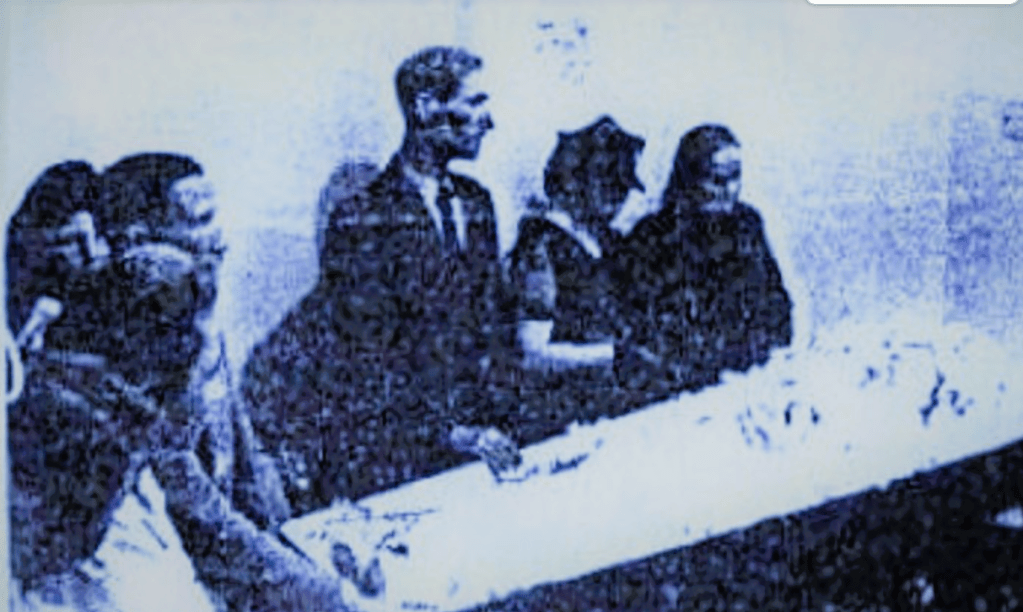
While this might appear to be a noble gesture, had Hugo Boss treated his workers humanely, Josefa might never have attempted to flee in the first place.
Hugo Boss died in 1948, but his company went on to become one of the largest fashion houses in the world, a multi-billion-dollar empire that endures to this day.
Josefa Gisterek’s story highlights the human cost behind the industrial and economic operations that supported Nazi Germany. Her journey from Poland to Metzingen and her tragic death speak volumes about the horrors endured by forced laborers during the war. Gisterek’s treatment and ultimate fate reflect the broader systemic cruelty faced by millions of individuals who were exploited for profit by companies like Hugo Boss, which thrived under the Third Reich. While Boss may have paid for her funeral, this act does little to absolve the larger moral responsibility for the inhumane conditions she endured.
I find this difficult to comprehend. When you look at the life of someone like Oskar Schindler, who risked everything to save lives during the war, he died a poor man, with his factory now serving as a museum. Yet companies like Hugo Boss, Volkswagen, C&A, and BMW—corporations that profited from the atrocities of World War II—became colossal enterprises. How is this even possible?
Sources
https://www.warhistoryonline.com/war-articles/hugo-boss-hitlers-tailor.html
https://www.bbc.com/news/world-europe-15008682
https://www.jewishvirtuallibrary.org/hugo-boss-and-the-nazis
Donation
Your readership is what makes my site a success, and I am truly passionate about providing you with valuable content. I have been doing this at no cost and will continue to do so. Your voluntary donation of $2 or more, if you are able, would be a significant contribution to the continuation of my work. However, I fully understand if you’re not in a position to do so. Your support, in any form, is greatly appreciated. Thank you. To donate, click on the credit/debit card icon of the card you will use. If you want to donate more than $2, just add a higher number in the box left from the PayPal link. Your generosity is greatly appreciated. Many thanks.
$2.00
 History of Sorts
Leave a comment