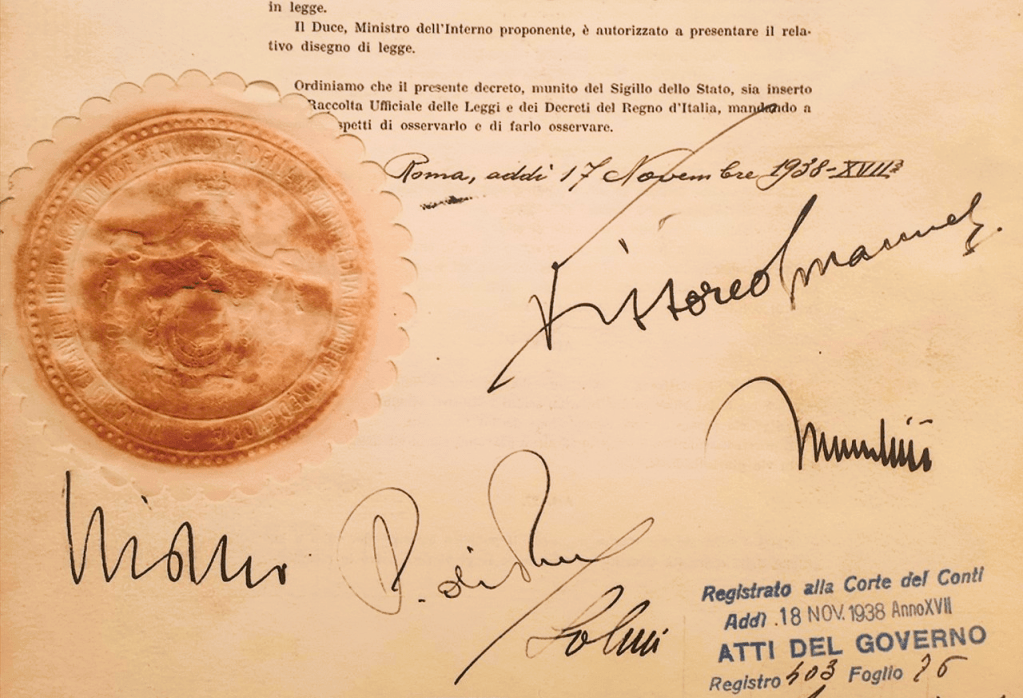
The Italian Racial Laws (Leggi Razziali): A Dark Chapter in Italy’s History
The Italian Racial Laws (Leggi Razziali), enacted in November 1938 under the Fascist regime of Benito Mussolini, marked a significant and deeply troubling shift in Italy’s political and social history. These laws institutionalized antisemitism and racial discrimination, marginalizing Jewish citizens and setting the stage for collaboration with Nazi Germany’s genocidal policies. Understanding the motivations, implementation, and consequences of these laws is crucial for grasping the broader context of Fascist Italy’s descent into racial ideology and its role in the Holocaust.
Context and Motivations
When Mussolini rose to power in 1922, antisemitism was not a core tenet of the Fascist ideology. In fact, Jewish Italians were often integrated into Italian society, and some even participated in the Fascist movement. However, the geopolitical dynamics of the 1930s, particularly Mussolini’s growing alliance with Adolf Hitler, significantly altered this stance. After Italy invaded Ethiopia in 1935 and subsequent condemnation by the League of Nations, Mussolini sought to deepen ties with Nazi Germany. This pivot required embracing racial ideology to align with Hitler’s vision of a racially pure Europe.

Mussolini began to adopt racial rhetoric in speeches, framing Italy’s empire-building efforts in Africa as a “civilizing mission” of a superior race. By 1938, this rhetoric culminated in the Manifesto of Race, a pseudo-scientific document that declared the Italian people part of the Aryan race. This manifesto laid the groundwork for the Leggi Razziali, a series of legislative measures that institutionalized racial discrimination.
Key Provisions of the Laws
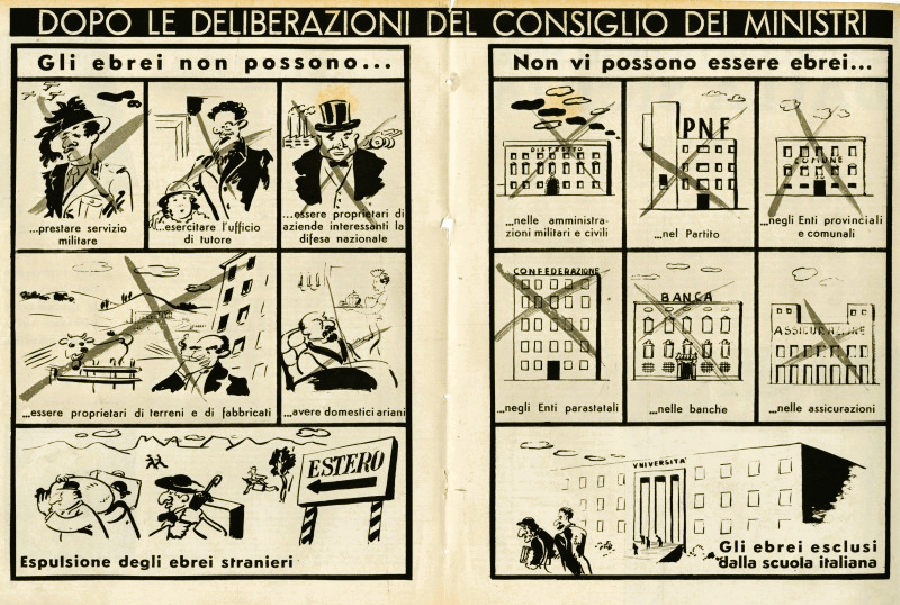
The Leggi Razziali was sweeping in scope, targeting Jewish Italians in every aspect of public and private life. The key provisions included:
- Exclusion from Education and Employment:
Jewish students were expelled from public schools, and Jewish teachers and professors were dismissed from their positions. This exclusion extended to all public-sector jobs, including the military and government roles. - Economic Restrictions:
Jewish-owned businesses were subjected to expropriation or forced liquidation. Jews were prohibited from owning land exceeding a specific size or employing non-Jewish workers. - Marriage and Citizenship:
The laws banned intermarriage between Jews and non-Jews and stripped naturalized Jewish citizens of their Italian nationality. - Social and Cultural Isolation:
Jews were barred from professional organizations and cultural activities, effectively segregating them from broader Italian society.
These laws aimed not only to marginalize the Jewish population but also to inculcate racial prejudice into the broader Italian populace.
Prominent figures within the National Fascist Party (PNF), such as Dino Grandi and Italo Balbo, were reportedly opposed to the Racial Laws. These laws were deeply unpopular among the majority of Italian citizens, largely because the Jewish community in Italy was small and well-integrated and had contributed significantly to Italian society and culture over centuries.
Italy’s Jewish population was diverse and rooted in history. Many were descendants of ancient Italian Jews practicing the Italian rite, whose presence dates back to the days of the Roman Empire. Others were Western Sephardic Jews who had fled the Iberian Peninsula during the 1490s following the Reconquista and the Alhambra Decree. Smaller Ashkenazi communities had settled in Northern Italy during the Middle Ages, gradually blending with established Italian-rite and Sephardic traditions.
Unlike parts of Europe where antisemitism had long been pervasive—especially in German-speaking regions and areas of Northern, Northwestern, and Eastern Europe—Italy had relatively little experience with such prejudice. For most Italians, the Jewish community was an unfamiliar yet integral part of their nation’s fabric, making the introduction of antisemitic policies even more jarring and alien to their societal norms.
Implementation and Escalation
Initially, the enforcement of the Leggi Razziali varied across regions, and there was some resistance among Italians who had long-standing relationships with Jewish neighbors. However, the state apparatus steadily reinforced compliance, aided by propaganda that painted Jews as a threat to Italian society.
The situation worsened dramatically after 1943, when Mussolini’s regime collapsed, and Nazi Germany occupied northern and central Italy. Under the German-backed Italian Social Republic (RSI), the persecution of Jews intensified. Italian authorities collaborated with the Nazis in the deportation of approximately 8,000 Jews to concentration camps, the majority of whom perished.
Consequences and Legacy
The Leggi Razziali had devastating consequences for Italy’s Jewish community, which numbered around 47,000 before the laws were enacted. Thousands lost their livelihoods, homes, and access to education. The social ostracism they endured was compounded by the physical threat of deportation during the German occupation.
In the aftermath of World War II, Italy repealed the Leggi Razziali in 1944, and the post-war government sought to distance itself from its Fascist past. However, the legacy of these laws continues to haunt Italy. Survivors and historians have highlighted the complicity of Italian authorities and citizens in enforcing these policies. The Leggi Razziali was not merely a result of Nazi influence but also a reflection of Italy’s willingness to adopt racial ideology to further its imperial and political ambitions.
The Leggi Razziali represents one of the darkest chapters in Italian history, a period when the state turned against its own citizens in the name of racial purity and political expediency. By institutionalizing antisemitism, Fascist Italy not only betrayed its Jewish population but also contributed to the broader horrors of the Holocaust. Remembering this history is essential to ensuring that such discrimination and violence are never repeated. The Leggi Razziali serves as a stark reminder of the dangers of authoritarianism and the human cost of aligning political ambitions with racial prejudice.
Sources
https://www.journals.uchicago.edu/doi/abs/10.1086/684895?journalCode=jmh
https://en.wikipedia.org/wiki/Italian_racial_laws
Donations
Your readership is what makes my site a success, and I am truly passionate about providing you with valuable content. I have been doing this at no cost and will continue to do so. Your voluntary donation of $2 or more, if you are able, would be a significant contribution to the continuation of my work. However, I fully understand if you’re not in a position to do so. Your support, in any form, is greatly appreciated. Thank you. To donate, click on the credit/debit card icon of the card you will use. If you want to donate more than $2, just add a higher number in the box left from the PayPal link. Your generosity is greatly appreciated. Many thanks.
$2.00

 History of Sorts
Leave a comment