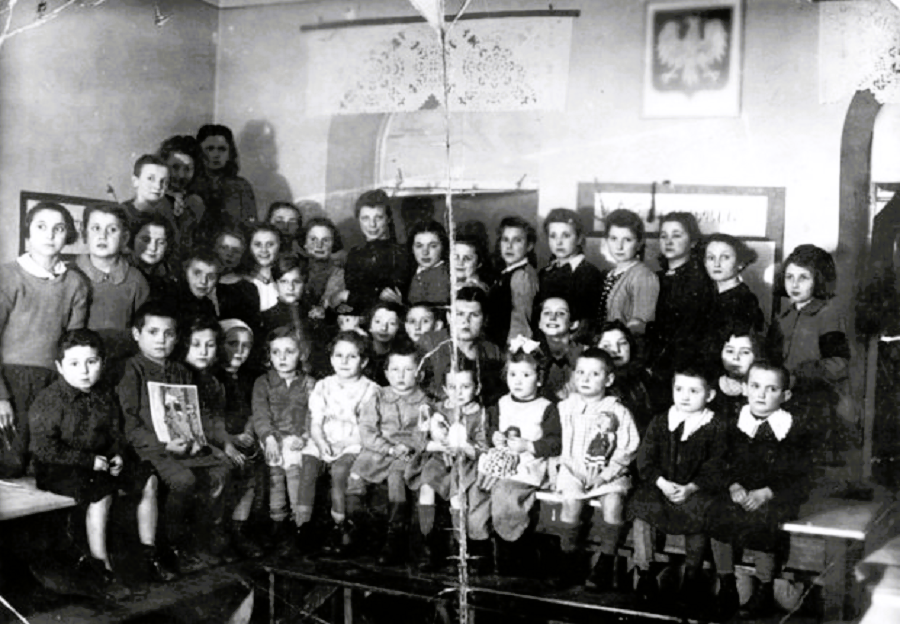
I want to begin by clarifying that the photographs featured in this blog do not depict the actual victims. However, this is precisely why the crime has been largely forgotten—it was concealed in secrecy, both by the perpetrators and the victims.
While exact figures are unavailable, it is estimated that 15% of all Jewish children in hiding were subjected to physical or sexual abuse by those entrusted with their care. These children had no recourse to local authorities for help and were often too frightened to seek assistance. In many cases, they endured abuse at the hands of their supposed “protectors.”
Some Jewish children were allowed a bit of freedom, able to walk around or play, while others were forced to hide in confined spaces such as rooms, attics, under floorboards, barns, or convents. All of these children were entirely dependent on strangers for their survival. With no parents to turn to for comfort or protection, they had no way of knowing whether their families were alive or even where they were. Despite this, many of them clung to the hope that their parents would one day come to find them.

Some hidden children were fortunate to be cared for by compassionate rescuers. When these “rescue parents” were able to provide the nurturing and love the children desperately needed, it temporarily eased their feelings of sadness, longing, and abandonment. This care allowed these children the opportunity to form other healthy attachments with those who took them in.
The trauma endured by children hidden during the Holocaust has been largely overlooked. Unlike their peers, who perished in ghettos or concentration camps, most hidden children survived the war, and many were reportedly treated well by their well-meaning surrogate caregivers.
However, for some, physical and sexual abuse became a constant presence in their hidden homes. While exact figures remain elusive, experts estimate that one in six children in hiding during the Holocaust were sexually abused, and at least five percent were subjected to severe mistreatment by those responsible for their care.
Psychiatrist Paul Valent, who works with child survivors of the Holocaust, observed that the desire to reveal or even remember the trauma could be hindered by intense fear, splitting of consciousness, or dissociation. Valent also noted that some survivors attempted to bury their past after the war ended. “Certainly, few—especially parents—wanted to acknowledge how they were affected,” he remarked. “The children responded by continuing to suppress their emotions and thoughts, always holding on to hope for a better future.”
Recently, several former child survivors have found the courage to share their stories. Their accounts reveal the dark side of what it meant for some children to be “lucky” enough to be hidden from the Nazi terror.
Pauline
In 1984, a woman known as ‘Pauline’ finally revealed a horrifying secret. As a hidden child during the Holocaust, she had been sexually abused by those who had sworn to protect her from the Nazis. For two years, she endured this abuse, too frightened to speak out, fearing her abusers would turn her in. According to Joan Ringelbaum, who interviewed her for her book Women in the Holocaust, ‘Pauline’ carried the weight of her trauma and secret long after the war ended.
“She didn’t tell the Jewish woman who checked on her periodically. She didn’t tell her twin sister. After the war, she did not tell her husband or her daughter,” Ringelbaum wrote. Forty-four years later, ‘Pauline,’ still too ashamed to reveal her real name, admitted, “This is the first time I ever admitted this.”
While the atrocities of death camps, forced labor, and ghetto life have been widely shared by survivors, many child survivors, like ‘Pauline,’ remained silent for years about the sexual abuse they endured. This silence was fueled by the terror and shame associated with such admissions.
Anne
Anne, a young girl during the Holocaust in occupied France, recounted her story of abuse to Dr. Paul Valent. “I moved from family to family every three months. They were not fond of me; they were paid to take me in. They made sure I suffered,” she revealed.
Anne was subjected to both physical and sexual abuse by those who hid her. “I had to have sex with men. I was tied to wooden chairs and forced to kneel; I was made to lie in a bed of thorns. They punished me because their lives were in danger,” she recalled.
Like ‘Pauline,’ Anne was threatened with violence and denouncement if she spoke out. “They threatened me with the wall oven. I knew that Jewish children had been burned in a synagogue. They threatened to turn me over to the Germans.”
While the names of the survivors may be pseudonyms, their stories are undeniably real.
sources
Please donate so we can continue this important work
Donations
Your readership is what makes my site a success, and I am truly passionate about providing you with valuable content. I have been doing this at no cost and will continue to do so. Your voluntary donation of $2 or more, if you are able, would be a significant contribution to the continuation of my work. However, I fully understand if you’re not in a position to do so. Your support, in any form, is greatly appreciated. Thank you. To donate, click on the credit/debit card icon of the card you will use. If you want to donate more than $2, just add a higher number in the box left from the PayPal link. Your generosity is greatly appreciated. Many thanks.
$2.00

 History of Sorts
Leave a reply to tzipporahbatami Cancel reply