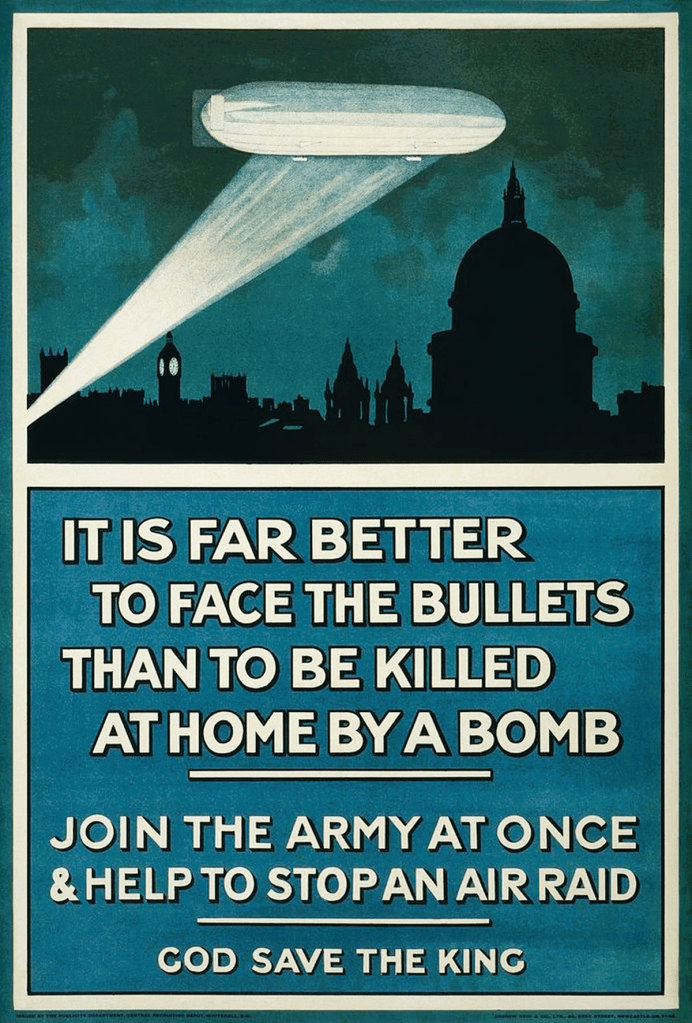
Most people associate the German bombing of Britain with the 1940-41 Blitz campaign during World War II. However, during the First World War, Germany also sought to bomb the UK into submission, using Zeppelin airships to carry out air raids. The first of these raids occurred on January 19, 1915.
The January 19, 1915 Air Raid on Britain: A Turning Point in Modern Warfare
The January 19, 1915, air raid on Britain marked a significant moment in the history of warfare. This event, carried out by Germany during the early stages of World War I, was the first aerial bombardment of the British mainland and symbolized a shift in military strategy that brought the civilian population into the line of fire.
Background: The Dawn of Aerial Warfare
By the onset of World War I, technological advances in aviation and airships had revolutionized military strategy. Germany, having developed a fleet of zeppelins, saw these massive airships as tools to terrorize enemy nations and disrupt morale. The German High Command believed that targeting Britain, a country heavily reliant on its island security, could break the public spirit and force political concessions.
Zeppelins were state-of-the-art aircraft at the time. They could carry large payloads of bombs and had a range far exceeding that of most airplanes of the era. Their ability to fly at high altitudes made them seem invulnerable to the primitive air defenses available. Thus, Germany planned to use them for long-range bombing raids, targeting industrial centers, ports, and civilian areas.
The Raid: Execution and Impact
On the night of January 19, 1915, two German zeppelins, the L3 and L4, departed from their bases in Germany, heading for England. Their mission was to bomb key targets along the eastern coast. Initially, the plan was to strike the industrial hub of Humberside, but inclement weather and navigational errors forced them to alter their course. Instead, they attacked the towns of Great Yarmouth and King’s Lynn in Norfolk.
The raid resulted in the deaths of four civilians and caused property damage, including the destruction of several houses. While the casualties were relatively small by later standards, the psychological impact was immense. For the first time in history, British civilians experienced the terror of aerial bombardment in their own towns. The attack demonstrated that Britain’s geographical isolation could no longer shield it from the effects of modern warfare.

Consequences and Significance
The January 19 raid had far-reaching consequences, both tactically and symbolically. On the military front, it exposed the vulnerabilities of Britain’s air defenses. The Royal Flying Corps (RFC) and other military units began to prioritize the development of countermeasures, including anti-aircraft guns, searchlights, and the interception of enemy aircraft. Over time, this led to the establishment of more sophisticated air defense networks.
The raid also profoundly impacted public morale and government policy. Civilians, who had previously been insulated from direct attacks, became acutely aware of their exposure. This shift spurred efforts to strengthen civil defense measures, such as blackout procedures and early warning systems. Politically, the attack hardened British resolve, with newspapers and political leaders using the incident to rally support for the war effort and portray Germany as a barbaric aggressor.
Strategically, the raid marked the beginning of a new era in warfare. It was a precursor to the extensive bombing campaigns of World War II, in which both sides targeted civilian populations to undermine enemy morale and industry. The psychological impact of aerial bombing became a critical factor in military planning, underscoring the importance of controlling the skies.
The January 19, 1915, air raid on Britain was a watershed moment in the history of warfare, signaling the advent of aerial bombardment as a tool of terror and strategy. Although the immediate physical damage was limited, the raid had profound implications for military tactics, civil defense, and public consciousness. It shattered the illusion of security afforded by Britain’s geographical isolation and highlighted the transformative power of technology in modern conflict. Ultimately, this event marked the beginning of a new chapter in warfare, where civilians would increasingly bear the brunt of conflict, setting the stage for the total wars of the 20th century.
Sources
https://www.bbc.co.uk/bitesize/articles/zmqjnrd
https://www.nam.ac.uk/explore/bombs-over-britain
https://www.history.com/this-day-in-history/first-air-raid-on-britain
https://www.onthisday.com/photos/first-air-raid-on-britain
Donations
Your readership is what makes my site a success, and I am truly passionate about providing you with valuable content. I have been doing this at no cost and will continue to do so. Your voluntary donation of $2 or more, if you are able, would be a significant contribution to the continuation of my work. However, I fully understand if you’re not in a position to do so. Your support, in any form, is greatly appreciated. Thank you. To donate, click on the credit/debit card icon of the card you will use. If you want to donate more than $2, just add a higher number in the box left from the PayPal link. Your generosity is greatly appreciated. Many thanks.
$2.00
 History of Sorts
Leave a comment